| 📌 | Topic: Animal Crossing New Horizons guide to progress without missing useful mechanics |
| 🎯 | Goal: build a functional, profitable, and coherent island before aiming for pure decoration |
| 🧰 | Prerequisites: a Nintendo Switch, a daily rhythm, and patience for the early stages |
| 🪙 | Priority: secure bells and tools before multiplying unnecessary purchases |
| 🏝️ | Central focus: terraforming, infrastructure, customization, and seasonal events |
| 📘 | Reference point: understand what the official collector’s guide really offers compared to a basic guide |
Complete Animal Crossing New Horizons Guide: Tips and Advice to Succeed in Your Island Adventure
This Animal Crossing New Horizons guide goes straight to the point: to help you progress cleanly on the island, avoid false starts, and organize your game like a true gameplay cycle, not like a collection of randomly placed furniture. Animal Crossing: New Horizons rewards consistency, planning, and smart use of the game’s systems. The rest is just decoration.
By the end of this article, you will know what to do from the first days, how to stabilize your bell economy, when to invest in terraforming, how to use multiplayer without wasting time, and whether the official collector’s guide is really worth buying. No myths, no vintage cult. Just what’s useful in the game.
The real mistake in Animal Crossing New Horizons is not going slowly. It’s skipping the steps that unlock tools, buildings, and good habits.
How to start well in Animal Crossing New Horizons?
To start well in Animal Crossing New Horizons, you need to aim for three things: establish a daily routine, secure your first income, and avoid saturating the island with irreversible decisions. The first days are meant to create a stable rhythm, not to make a “perfect” island too early. The game is more rewarding when you let it breathe.
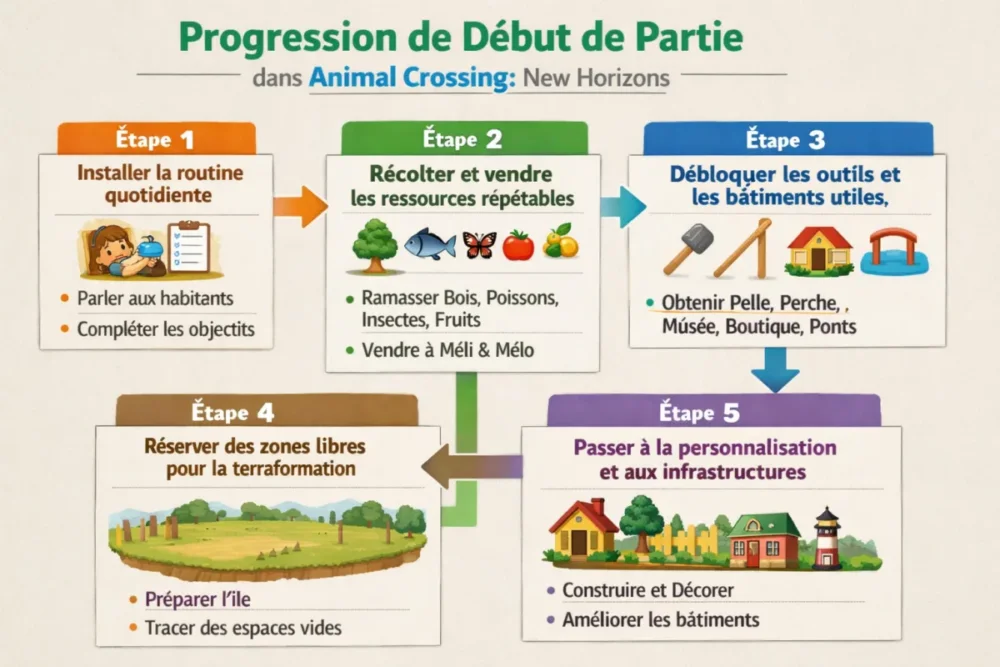
1. Establish the routine of the first three days
Start by collecting everything that renews daily: branches, fruits, stones, wood, and beach items. Sell what is not immediately useful, then keep a minimal reserve of materials for upgrades and crafting. Expected result: a clean stock, regular bells, and less unnecessary back and forth.
2. Unlock priorities before decorative purchases
Do not spend your resources on purely aesthetic items as long as tools, the shop, and progression functions are not within reach. The Animal Crossing New Horizons guide works better when you invest in what opens new possibilities, not in what simply fills an inventory slot. Expected result: faster progression and less frustration.
3. Keep free zones for later
The island seems large at first. It never really is once bridges, ramps, shops, enclosures, and terraforming start to overlap. Leave traffic corridors and empty spots around strategic areas. Expected result: a modifiable island without starting from scratch.
How to earn Bells without wasting your time?
To earn Bells without getting distracted, you need to treat the game’s economy as a series of small profitable habits. Sell what renews quickly, keep rare materials, and don’t invest your savings too early in poorly understood bets. The most useful Animal Crossing New Horizons guide is the one that teaches you how to smooth out your income.
The turnip market often attracts attention, but the real issue is discipline. If you buy without margin, or if you sell too early out of panic, you break your own progress. The goal is not to “play the stock market,” but to have enough Bells to finance the house, infrastructure, and amenities without slowing down everything else.
- Sell repeatable resources: wood, fruit, common fish, easy insects.
- Keep rare materials: they are more useful for unlocking than for filling your wallet.
- Avoid impulsive buying: every expense must serve progression or productivity.
- Focus on the daily routine: small regular gains are better than a poorly prepared isolated hit.
Island management and optimization
Island management becomes interesting when you stop seeing it as a backdrop and start treating it as a structure. Bridges, paths, storage areas, terraforming surfaces, and building locations must interact with each other. Animal Crossing terraforming is not a late decoration: it’s a spatial organization tool.
The complete Animal Crossing New Horizons guide also covers often underestimated points: inventory expansion, obtaining golden tools, managing residents, and upgrading infrastructure. If you want to avoid redoing your layouts every two weeks, think in functional blocks rather than “pretty scenes.”
- Distribute services: town hall, shop, museum, and access zones must remain clear.
- Reserve functional storage: materials, flowers, fruit trees, seasonal items.
- Prepare circulation: a well-thought-out island is quick to cross and easy to rearrange.
- Work by sectors: beach, residential area, production, visitor space.
A beautiful but poorly organized island remains a fragile set. A functional island transforms without starting from scratch.
Fauna, flora, and seasonal events
Animal Crossing New Horizons gains depth when you follow its seasons instead of enduring them. Fish, insects, fossils, and hybrid flowers are not just for completing collections: they set the rhythm of your sessions, your economy, and your long-term goals. Seasonal content gives the game its true pace, the one that avoids empty routine.
Solid guides also detail seasonal materials like bamboo, maple leaves, or mushrooms, as well as special events like Halloween, weddings, or International Museum Day. You save time if you link these events to your stock management rather than treating them as decorative interludes.
What to prioritize
- Collections: fish, insects, fossils, artwork, hybrid flowers.
- Seasons: they change available resources and current objectives.
- Events: they bring limited items, interactions, and rewards.
- Special materials: bamboo, maple leaves, mushrooms, and temporal variants.
Customization and creativity
Customization becomes useful when the island is already stable. Otherwise, it makes you waste time painting a facade while the foundations are not yet solid. Patterns, shared codes, decoration, and outdoor compositions have a real impact, but only if you have first defined the functions of each zone. Creativity without framework mostly produces visual noise.
The best use of customization in an Animal Crossing New Horizons guide is to create a logic: access path, residents’ neighborhood, work zone, visitor area, photo corner. From there, patterns and objects serve a clear reading of the island. They do not hide it.
A simple method to decorate without getting distracted
- Choose one theme per area, not one theme for the entire island.
- Limit the number of visible materials in the same scene.
- Maintain continuity between floors, fences, and furniture.
- Test your placements at night and during the day to check readability.
Is multiplayer really worth it?
Yes, if you use it for what it does best: speeding up exchanges, sharing resources, showing your creations, and avoiding having to redo everything alone. Animal Crossing multiplayer also helps to better utilize online features, including Nook Link and voice chat. The game changes less by the “friends” effect than by the collective efficiency it allows.
The right reflex is to prepare what you want to exchange before starting a session. Otherwise, you waste time inventorying in the middle of a visit. Think useful trades, targeted items, and specific goals. Improvised visits quickly resemble unproductive tourism.
Uses that really add value
- Material exchange to unlock certain amenities faster.
- Sharing patterns and creations to avoid starting from scratch.
- Targeted visits to compare layouts or retrieve a specific item.
- Online cooperation to streamline lengthy steps.
The official Animal Crossing guide: standard vs collector edition
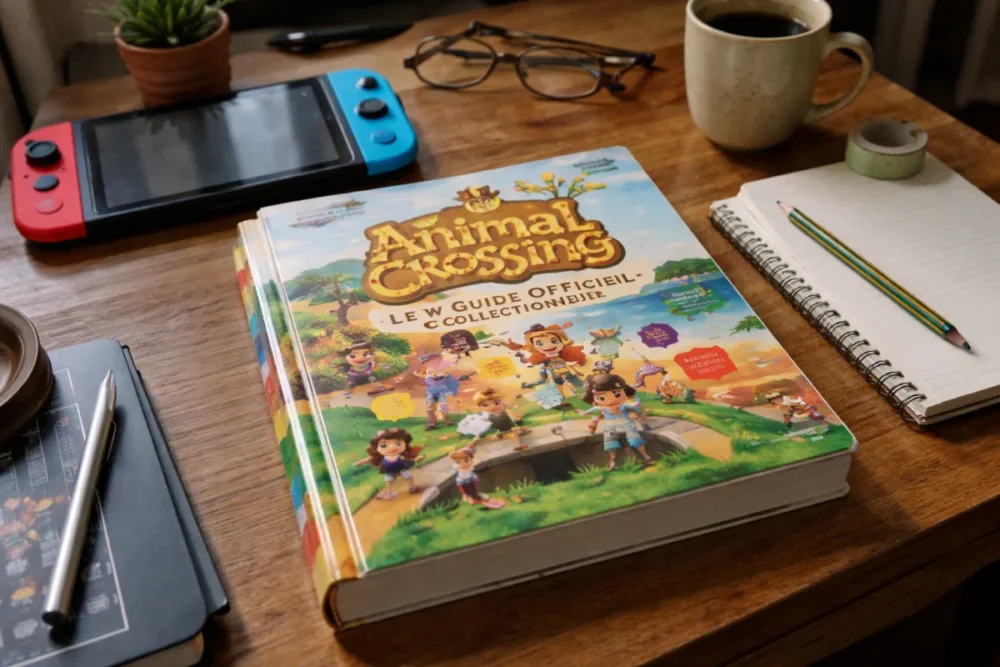
If you’re looking for a comprehensive reference, the collector’s official guide clearly has the edge. The official Animal Crossing New Horizons guide mentioned here is published by Future Press, has 688 pages, features a hardcover, and includes the 2.0 update, the Happy Home Paradise DLC, as well as seasonal events. For occasional consultation, a lighter version is often sufficient. For a true game encyclopedia, the collector’s edition makes sense.
| Criterion | Standard edition | Collector |
|---|---|---|
| Main use | Occasional help and quick reference | Comprehensive reference to follow all content |
| Depth | More limited in approach | 688 pages, hardcover, in-depth reading |
| Content covered | Base game | Update 2.0, Happy Home Paradise, seasonal events |
| Observed price | Not specified in provided data | About €37 on sale, €49.99 pre-order |
| Target audience | Player wanting a quick reference | Player wanting to centralize progression, content, and variants |
The real question is not “collector or not,” but “how much time you still spend on the game.” If you play regularly, the collector becomes a solid consultation tool. If you start the game occasionally, it may be oversized. Price doesn’t say it all; actual use does.
Advanced tips and mistakes to avoid
At this stage, most blockages come less from lack of information than from poor prioritization. We often see the same mistakes: too much decoration too early, too little space reserved for infrastructure, and messy material management. The useful Animal Crossing New Horizons guide doesn’t add noise. It cuts through it.
The game rewards continuity. A well-maintained game over several weeks is better than a “finished” but unmanageable island.
Common mistakes
- Spending bells as soon as they arrive, without a safety reserve.
- Filling the island with objects before establishing traffic routes.
- Neglecting seasonal materials and then chasing them after the event has already passed.
- Forgetting to check online functions before a multiplayer session.
- Confusing customization with optimization: they are not the same thing.
Best practices
- Keep a stock of basic materials for emergencies.
- Define a production zone and a separate visiting zone.
- Advance the game date only if you know exactly why you are doing it.
- Check your goals by season, not just by current desire.
Additional resources
To maintain clean progression, rely on tracking sources that cover basics, special characters, collections, terraforming, and events. Comprehensive guides structure your sessions better than scattered tips gathered over weeks. The goal is simple: know what to do today, and what it unlocks tomorrow.
- Review your goals after each major update.
- Note the resources that are truly missing, not those that “might be useful.”
- Keep track of seasonal events already completed.
- Evaluate your island by functional zones, not just aesthetics.
Conclusion
A good Animal Crossing New Horizons guide does not just tell you what to collect. It helps you build a rhythm, use terraforming at the right time, take advantage of seasonal events, and decide if the official collector’s guide deserves a place on your shelf. The game becomes better when your choices are consistent; less so when you try to do everything at once.
Key takeaways
- 🌱 Daily routine is worth more than isolated big moves.
- 💰 Bells should fund progression, not improvisation.
- 🏗️ Terraforming primarily serves organization, then decoration.
- 🎮 Multiplayer speeds up exchanges and clarifies useful sessions.
- 📘 The collector’s guide makes sense if you seek a comprehensive and lasting reference.
FAQ
Should you advance the game date to progress faster?
Only if you know exactly what you are trying to unlock. Advancing the date can help for certain cycles, but if misused, it breaks your rhythm and blurs season tracking. The cleanest approach is to use it as a one-time tool, not as a permanent progression method.
How to unlock terraforming more efficiently?
By preparing the island before reaching it. Keep free spaces, stabilize your income, and secure basic infrastructure. Terraforming becomes truly useful when it fits into an already planned structure, not when it serves to fix a missing plan.
Is the official collector’s guide worth its price?
It’s worth it if you still play regularly and want a complete reference. With 688 pages, a hardcover, update 2.0, Happy Home Paradise, and seasonal events, it clearly targets players who often consult their guide. For occasional use, it’s more debatable.
Does multiplayer really change progression?
Yes, especially for trades, targeted visits, and sharing creations. It doesn’t replace your solo progression, but it makes it faster and more flexible. Used with Nook Link and voice chat, it avoids many unnecessary frictions.
What is the most common mistake among beginners?
Wanting to decorate before structuring the island. Beginners often saturate the space too early, then have to move everything when bridges, accesses, and service zones become priorities. Start with function, finish with aesthetics.