.en-bref { max-width: 640px; margin: 2em auto; padding: 1.5em 1.8em; color: #3a2d0d; font-family: “Inter”, “Segoe UI”, sans-serif; text-align: left; position: relative; box-sizing: border-box; background: #f7f9f9; border: 1px solid #10b58b; border-left: 6px solid #10b58b; border-radius: 12px; box-shadow: 0 8px 24px rgba(251, 191, 36, 0.15); }
.en-bref h2, .en-bref .en-bref-header { font-size: 1.15em; font-weight: 700; margin-bottom: 0.6em; color: #d97706; }
.en-bref p, .en-bref li { font-size: 1em; line-height: 1.65; margin: 10px; }
.en-bref strong { color: #1c1917; }
.key-takeaways { max-width: 640px; margin: 2em auto; padding: 1.5em 1.8em; color: #3a2d0d; font-family: “Inter”, “Segoe UI”, sans-serif; text-align: left; position: relative; box-sizing: border-box; background: #f7f9f9; border: 1px solid #10b58b; border-left: 6px solid #10b58b; border-radius: 12px; box-shadow: 0 8px 24px rgba(251, 191, 36, 0.15); }
.key-takeaways h2, .key-takeaways .key-takeaways-header { font-size: 1.15em; font-weight: 700; margin-bottom: 0.6em; color: #d97706; }
.key-takeaways p, .key-takeaways li { font-size: 1em; line-height: 1.65; margin: 10px; }
.key-takeaways strong { color: #1c1917; }
.key-takeaways ul { list-style: none; padding-left: 0; }
.key-takeaways li { margin: 0.45em 0; padding-left: 0.2em; }
.magic-pdf-download{margin:2em 0;padding:1.25em 1.5em;border:1px solid #e3e6ea;border-left:4px solid #0ea5e9;border-radius:10px;background:#f8fafc;display:flex;align-items:center;gap:1.2em;flex-wrap:wrap}.magic-pdf-download .mpd-txt{flex:1;min-width:220px}.magic-pdf-download .mpd-txt strong{display:block;font-size:1.05em;color:#0f172a;margin-bottom:.15em}.magic-pdf-download .mpd-txt span{color:#64748b;font-size:.92em}.magic-pdf-download a.mpd-btn{display:inline-block;background:#0ea5e9;color:#fff;text-decoration:none;padding:.7em 1.5em;border-radius:8px;font-weight:600;white-space:nowrap}.magic-pdf-download a.mpd-btn:hover{background:#0284c7}
.magic-lb-overlay{position:fixed;inset:0;background:rgba(15,23,42,.92);display:none;align-items:center;justify-content:center;z-index:99999;cursor:zoom-out;padding:20px}
.magic-lb-overlay.open{display:flex}
.magic-lb-overlay img{max-width:95vw;max-height:95vh;object-fit:contain;border-radius:8px;box-shadow:0 8px 32px rgba(0,0,0,.5)}
.magic-lb-close{position:absolute;top:16px;right:20px;color:#fff;background:rgba(0,0,0,.5);border:none;width:40px;height:40px;border-radius:50%;font-size:24px;cursor:pointer;display:flex;align-items:center;justify-content:center}
.magic-lb-close:hover{background:rgba(0,0,0,.8)}
.wp-block-image img{cursor:zoom-in;transition:transform .15s ease}
.wp-block-image img:hover{transform:scale(1.01)}
.magic-img-link{display:inline-block;text-decoration:none}
(function(){
var ov=document.getElementById(‘magic-lb’);if(!ov)return;
var img=ov.querySelector(‘img’),btn=ov.querySelector(‘.magic-lb-close’);
function open(src){img.src=src;ov.classList.add(‘open’);document.body.style.overflow=’hidden’}
function close(){ov.classList.remove(‘open’);img.src=”;document.body.style.overflow=”}
document.addEventListener(‘click’,function(e){
var a=e.target.closest(‘a.magic-img-link’);
if(a){e.preventDefault();open(a.getAttribute(‘href’));return}
var i=e.target.closest(‘.wp-block-image img’);
if(i&&!e.target.closest(‘a’)){e.preventDefault();open(i.currentSrc||i.src)}
});
ov.addEventListener(‘click’,function(e){if(e.target===ov||e.target===btn)close()});
document.addEventListener(‘keydown’,function(e){if(e.key===’Escape’)close()});
})();
Best Brawlers for Beginners in Brawl Stars: Which Ones to Choose to Progress Quickly?
The best brawlers for beginners in Brawl Stars are those that require little precision, forgive mistakes, and remain useful without a big investment. Shelly, Jessie, Nita, Poco, and Rosa form a solid foundation to learn fighting, positioning, and objectives without being punished in every duel.
The right choice mainly depends on your playstyle and the mode, but an easy-to-play brawler should first simplify survival and match reading. This guide ranks the most accessible profiles, explains their limits, and shows which ones to level up first to progress quickly.
In Brief
🟢 Shelly remains the simplest choice to learn close combat and survive placement mistakes.
🎯 Jessie, Nita, and Poco are more versatile, as they help understand range, support, and team play.
🛡️ Bull, El Primo, and Rosa appeal to aggressive players, but they require a bit more timing.
📈 The most important thing at the start is to prioritize simplicity, consistent damage, and survival over raw performance.
How to Choose a Brawler When You’re a Beginner?
For a beginner, the right brawler is one that reduces difficult decisions and allows some margin when aiming or positioning are still approximate. Look for three things in priority: a readable attack, good survival, and decent utility even without gadget or star power.
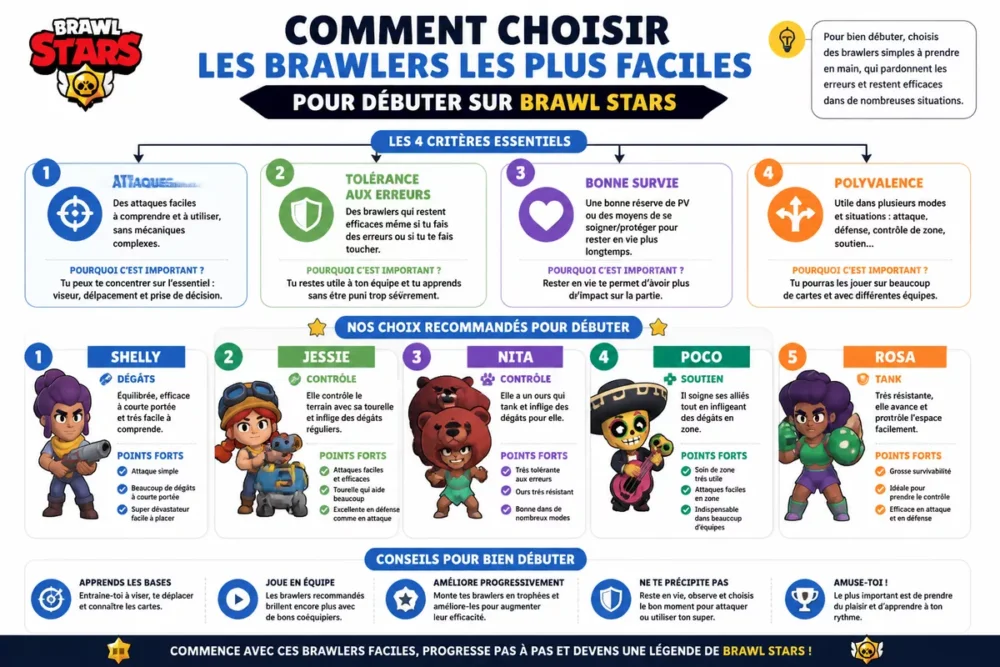
- Simple attacks: you must quickly understand where your projectiles shoot and at what distance.
- Error tolerance: a good choice lets you survive after a bad angle or a missed shot.
- Decent survival: health points and escape options matter as much as damage.
- Versatility: the brawler must be useful in several modes, not just on one map.
A beginner brawler should turn a mistake into a retreat, not an immediate elimination.
The logic is simple: a beginner progresses faster with a brawler that forgives a trajectory error, not with a pick that demands perfect angles. That is why characters with readable attacks, good range, or strong survival have the advantage at the start.
Shelly, Nita, Jessie, and Poco: Which Choice Is the Easiest at the Start?
Shelly is the most direct, Jessie the most educational, Nita the most flexible, and Poco the safest in a team. These four profiles cover almost everything a beginner needs to learn without requiring fine mechanics from the first matches.
| Brawler | Ease of Use | What It Teaches | Easiest Mode | Main Limitation |
|---|---|---|---|---|
| Shelly | Very easy | Close combat and smart retreat | Survivor, Brawl Ball | Less comfortable at range |
| Nita | Easy | Consistent pressure and zone control | Gem Grab | Requires some positioning |
| Jessie | Very easy | Field control and patient play | Heist, Gem Grab | Less strong if you rush alone |
| Poco | Easy | Support and consistency | Brawl Ball, team | May lack impact solo |
| Rosa | Easy | Engagement timing and holding position | Brawl Ball, Survivor | Needs to get close to really make an impact |
If you want to check what is rising or falling in the meta, the Brawl Stars tier list provides a useful benchmark to avoid investing blindly. For upgrade purchases, the guide to the best Brawl Stars gadgets helps prioritize spending later.
Shelly: the simplest entry point
Shelly remains the best starting point if you want to immediately feel what it means to win a duel without complicated mechanics. Her kit is straightforward, her punishment is clear, and her margin for error is sufficient to learn the basics without feeling overwhelmed by the game.
Shelly mainly teaches you to respect close range and to choose the right moment to advance. She is effective on closed maps, in Brawl Ball and Showdown, because she immediately threatens enemies who get too close.
- Strengths: readable, simple, very good for understanding close combat.
- Weaknesses: less comfortable if you have to hold a long distance.
- To do: wait for the enemy to expose themselves then advance cautiously.
Nita, Jessie, and Poco: the versatile choices
Nita, Jessie, and Poco are often the best beginner brawlers when you want to learn without closing doors. These three profiles remain useful across several modes, which avoids leveling up a character that only serves once in ten games.
Nita applies pressure with her regular attacks, Jessie helps control an area without requiring perfect aim, and Poco makes the team more stable over time. If you’re looking for a brawler to start with without locking yourself into a unique style, this trio is the most reassuring.
Progression is faster when the brawler helps you understand the match instead of hiding the fundamentals.
- Nita: good compromise between simplicity and usefulness in several modes.
- Jessie: very educational for learning to hold an area and support a push.
- Poco: excellent if you like to play clean, stay useful, and protect allies.
Bull, El Primo, and Rosa: the melee brawlers
Bull, El Primo, and Rosa suit beginners who like to get up close, but they require more timing than Shelly. Their strength is obvious when the entry into combat is well chosen, but a bad advance is quickly punished.
Bull and El Primo are presented as short-range brawlers, so they win when the terrain allows reducing the distance without being cut down before engagement. Rosa adds more resistance and reassures players who want to hold a line without playing too far away.
- Bull: simple to understand, but you have to choose the right angle of entry.
- El Primo: good for learning frontal pressure, less so for playing safely.
- Rosa: very solid for a beginner who wants to survive long and advance methodically.
Should you choose a ranged or melee brawler?
For a beginner, range is safer if aiming is unstable, while melee better teaches timing but forgives less. If you often miss your shots, a sturdy character at short or medium range remains more profitable than a fragile shooter who demands precise positioning.
Colt and Piper are long-range brawlers, so they teach discipline very well, but they already require real shooting precision. If you enjoy reading duels, the guide to the best Duel brawlers in Brawl Stars helps understand which profiles hold up better under face-to-face pressure.
- Range: better for learning positioning and staying alive.
- Melee: more intuitive in short fights, but riskier.
- Support: ideal if you want to contribute without carrying the whole duel.
Which brawler to use according to the game mode?
The same brawler does not have the same value depending on the mode, and this is often where beginners make the most mistakes. The Gem Grab mode requires collecting and holding ten gems until the time runs out, Heist involves destroying the opponent’s safe, Brawl Ball is inspired by football, and Showdown is played like a solo or duo battle royale.
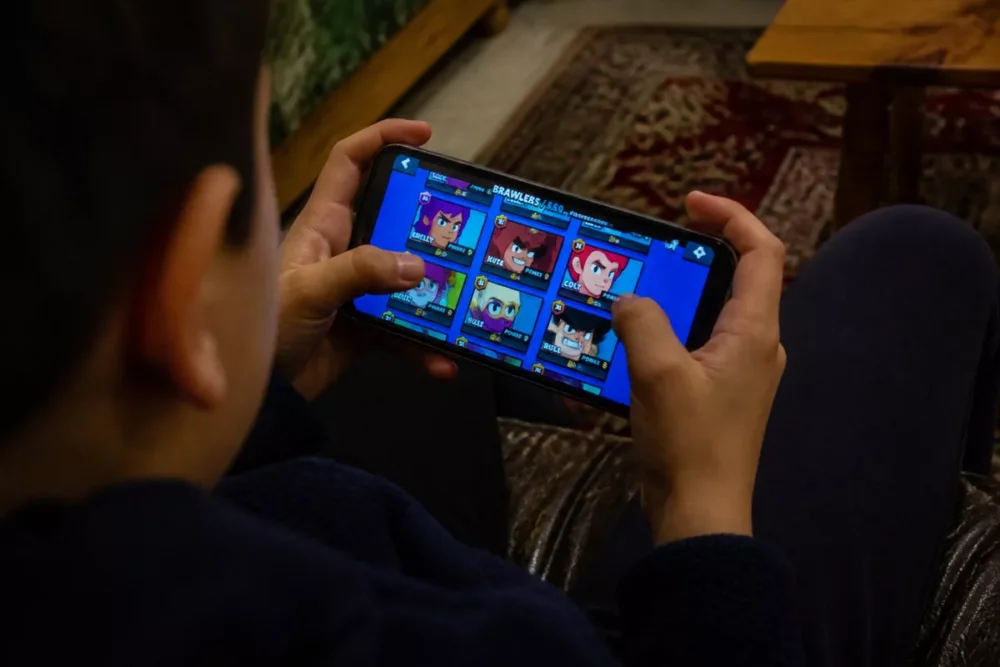
For Gem Grab, Jessie and Nita are good benchmarks because they secure the area without requiring extreme precision. In Heist, a brawler who holds a line and pushes when the path is open, like Jessie or Bull depending on the map, remains easier to leverage than a character that is too fragile.
In Brawl Ball, Shelly, Rosa, and El Primo are easier to understand for beginners, as they better convert a good advance into concrete action. In Showdown, Shelly and Bull help to understand the tempo of fights, while in Bounty, a more disciplined shooter like Colt or Piper can serve as a later step, but it is not the most comfortable entry point.
- Gem Grab: aim for consistency and survival before aggressive scoring.
- Heist: favor a brawler who can easily hit the safe or stop the advance.
- Brawl Ball: choose a profile that can push, defend, and survive in the short term.
- Showdown: pick a brawler that lets you learn fights without exposing yourself too quickly.
Common beginner mistakes and how to avoid them
The most costly mistakes at the start are almost always the same: advancing without vision, choosing a brawler that is too technical, and ignoring the mode’s objective. A good beginner gains more by playing cleanly than by seeking spectacular actions.
- Playing too aggressively: you lose the advantage even before the fight begins.
- Wanting a “strong” brawler rather than a simple one: the difficulty of mastering slows down progress.
- Forgetting the mode: a good duel does not compensate for a bad game objective.
- Forcing shots: it’s better to wait for a clear angle than to empty your ammo into the void.
The biggest gain for a beginner does not come from perfect shooting, but from choosing a brawler that reduces friction.
How to progress faster with a beginner brawler?
Fast progression comes from a simple sequence: pick a readable brawler, play a stable mode, repeat the same maps, and correct one mistake at a time. This is more profitable than changing characters every two games.
- Choose a simple brawler. Shelly, Jessie, Nita, or Poco avoid overloading the learning process.
- Set a main mode. Gem Grab, Brawl Ball, or Showdown provide faster benchmarks.
- Reduce risks. Retreating after a bad exchange is often better than a forced duel.
- Then build a second profile. Switch to a more technical brawler only when your basics hold up.
Once you understand the basics, the Brawl Stars tier list helps decide if your next investment is really worth it. The guide to the best Brawl Stars gadgets becomes useful only after this initial sorting, otherwise you scatter your resources.
Key Takeaways
- 🟢 Shelly is the simplest entry point to learn the basics.
- 🎯 Jessie, Nita, and Poco are the most versatile for progressing without getting stuck.
- 🛡️ Bull, El Primo, and Rosa are useful, but their timing matters more.
- 📌 The mode plays as much as the brawler: a good choice out of context quickly becomes average.
- 📈 To start quickly, prioritize simplicity, survival, and consistent damage.
Frequently Asked Questions
What is the best brawler to start with in Brawl Stars?
Shelly remains the simplest choice if you want an immediate and clear start. Jessie and Nita are very close behind, as they also teach positioning and team utility without requiring very fine mechanics.
Should you choose a ranged or melee brawler when starting out?
Ranged is often more comfortable if your aim is still inconsistent. Melee can be more intuitive in short fights, but it forgives entry and timing errors less.
Which brawlers are easy without having very good aim?
Shelly, Jessie, Poco, and Rosa are good starting points. Their attacks or roles better compensate for hesitant aiming, especially if you play maps where survival matters a lot.
Can you play well solo with a beginner brawler?
Yes, especially with Shelly, Bull, or Rosa in modes like Showdown. In team play, Jessie, Nita, and Poco remain easier to make effective because their utility does not depend on a single successful duel.
Which brawlers should be avoided at the start?
Profiles that require strong precision, very clean positioning, or advanced movement mechanics are less suited for beginners. Colt and Piper can be useful later to learn aiming, but they are not the easiest to start with.