.en-bref { max-width: 640px; margin: 2em auto; padding: 1.5em 1.8em; color: #3a2d0d; font-family: “Inter”, “Segoe UI”, sans-serif; text-align: left; position: relative; box-sizing: border-box; background: #f7f9f9; border: 1px solid #10b58b; border-left: 6px solid #10b58b; border-radius: 12px; box-shadow: 0 8px 24px rgba(251, 191, 36, 0.15); }
.en-bref h2, .en-bref .en-bref-header { font-size: 1.15em; font-weight: 700; margin-bottom: 0.6em; color: #d97706; }
.en-bref p, .en-bref li { font-size: 1em; line-height: 1.65; margin: 10px; }
.en-bref strong { color: #1c1917; }
.key-takeaways { max-width: 640px; margin: 2em auto; padding: 1.5em 1.8em; color: #3a2d0d; font-family: “Inter”, “Segoe UI”, sans-serif; text-align: left; position: relative; box-sizing: border-box; background: #f7f9f9; border: 1px solid #10b58b; border-left: 6px solid #10b58b; border-radius: 12px; box-shadow: 0 8px 24px rgba(251, 191, 36, 0.15); }
.key-takeaways h2, .key-takeaways .key-takeaways-header { font-size: 1.15em; font-weight: 700; margin-bottom: 0.6em; color: #d97706; }
.key-takeaways p, .key-takeaways li { font-size: 1em; line-height: 1.65; margin: 10px; }
.key-takeaways strong { color: #1c1917; }
.key-takeaways ul { list-style: none; padding-left: 0; }
.key-takeaways li { margin: 0.45em 0; padding-left: 0.2em; }
.magic-pdf-download{margin:2em 0;padding:1.25em 1.5em;border:1px solid #e3e6ea;border-left:4px solid #0ea5e9;border-radius:10px;background:#f8fafc;display:flex;align-items:center;gap:1.2em;flex-wrap:wrap}.magic-pdf-download .mpd-txt{flex:1;min-width:220px}.magic-pdf-download .mpd-txt strong{display:block;font-size:1.05em;color:#0f172a;margin-bottom:.15em}.magic-pdf-download .mpd-txt span{color:#64748b;font-size:.92em}.magic-pdf-download a.mpd-btn{display:inline-block;background:#0ea5e9;color:#fff;text-decoration:none;padding:.7em 1.5em;border-radius:8px;font-weight:600;white-space:nowrap}.magic-pdf-download a.mpd-btn:hover{background:#0284c7}
.magic-lb-overlay{position:fixed;inset:0;background:rgba(15,23,42,.92);display:none;align-items:center;justify-content:center;z-index:99999;cursor:zoom-out;padding:20px}
.magic-lb-overlay.open{display:flex}
.magic-lb-overlay img{max-width:95vw;max-height:95vh;object-fit:contain;border-radius:8px;box-shadow:0 8px 32px rgba(0,0,0,.5)}
.magic-lb-close{position:absolute;top:16px;right:20px;color:#fff;background:rgba(0,0,0,.5);border:none;width:40px;height:40px;border-radius:50%;font-size:24px;cursor:pointer;display:flex;align-items:center;justify-content:center}
.magic-lb-close:hover{background:rgba(0,0,0,.8)}
.wp-block-image img{cursor:zoom-in;transition:transform .15s ease}
.wp-block-image img:hover{transform:scale(1.01)}
.magic-img-link{display:inline-block;text-decoration:none}
(function(){
var ov=document.getElementById(‘magic-lb’);if(!ov)return;
var img=ov.querySelector(‘img’),btn=ov.querySelector(‘.magic-lb-close’);
function open(src){img.src=src;ov.classList.add(‘open’);document.body.style.overflow=’hidden’}
function close(){ov.classList.remove(‘open’);img.src=”;document.body.style.overflow=”}
document.addEventListener(‘click’,function(e){
var a=e.target.closest(‘a.magic-img-link’);
if(a){e.preventDefault();open(a.getAttribute(‘href’));return}
var i=e.target.closest(‘.wp-block-image img’);
if(i&&!e.target.closest(‘a’)){e.preventDefault();open(i.currentSrc||i.src)}
});
ov.addEventListener(‘click’,function(e){if(e.target===ov||e.target===btn)close()});
document.addEventListener(‘keydown’,function(e){if(e.key===’Escape’)close()});
})();
Recognizing an Authentic Retro Cartridge Before Buying
An authentic retro cartridge is mainly recognized by the consistency between the shell, the label, the markings, the internal board, and the provided accessories. A single isolated detail proves nothing, but several aligned inconsistencies often suffice to reveal a reproduction, a dubious reconditioning, or a disguised listing.
The right approach is to first check the visible clues, then the technical clues, and finally the proofs requested from the seller. This method avoids buying based on a flattering photo and helps quickly decide when a piece still deserves trust, when to ask for supporting documents, and when it’s better to pass.
In Brief
🔎 The proper method involves three levels: look at the shell and the label, check the internal board if needed, then demand consistent proof from the seller.
🧩 An original cartridge may be worn without being fake. Conversely, a piece that is too clean is not reassuring if the markings, screws, or region don’t match.
💸 The real risk is not just the fake, but the disappointing purchase. A reproduction may work, but it is not worth an original cartridge if you are looking for a collectible piece.
⚠️ As soon as a significant doubt persists, give up. In retro gaming, vague listings often cost more than a missed purchase.
Understanding What Makes Authenticity
An authentic retro cartridge is a period piece or an official edition consistent with its model, region, and manufacturing, not just an object that looks like the right game.
Two pieces of the same title can differ by a board revision, a label glue, or a slight shell variation, so authenticity is determined by cross-checking and not by intuition.
- Original cartridge: period piece produced for the official market, with consistent manufacturing and collectible value.
- Reproduction: modern copy that imitates the game, useful for playing but without material authenticity value.
- Reconditioned: original piece cleaned, repaired, or partially restored, acceptable if the interventions are disclosed.
- Modified: cartridge or medium reworked for a particular use, to be distinguished from an intact original.
How to Recognize an Authentic Retro Cartridge?
A real retro cartridge is first spotted by the label, typography, plastic quality, screw alignment, and color consistency with the precise model, whereas a fake often shows overly neat gluing, irregular edges, or an approximate logo.
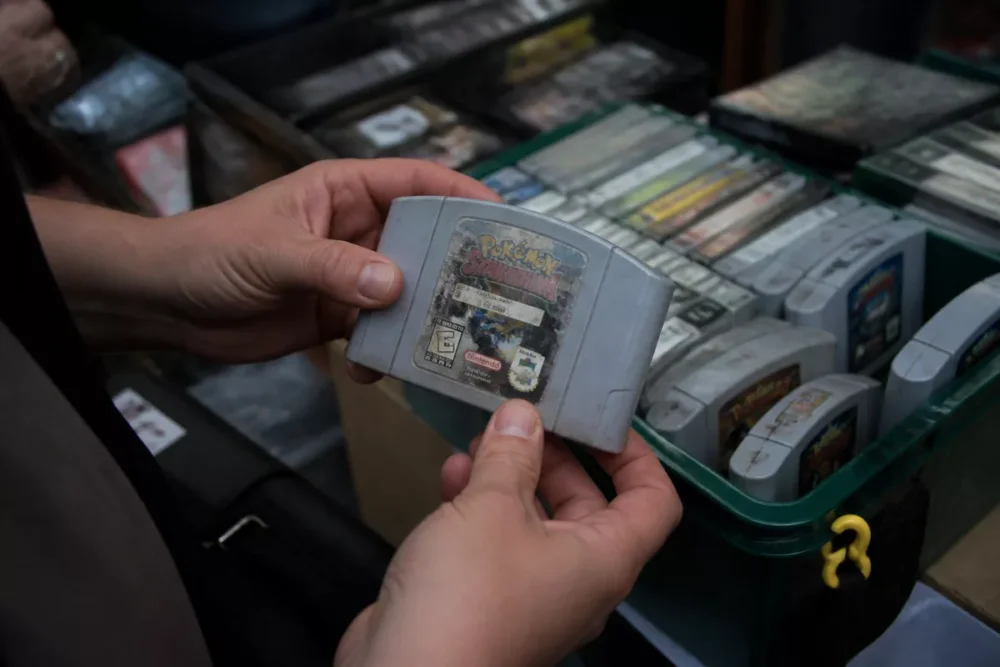
A clear photo taken from the front, then another with the edge and screws, often allows spotting recent gluing, a replaced shell, or a label too clean to be credible.
- Label: check the edges, logo sharpness, print regularity, and absence of bubbling.
- Shell: check the moldings, tint, opening marks, and texture differences between front and back.
- Screws: look for damaged, replaced, or inconsistent heads with the announced model.
- Markings: compare the reference, region, and legal mentions with reference photos of the same game.
- Wear: accept logical age marks, but beware of an ensemble too new for a piece supposed to be old.
What technical details confirm a genuine cartridge?
Technical details become decisive when visual clues are no longer enough, because a genuine cartridge keeps a consistent board, soldering typical of its era, and references compatible with the announced model.
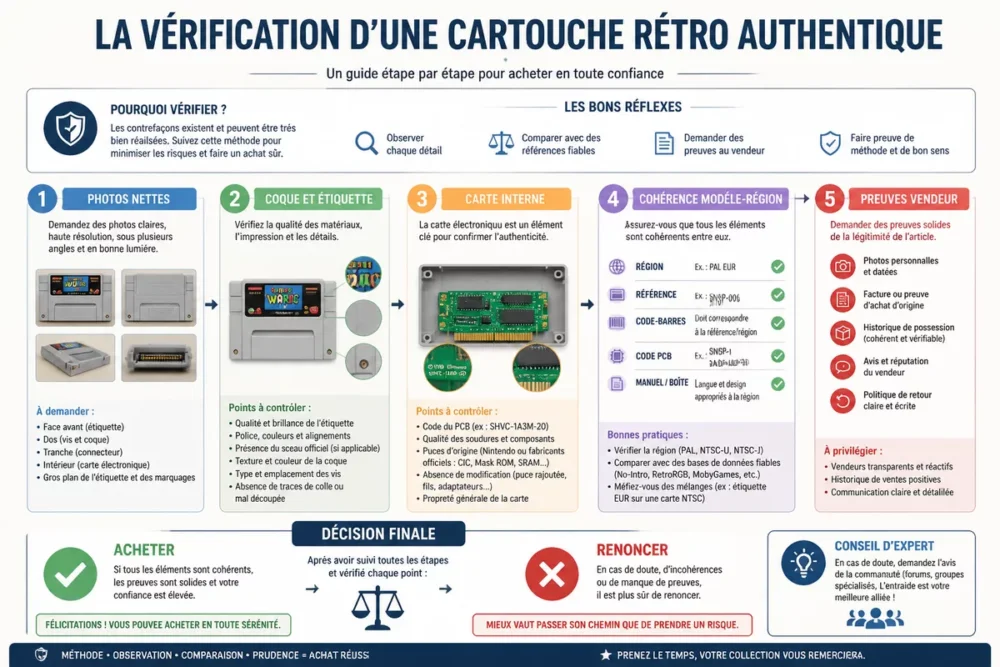
Opening is not a reflex, it is a way to decide when external clues are no longer sufficient.
- First ask for detailed photos of the shell. A clean listing should already show the screws, the label, and the edges without blur.
- Compare the internal board to the announced model. A board that does not match the version sold tips the doubt in the right direction.
- Spot recent or overly regular soldering. Restoration can be legitimate, but it must be clearly stated.
- Check regional and material consistency. A Japanese, European, or American reference does not tell the same story.
- Give up if the seller refuses technical proof. Without verifiable elements, the risk remains complete.
How to check a retro console before purchase?
The console matters as much as the cartridge, because a dirty slot, a makeshift power supply, or a modified console can hide a reading problem and distort the test.
- Shell and covers: look for gaps, marked screws, and parts that do not fit properly.
- Serial number: compare it to the announced model and region if the console has a readable one.
- Power supply: check the cable type, plug stability, and absence of dubious adapters.
- Startup: test the power-on, display, sound, and cartridge detection on a stable screen.
- Cartridge port: inspect the inside of the connector, as a bad contact is enough to confuse the diagnosis.
What documents and proof to ask from the seller?
A serious seller agrees to show what a listing alone cannot prove: clear photos, startup video, close-up of the board or label, purchase history, and possible presence of the original box.
The faster and more straightforward the proofs come, the more the file inspires confidence.
- Front and back photos: they must show the real condition, not just the flattering angle.
- Close-up on the label: it serves to verify the consistency of markings and print quality.
- Test video: it confirms startup, reading, and absence of obvious false contact.
- Original box and manual: they help, but never suffice alone to prove authenticity.
- Lot history: it becomes useful if the seller explains where the piece comes from and what has been replaced.
A serious listing lets you verify, not guess.
What signals should make you give up the purchase?
The worst file is not always the cheapest, it is the one where weak signals accumulate: blurry photos, vague answers, inconsistent accessories, refusal to open, and abnormally low price.
When two of these signals appear together, the risk of a fake or tampered piece rises quickly.
- Price too low: it catches the eye, but often compensates for a defect, a copy, or an incomplete lot.
- Generic photos: they prove nothing about the real condition of the piece sold.
- Vague answers: they often hide ignorance or a desire to avoid details.
- Refusal to open: it prevents checking the board when external examination is not enough.
- Inconsistent accessories: a box, manual, or region that does not match the model should alert you.
Comparison: original, reproduction, refurbished
The original cartridge serves the collection, the reproduction is mainly for playing at a lower cost, the refurbished one can be suitable if the restoration is documented, and the flash cartridge is used to play without damaging a vintage piece.
The right choice therefore depends on the real purpose, not the advertisement slogan.
| Type | What it is | Useful clue | When to buy |
|---|---|---|---|
| Original cartridge | Period piece produced for the official market | Consistent markings, logical wear, compatible board | For collection and heritage value |
| Reproduction | Modern copy that imitates the game | Recent components, sometimes too clean finishes | To play at a lower cost, not for collecting |
| Refurbished | Original piece cleaned, repaired or partially restored | Announced repair, documented replaced parts | If the restoration is transparent |
| Flash cartridge | Programmable medium intended to load multiple games | Practical function, but not an original piece | For testing or use, not for authenticity |
If your main goal is to play, mini retro consoles limit the hardware risk; if you want to extend the life of a machine, retro homebrew projects offer another path; and for a catalog-oriented approach rather than cartridge, playing classics in 2026 avoids the hunt for rare pieces.
How to buy without making a mistake?
The safest method is simple: start with the photos, move on to technical proofs, then check the consistency of the lot and the seller before paying.
As soon as a response is missing or the story changes, doubt should weigh more than desire.
- Start with the visual examination. Look at the shell, the label, the screws, and the markings without being distracted by the price.
- Compare with known references. A genuine authentic retro cartridge looks like the correct model, not a “close enough” version.
- Ask for technical proofs if doubt remains. A photo of the internal board or a playback video is better than a long speech.
- Check the console and accessories. A healthy cartridge in a questionable console can still malfunction and complicate the verdict.
- Give up if the consistency does not hold. A failed purchase costs more than a piece left aside.
Key takeaways
- 🔎 The consistency of details is worth more than a single isolated clue.
- 🧪 Opening only makes sense if the external examination is not enough.
- 🧾 Seller’s proofs count as much as the piece itself.
- ⚠️ Vague ads justify refusal, even if the price seems good.
- 🧠 A worn period cartridge can remain authentic if everything else fits.
Frequently Asked Questions
How to know if a cartridge is authentic without opening it?
The consistency of the label, shell, screws, and price already provides a good first filter. Without opening, doubt does not always disappear, so it is especially important to cross-check clues and demand a test video.
Is a refurbished cartridge still acceptable?
A refurbished cartridge can remain interesting if the repairs are announced and consistent with the original model. The problem starts when the restoration is not documented or when non-compliant parts have been installed without disclosure.
Does an original box prove authenticity?
An original box helps in the evaluation, but it does not alone prove that a cartridge is genuine. A box can be associated with another copy, and a complete lot can still hide a reproduction.
Which signs should make you give up immediately?
Blurry photos, a refusal to provide a video, and a seller who changes their story are very clear signals. If the price is also very low, the case often deserves to be set aside.
Should very cheap lots be avoided?
A very cheap lot is not necessarily fake, but it requires more checks than usual. If the seller cannot explain the origin of the items or show simple proof, the risk quickly outweighs the expected savings.