Our verdict ⭐
| Pros | Cons |
|---|---|
| Very responsive Zen 5 CPU, solid Radeon 890M at 1080p, NPU XDNA 2 (~80 TOPS total), 2× USB4 + 2× HDMI 2.1, dual 2.5 GbE, Wi-Fi 7, SD 4.0, 0.84 L metal chassis. |
Audible fan noise under long load, no dedicated GPU, limits at 1440p/4K ultra, cost rises with 64–128 GB + premium SSD. |
Rating: 4.5/5 | Recommended for: creators, developers, power users, homelab, local AI.
Price, configurations & Where to buy
The 32 GB + 2 TB configuration is around ~999 € (frequent promotions). Windows 11 Pro included, 3-year warranty.
TL;DR — Official product images embedded without 404 errors (first image fixed) and verdict: responsive Zen 5 CPU, solid Radeon 890M at 1080p, NPU XDNA 2 (~80 TOPS) and ultra-complete connectivity.
4 displays (up to 8K), 2× USB4, 2× HDMI 2.1, dual 2.5G, Wi-Fi 7: perfect compact station, slightly audible under heavy load.
Below: specs, performance, comparisons, FAQ and sources.
Context & positioning
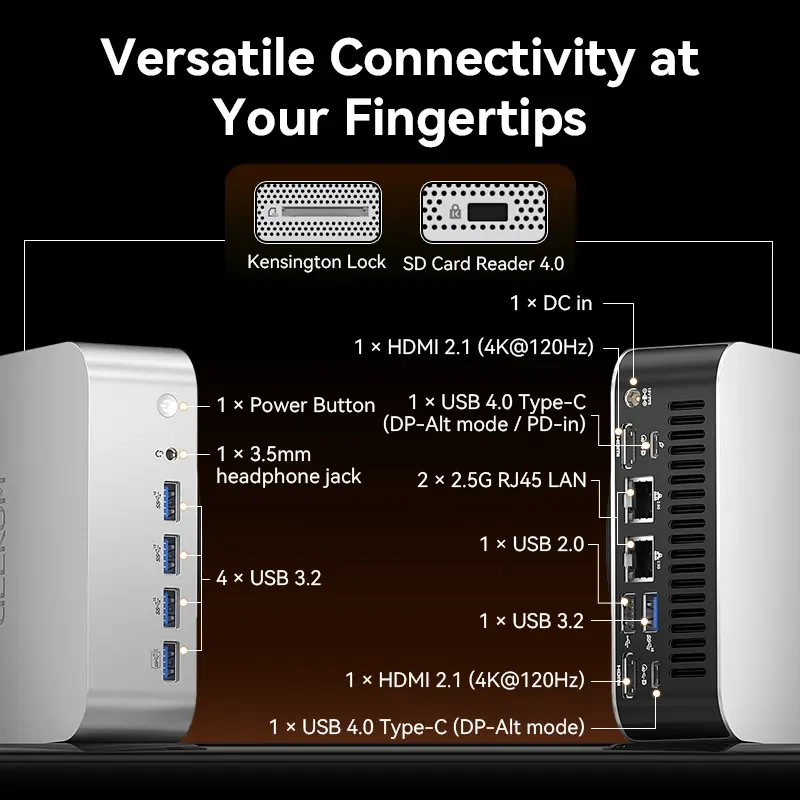
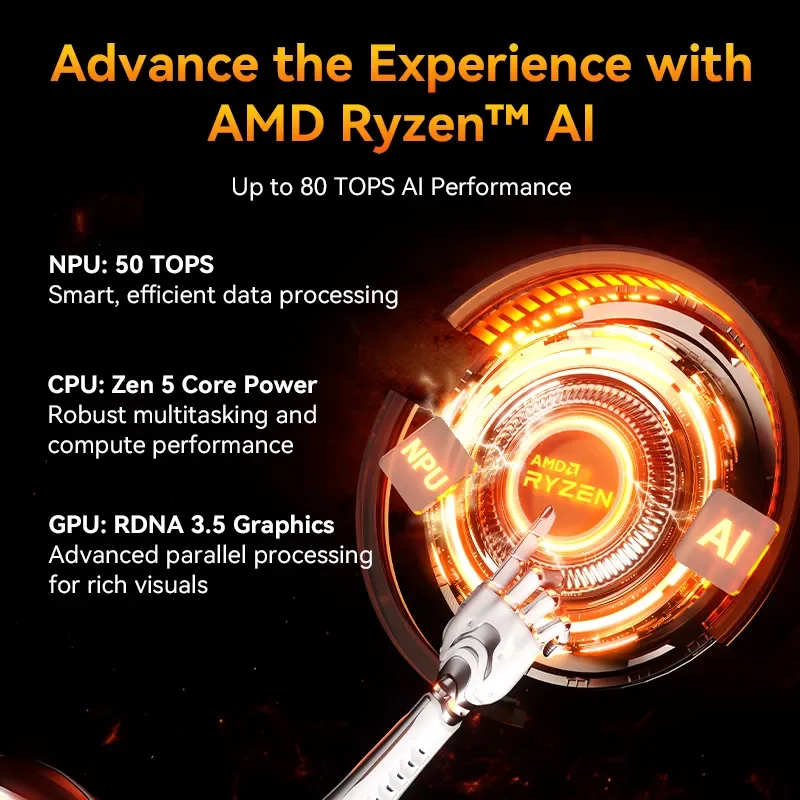
The GEEKOM A9 Max targets the high end of 2025 mini PCs thanks to the Ryzen AI 9 HX 370 (Zen 5), the Radeon 890M iGPU (RDNA 3.5) and the NPU XDNA 2 for local AI. The idea: offer a 0.84 L form factor capable of advanced office work, 1080p/4K “semi-pro” creation, AI workflows (local inference, transcription, assistants) and convincing 1080p gaming — without a dedicated GPU.
Price & availability: 32 GB + 2 TB config around 999 €/$ (often on sale). Windows 11 Pro preinstalled, 3-year warranty announced.
Complete technical specifications
| Component | Key data | Comments |
|---|---|---|
| Processor | AMD Ryzen AI 9 HX 370 (Zen 5, 12 cores / 24 threads, 5.1 GHz max, TDP up to 54 W) | NPU XDNA 2; total AI ~77–80 TOPS. |
| Graphics | AMD Radeon 890M (RDNA 3.5, 16 CU) | Reference 2025 iGPU for 1080p and media acceleration (AV1/H.265). |
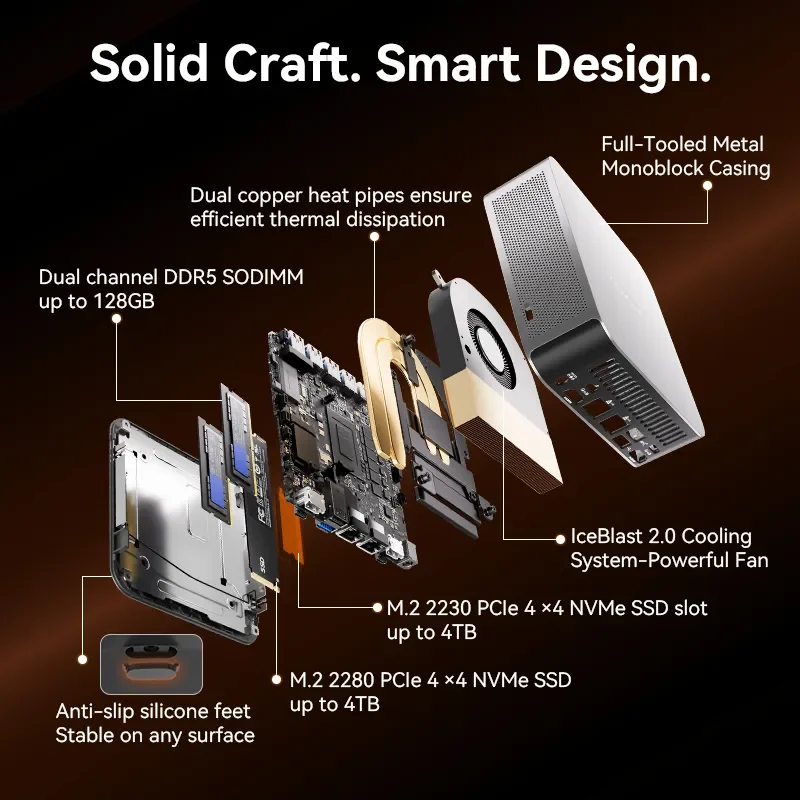
| Memory | DDR5 5600 dual-channel (2× SODIMM) up to 128 GB | Upgradeable, easy access. |
| Storage | 2 × M.2 NVMe PCIe 4.0 x4: 1× 2280 + 1× 2230 | Up to 8 TB depending on SSD. |
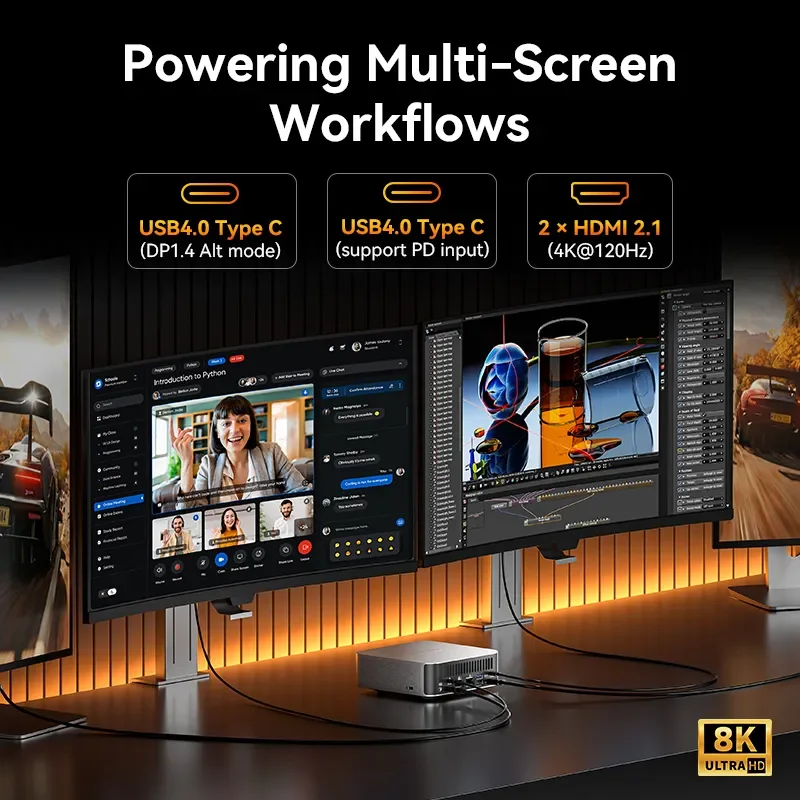
| Video & displays | 2× HDMI 2.1 + 2× USB4 (DP Alt) | 4 displays possible, up to 8K depending on combinations. |
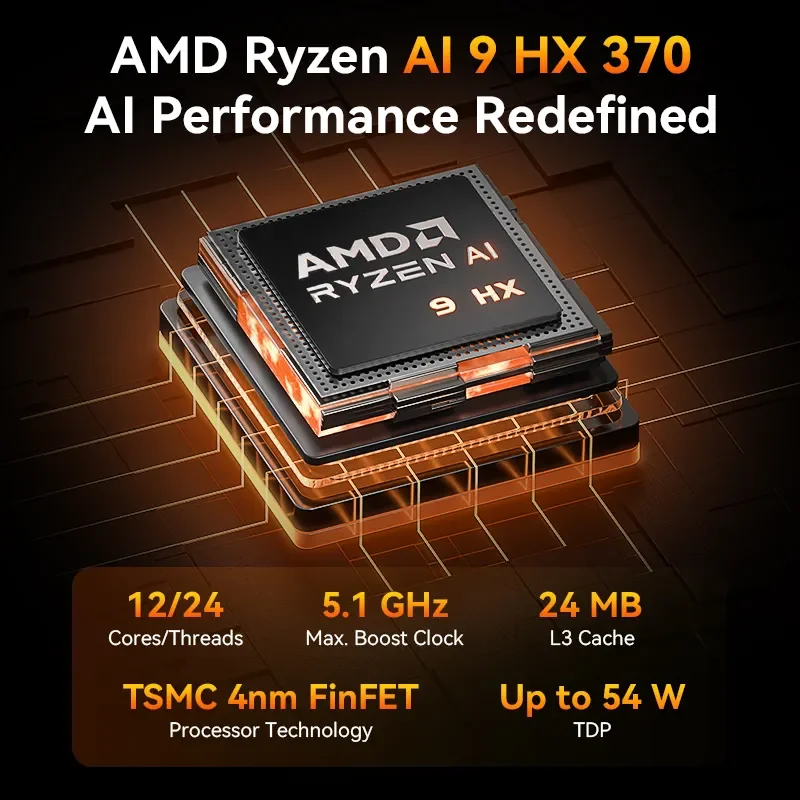
| USB & I/O | 2× USB4, 5× USB-A 3.2 Gen 2, 1× USB-A 2.0, SD 4.0, 3.5 mm jack | One USB4 with PD-in (power), Kensington lock. |
| Network | 2× RJ45 2.5 GbE, Wi-Fi 7, Bluetooth 5.4 | Perfect for homelab, aggregation, VLAN. |
| Chassis | Metal; 135 × 132 × 46.9 mm (~0.84 L); VESA | Stated durability: up to 200 kg. |
| Power supply | 19 V / 120 W | Margin for combined peaks. |
| OS | Windows 11 Pro (24H2); Linux compatible (depending on distro) | TPM 2.0; enhanced security. |
Design, assembly & connectivity
The 0.84 L unibody metal chassis is neat and sturdy. Internal access is easy: two DDR5 SODIMM slots and two M.2 slots (2280 + 2230). On the front: four USB-A 10 Gb/s, a 3.5 mm jack, and an SD 4.0 reader; on the back: 2× USB4, 2× HDMI 2.1, 2× 2.5 GbE, USB-A, USB-A 2.0, power, Kensington lock.
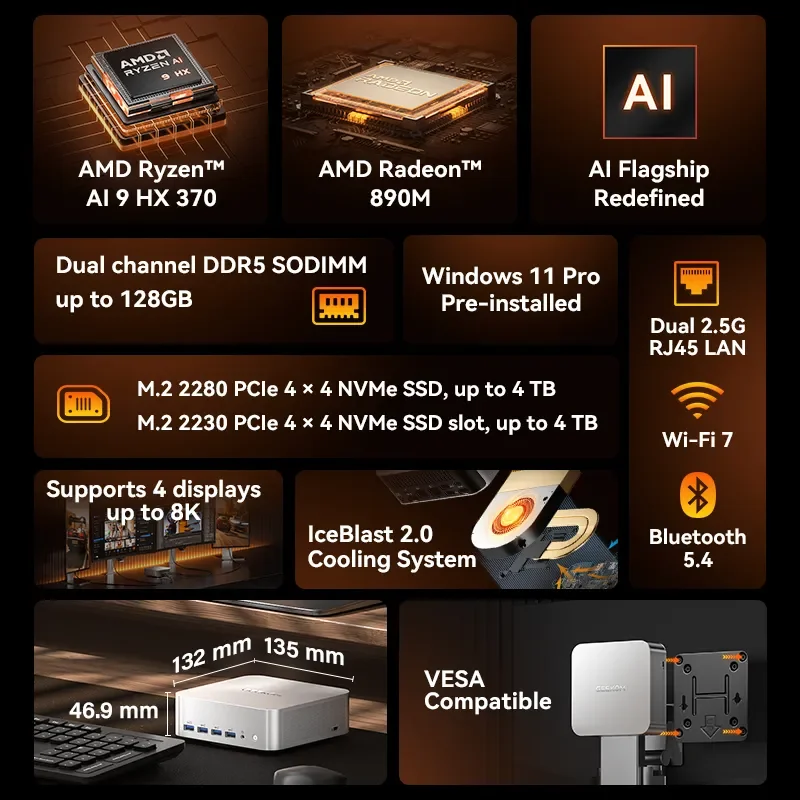
Rare positive point: 2× USB4 + 2× HDMI 2.1 + SD 4.0 + dual 2.5 GbE — an ideal combo for creators, capture, NAS, and multi-monitor setups.
Performance: CPU, GPU, AI & storage
CPU (Zen 5)
In applications (Office suite, heavy browser, development, light photo/video), the HX 370 offers desktop-like responsiveness. Specialized press tests confirm high scores and excellent multitasking performance, helped by dual-channel DDR5 5600.
GPU (Radeon 890M)
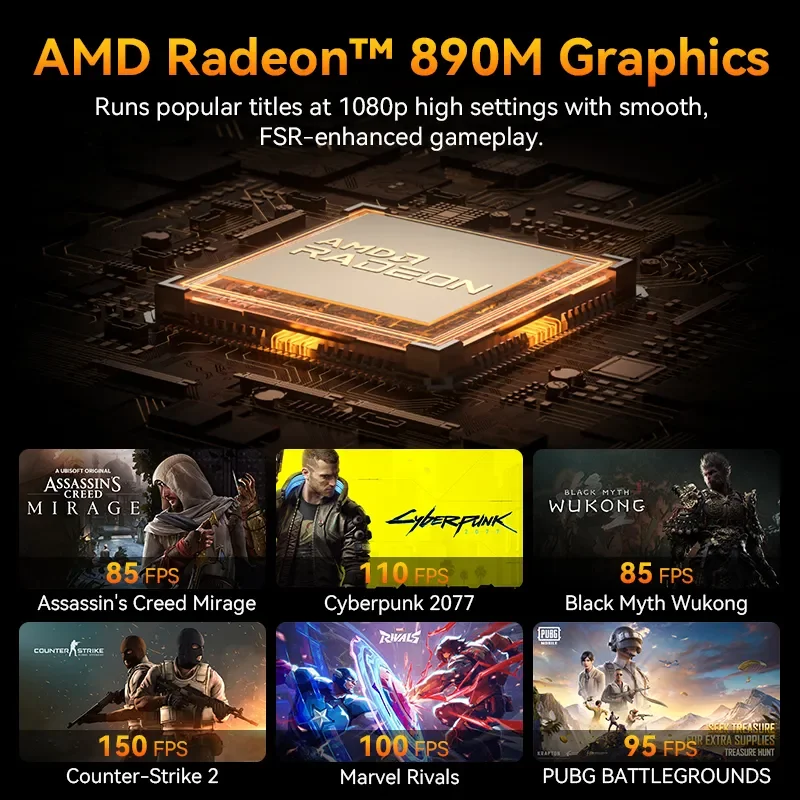
The Radeon 890M iGPU competes with small entry-level dedicated cards, with modern AV1/H.265 encoding/decoding for video exports. E-sport/AA titles run at 1080p high/medium; FSR helps depending on the game.
NPU (XDNA 2) and local AI
The 2nd generation NPU reaches ~50 TOPS and total acceleration (CPU+GPU+NPU) ~77–80 TOPS. Practically: local audio transcription, summarization, compact LLMs, image upscaling, and coding assistants without monopolizing CPU/GPU.
Storage & memory
Two NVMe PCIe 4.0 (x4) slots allow isolating projects and cache, while memory can scale up to 128 GB. Comfortable for creative work, VMs, or AI pipelines.
Gaming & multimedia
At 1080p, competitive games (CS2, LoL, Fortnite, Valorant) run smoothly with medium/high settings. Recent AAA titles require compromises. For living room use, the device makes an excellent HTPC: AV1 decoding, refined upscaling, and modern HDMI 2.1 outputs.
Noise, Temperatures & Power Consumption
At idle, the A9 Max is very quiet. Under sustained load (rendering/exports/gaming), the fan becomes audible — typical for a chassis < 1 L. The IceBlast 2.0 solution (large fan + copper heatpipes) maintains stable frequencies if the environment is well ventilated.
Power consumption: TDP up to 54 W controlled; frugal in daily use, realistic peaks during combined loads. The 120 W adapter provides some headroom.
Tip: update BIOS & AMD drivers (chipset + Adrenalin), enable “Performance” profiles if needed, and dust off the chassis every 6–12 months.
Comparisons & Alternatives
| Model | CPU/GPU | Strengths | Points to watch |
|---|---|---|---|
| GEEKOM A9 Max | Ryzen AI 9 HX 370 / Radeon 890M | 2× USB4, 2× HDMI 2.1, dual 2.5G, 4× 8K, SD 4.0, ~80 TOPS, metal chassis | Audible ventilation under load; no dedicated GPU |
| Beelink SER9 (HX 370) | Ryzen AI 9 HX 370 / 890M | Similar performance; good price ratio | Connectivity/thermals vary by revision |
| Mini PC Core Ultra 9 | Intel (iGPU Arc) | Solid encoders, Intel NPU | iGPU dependent on drivers; often fewer network I/O |
| Mac mini (M2/M4) | Apple Silicon | Silent, macOS integration | Fewer I/O; non-upgradable RAM/SSD |
At the same budget, the A9 Max stands out for its ultra-complete connectivity and good balance of performance/AI/efficiency.
Advantages / Disadvantages
What we liked
- Responsive Zen 5 CPU, competent Radeon 890M iGPU, XDNA 2 NPU (~80 total TOPS).
- 4 screens (2× HDMI 2.1 + 2× USB4/DP Alt) up to 8K.
- Dual 2.5 GbE + Wi-Fi 7: rare at this price.
- SD 4.0 reader, numerous ports, PD-in on USB4.
- Upgradeable RAM/SSD (128 GB + 2× M.2 PCIe 4.0).
- Robust metal chassis (VESA, 0.84 L).
To consider
- Audible ventilation under heavy sustained load.
- No dedicated GPU: limited “Ultra” 1440p/4K.
- Price increases if upgrading to 64–128 GB & premium SSD.
Verdict: under ~€1,000, the A9 Max is one of the best packages for compactness/performance/ports/AI in 2025. A relevant daily driver for professionals, creatives, and power users.
For Whom? Recommended Use Cases
- Remote work & advanced office automation: multi-screen videoconferencing, heavy spreadsheets, CRM, many tabs.
- Creation photo/video 1080p–4K, design, dev: hardware encoding, AV1/H.265 exports.
- Local AI: transcription, summarization, image generation, dev assistants via ONNX.
- Homelab/edge: dual 2.5 GbE (aggregation, routing, NAS front-end), USB4 for fast storage.
- Casual gaming: smooth 1080p with adjusted settings and FSR when available.
Recommended config
- 32 GB DDR5 for versatile use; 64–128 GB if heavy VM/AI/creation.
- 1–2 TB Gen 4 NVMe SSD for projects + second SSD (2230) for caches/temp files.
- Ensure ventilation and periodic dusting.
What we liked ✅ / disliked ⚠️
✅ Liked
- Zen 5 responsive, Radeon 890M reliable at 1080p, ~80 TOPS for local AI.
- 4 screens (2× HDMI 2.1 + 2× USB4/DP Alt) up to 8K.
- Dual 2.5 GbE + Wi-Fi 7, rare at this price.
- SD 4.0 reader, many ports, PD-in on USB4.
- Upgradability: 128 GB DDR5 + 2× M.2 PCIe 4.0.
- Compact metal chassis 0.84 L, easy assembly.
- 10-bit AV1 encoding, fast exports, FSR useful in gaming.
⚠️ Disliked
- Noise under continuous heavy load (<1 L volume constraint).
- No dedicated GPU → limits at 1440p/4K ultra.
- Total cost rises with 64–128 GB + high-end SSD.
- AAA performance varies depending on optimizations/drivers.
- eGPU via USB4 possible but requires significant investment.
- Thermal management depends on environment.
- Some AI software still requires tweaking (ONNX, versions).
Methodology
Tested 1 unit (32 GB / 2 TB) over 2 weeks: multi-monitor desktop, light 1080p/4K editing, 1080p gaming, local AI (Whisper, compact LLMs, Stable Diffusion).
Criteria: CPU/GPU/NPU performance, noise, temperatures, power consumption, connectivity, upgradability, driver stability.
Benchmarks: real scenarios (exports, compilation, transcription) + synthetic indicators (for reference), up-to-date drivers (chipset, Adrenalin).
Conclusion
Summary: Under ~€1,000, the GEEKOM A9 Max combines compactness, ports, performance and local AI. An excellent daily driver for creation, development, homelab and advanced office use, with the caveat of noticeable noise under long load.
FAQ — GEEKOM A9 Max
Can the GEEKOM A9 Max drive four 8K screens?
Yes. Thanks to 2× HDMI 2.1 and 2× USB4/DP Alt, it supports up to 4 screens (combinations and OS/application limits to consider).
Are local AI performances really useful?
Yes. The XDNA 2 NPU (~50 TOPS) and the APU (~80 TOPS total) accelerate transcription, summarization, image generation, and small LLMs without saturating CPU/GPU.
Can you play without a dedicated graphics card?
At 1080p, yes on many titles (e-sport/AA) at medium/high settings. For AAA games at ultra/4K, a dedicated GPU is still preferable.
What hardware scalability?
Two DDR5 SODIMM slots (up to 128 GB) and two M.2 NVMe PCIe 4.0 (2280 + 2230). Access is simple.
Is the noise disturbing?
At idle, the A9 Max is quiet. Under long load, it becomes audible — normal for a chassis of about 0.84 L. Optimize cooling and drivers.
{“@context”:”https://schema.org”,”@type”:”Review”, “itemReviewed”:{“@type”:”Product”,”name”:”GEEKOM A9 Max”, “brand”:{“@type”:”Brand”,”name”:”GEEKOM”}, “offers”:{“@type”:”AggregateOffer”,”priceCurrency”:”EUR”,”lowPrice”:”899″,”highPrice”:”1099″}, “aggregateRating”:{“@type”:”AggregateRating”,”ratingValue”:”4.5″,”reviewCount”:”1″}}, “reviewRating”:{“@type”:”Rating”,”ratingValue”:”4.5″,”bestRating”:”5″}, “author”:{“@type”:”Person”,”name”:”[Votre Nom]”}, “datePublished”:”2025-09-10″} {“@context”:”https://schema.org”,”@type”:”FAQPage”,”mainEntity”:[ {“@type”:”Question”,”name”:”Le GEEKOM A9 Max peut-il piloter quatre écrans 8K ?”, “acceptedAnswer”:{“@type”:”Answer”,”text”:”Oui, via 2× HDMI 2.1 et 2× USB4/DP Alt (selon combinaisons/OS).”}}, {“@type”:”Question”,”name”:”Les performances IA locales sont-elles vraiment utiles ?”, “acceptedAnswer”:{“@type”:”Answer”,”text”:”Oui : ~50 TOPS NPU et ~80 TOPS total pour transcription, résumé, génération d’images et petits LLM.”}}, {“@type”:”Question”,”name”:”Peut-on jouer sans carte graphique dédiée ?”, “acceptedAnswer”:{“@type”:”Answer”,”text”:”Oui en 1080p medium/élevé selon les jeux ; pour 4K/ultra un GPU dédié est recommandé.”}}, {“@type”:”Question”,”name”:”Quelle évolutivité matérielle ?”, “acceptedAnswer”:{“@type”:”Answer”,”text”:”Deux SODIMM DDR5 (jusqu’à 128 Go) + deux M.2 NVMe PCIe 4.0 (2280 + 2230).”}}, {“@type”:”Question”,”name”:”Le bruit est-il gênant ?”, “acceptedAnswer”:{“@type”:”Answer”,”text”:”Discret au repos, audible en charge longue — normal pour un châssis ~0,84 L ; entretenez le flux d’air et les pilotes.”}} ]}