Forty years after the Commodore golden age, Apollo Computing launches the A6000, a modern 68k machine 100% Amiga compatible, designed on FPGA (Apollo Core 68080) with a chassis reminiscent of the 1992 A600. Here is the complete analysis: features, performance, availability, who it is relevant for, and what alternatives exist.
What is the Amiga A6000?
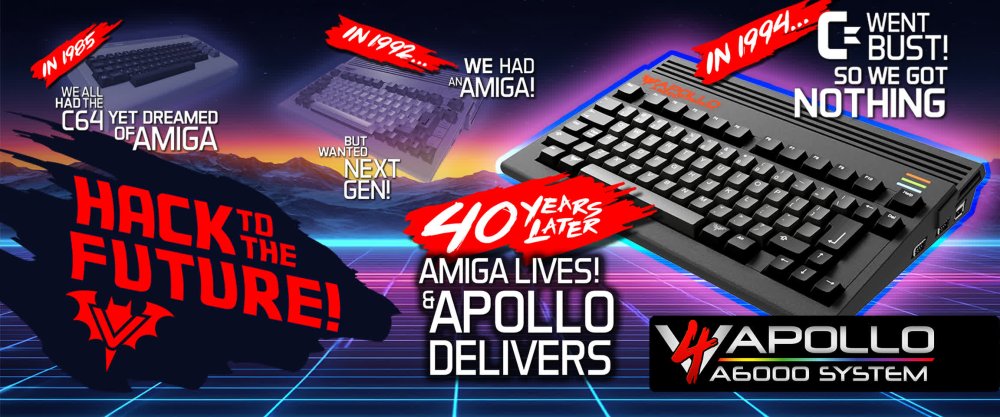
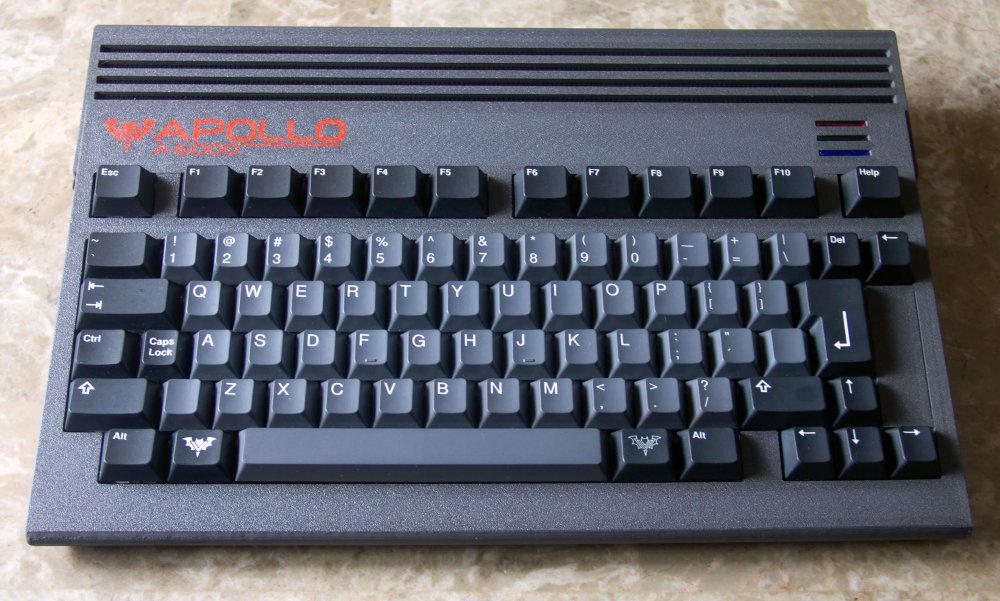
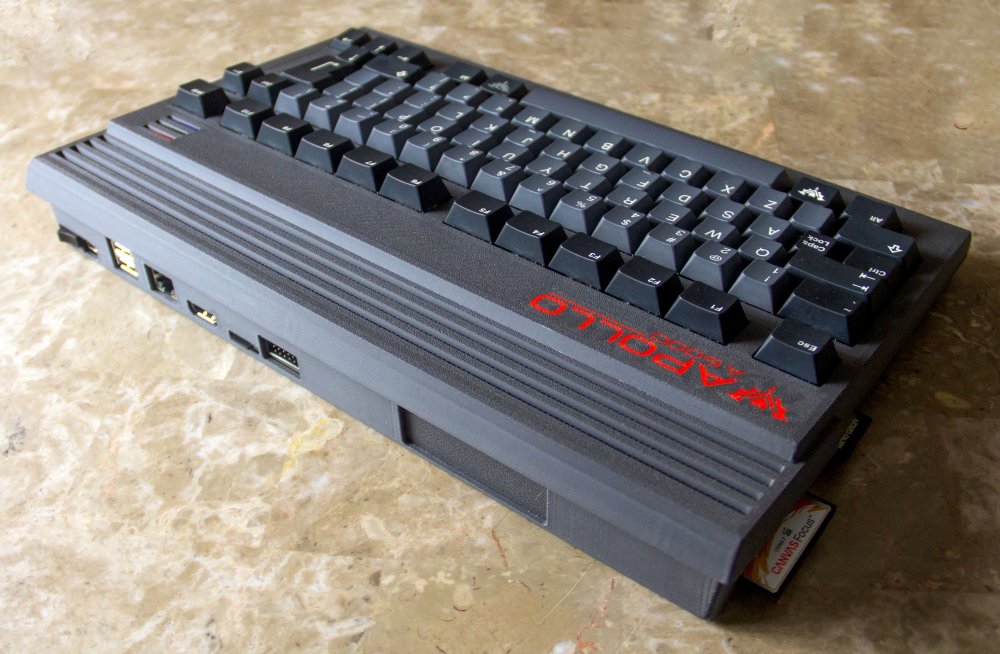
The Apollo A6000 is a complete computer, Amiga 68k compatible “from scratch” via a proprietary FPGA core (V4 Apollo Core 68080) that reimplements the Amiga chipset and the Motorola 68000 family, while adding modern extensions (AMMX instruction set, RTG, enhanced audio). The chassis reprises the “wedge” spirit (compact shell) of the Amiga 600, but redesigned (3D printing, mechanical keyboard). The goal: to regain the experience of a native Amiga, without ARM/x86 emulation, with very broad software compatibility and modern I/O.
The project is driven by Apollo (formerly Vampire), known for its accelerator cards and extensive R&D around the 68080 core and the SAGA/RTG stack. The proposal is not a “mini-console” nor a simple emulation box: it is a standalone 68k machine, delivered ready to use (ApolloOS preinstalled), accepting AmigaOS 3.x games/applications and, according to the publisher, part of the Atari/Mac 68k ecosystem. In the Amiga timeline, it is positioned as a contemporary “reimagination” rather than a period Commodore model (A600, A1200, A4000), with a retro-native philosophy more demanding than simple emulation.
Detailed technical specifications
Here are the specifications that define the A6000 today (according to Apollo sheets and press releases and specialized press). Values and options may evolve with upcoming production waves.
| Block | Key specifications |
|---|---|
| Processor (FPGA) | Apollo Core V4 AC68080 (68k compatible, AMMX extensions, modern pipeline) |
| Video chipset | SAGA (RTG), HDMI output, support for Amiga modes + RTG acceleration |
| Memory | 2 GB Fast RAM + 12 MB Chip RAM |
| Storage | 128 GB CF preinstalled (ApolloOS), dual SD card reader for expansion/exchange |
| Connections | HDMI, Ethernet, multiple USB (including power), mouse/gamepad ports, IDE, stereo audio, expansion bay |
| Keyboard | Mechanical, ABS keycaps, Cherry MX type switches |
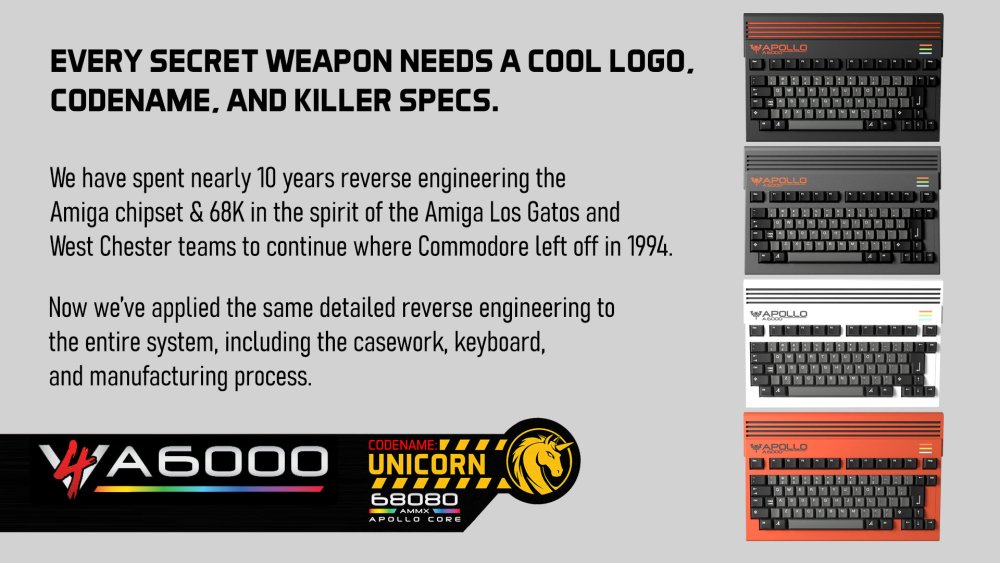
| Case | Compact shell inspired by A600, 3D printed (multiple colors according to visuals) |
| OS & compatibility | ApolloOS (68k) preinstalled; AmigaOS 3.x support (games/apps), and claimed Atari/Mac 68k compatibility |
The added value comes from integration: no hunting for kits or exotic power supplies, clean HDMI output, storage delivered ready to use, and an integrated “modern” keyboard. This “turnkey” positioning targets enthusiasts who neither want to sacrifice 68k authenticity nor tinker for weeks.
Performance & compatibility
What should be expected in practice? The AC68080 delivers orders of magnitude above the original A600’s 68000, with RTG and additional instructions to accelerate graphic/2D/3D and multimedia workloads. Communication elements emphasize very broad AmigaOS 3.x compatibility (WHDLoad games, demos, software), RTG support (modern screens/acceleration), and an ApolloOS system environment designed to start, configure, and quickly launch content. In terms of numbers, the press relays spectacular comparisons (> 400× vs A600 on certain marketing benchmarks) and MIPS orders of magnitude well above the “classic” — while reminding that these values must be contextualized relative to Amiga uses (games/demos/68k software) and not contemporary PC applications.
Important: the A6000 does not target modern web browsing, Electron apps, or compiling huge C++ codebases; it aims for the smoothest possible native Amiga experience (2D/3D “RTG” games, demoscene, 68k audio/graphic production, historic tools), with current I/O comfort (HDMI, USB, network). In other words: it is a very fast and integrated 68k “Amiga,” not a disguised PC.
Price, availability & bundles
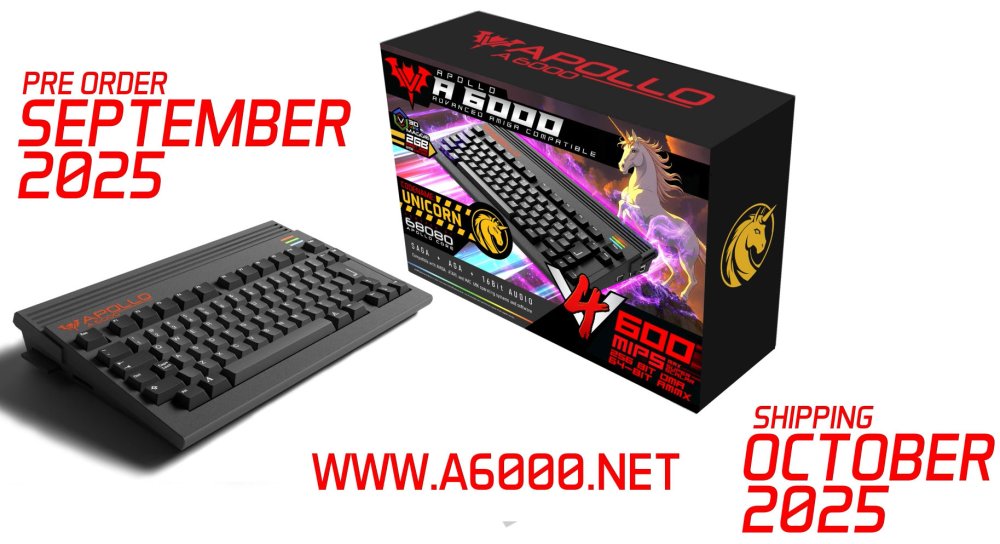
The first “First Edition” batch (codename Unicorn) — 40 units in Germany — sold out quickly at €960 including tax (retail price index). Official visuals mention a preorder window in mid-September and deliveries starting in October. More waves are expected; watch the official site and Apollo store for slots, colors, configurations, and included accessories (USB mouse, gamepad, mat, video cables, etc. depending on the bundle). Note that local taxes (VAT) and shipping fees may vary the final price.
Given the niche demand and limited production (case, keyboard, assembly, FPGA), availability may be sporadic. If you aim for a collector’s/exhibition machine or a specific demoscene use, plan ahead: subscribe to the newsletter, attend trade shows, and reserve budget for the desired edition/color.
Who is the A6000 for?
Winning profiles:
- 68k Amiga purists who want a native machine (not “just” emulation) with HDMI, USB, network and a ready-to-use environment.
- Demoscene, 68k developers and retro creatives wishing to iterate quickly, test RTG/AMMX, output to modern screens, capture via HDMI, etc.
- Collectors looking for a “statement” object (mechanical keyboard, special case, limited editions) celebrating 40 years of Amiga.
Less relevant if you are looking for a “versatile 2025” microcomputer for office work, modern web or PC/console gaming. At a similar budget, a mini x86 PC or a powerful ARM SBC will do better for those tasks — but will not offer the native 68k experience nor the Amiga “flavor.”
Advantages: 68k authenticity, neat integration (HDMI/USB), extended Amiga compatibility, comfortable keyboard, Apollo ecosystem (core/firmware). Disadvantages: premium price, limited supply, niche software ecosystem, performance incomparable to a modern PC outside Amiga uses.
Credible alternatives
Depending on your intention (play, create, collect), several paths exist:
- MiSTer FPGA (DE10-Nano): very popular multi-core hardware emulation (including Amiga), lower entry cost, scalable by “cores.” Less “plug-and-play,” variable integration (cases, I/O cards) and not the same dedicated Amiga machine logic.
- The A500 Mini: mass-market emulation console, simple and affordable to (re)discover classics. No native 68k, no mechanical keyboard, not the Amiga “system” experience.
- Original Amiga + accelerator (e.g. Vampire, PiStorm): maximum authenticity (Commodore motherboard) but rarity, restoration costs, tinkering, sometimes restrictive video outputs, and explosive prices for A1200/A4000 in good condition.
- Software emulation (WinUAE, FS-UAE, AmiKit): economical, flexible, very fast on modern PC, ideal for productivity/ease, but far from the sought “hardware” feel.
In short: the A6000 occupies the “modern plug-and-play 68k Amiga” segment for demanding enthusiasts. If your priority is budget, basic plug-and-play ease or PC performance, the above alternatives will be more rational.
Buying Tips & Checklist
Before ordering:
- Confirm the use: WHDLoad/RTG games, dev/demos, 68k music/graphics? Target your needs (RTG resolutions, controllers, network).
- Check the connectivity of your screen/capture (HDMI), hub/keyboard/mouse (USB), storage (additional SD cards, spare CF).
- Anticipate the software ecosystem: WHDLoad packs, RTG libraries, dev tools, transfers (network/SD), CF backups.
- Total budget: machine + accessories + shipping + local VAT. Compare with the “original Amiga + accelerator” combo if absolute authenticity appeals to you.
- Support & firmware: the advantage of Apollo is also the pace of core improvements (video, audio, performance). Watch the release notes.
Points of Debate & Limitations
“Is it a real Amiga?” From a legal/brand perspective, the A6000 is not a Commodore model; it is a 68k-compatible machine built by a third party, which reimplements the original hardware on FPGA. From a usage perspective, it runs native Amiga code with modern extensions. Purists and pragmatists will not have the same answer, and that’s perfectly fine.
Price: small series production, mechanical/keyboard footprint, and a sophisticated FPGA core explain the entry price. For some, the “MiSTer + nice casing” or “restored Amiga + modern video output” combo will be more sensible.
Performance measurement: MIPS or “×” multipliers are indicative and marketing-dependent; what matters is the experience on your titles/tools. Wait for independent tests if you hesitate.
Trends & Roadmap
The timing (40th anniversary of the Amiga) has rekindled the retro flame, with several parallel initiatives: Apollo’s A6000 on the native 68k side; remakes/“Amiga-style” products more oriented towards the general public; and announcements around inspired hardware (e.g., a “full-size” A1200 on the mini-console side). Regarding the A6000, expect restocks in waves, color/packaging options, and firmware/OS updates that will refine compatibility and stability.
On the technical side, the AC68080 core and the SAGA/RTG ecosystem are key: the more Apollo optimizes (pipeline, memory, video timing, drivers), the wider the gap with the “Amiga of the era” grows — while staying true to the 68k spirit. The vitality of the scene (retro 3D ports, new games, tools) will give the object its true value.
FAQ
Conclusion
The Apollo A6000 ticks almost all the boxes of the “modern Amiga” dream: native 68k compatibility, clean hardware integration (HDMI/USB/CF/SD), a pleasant keyboard, and a polished identity. It is a passionate machine, assumed and coherent with its audience. If your goal is the Amiga experience — playing, creating, coding, showcasing — the A6000 is the most accomplished turnkey option to date. If you are mainly looking for a versatile 2025 microcomputer, other paths will be more rational. It’s up to you to decide according to your heart… and your budget.
CTA: watch for pre-order openings, list your needs (games/RTG/dev), and prepare your dumps/SD cards to smoothly migrate your Amiga library.
{ “@context”: “https://schema.org”, “@type”: “Article”, “headline”: “Amiga A6000 : la « nouvelle Amiga » 68k d’Apollo — specs, perfs, prix, alternatives”, “description”: “Analyse complète de l’Apollo Amiga A6000 : caractéristiques, performances, compatibilité, prix, disponibilité, public cible et alternatives.”, “inLanguage”: “fr-FR”, “author”: { “@type”: “Person”, “name”: “Rédaction Article 2000” }, “publisher”: { “@type”: “Organization”, “name”: “Rédaction Article 2000” }, “datePublished”: “2025-09-25”, “dateModified”: “2025-09-25”, “image”: [ “https://www.techspot.com/images2/news/bigimage/2025/09/2025-09-19-image-26.jpg”, “https://www.techspot.com/images2/news/bigimage/2025/09/2025-09-19-image-27.jpg”, “https://www.techspot.com/images2/news/bigimage/2025/09/2025-09-19-image-28.jpg”, “https://cdn.mos.cms.futurecdn.net/u8fEgFhQv2Wds3SkdmfRRk.jpg”, “https://cdn.mos.cms.futurecdn.net/yDbJ4e3LcyNQSkxpqu3QRk.jpg” ], “mainEntityOfPage”: { “@type”: “WebPage”, “name”: “Amiga A6000 : la « nouvelle Amiga » 68k d’Apollo — specs, perfs, prix, alternatives” } }