Key landmarks and figures
The Amiga appeared in 1985 with the Amiga 1000, equipped with a Motorola 68000 and a trio of custom chips (Agnus, Denise, Paula) that offload the CPU from graphics, sound, and I/O. The OS, AmigaOS, relies on a microkernel called Exec and offers preemptive multitasking — a first in the consumer market at this level of integration. In 1987, the Amiga 500 democratized the platform and became the best-selling model, especially in Europe. In 1992, AGA (Advanced Graphics Architecture) arrived with the A1200/A4000 and expanded the palette.
On the sales side, consolidated estimates place the Amiga family around 4.9 million units across all generations, with the A500 representing the bulk of the installed base (several million units, with precisely documented figures in Germany). Commodore declared bankruptcy in 1994, but the ecosystem continued through hardware/software takeovers, OS forks, and a very active retro scene.

1985: an iconic launch (Warhol & Debbie Harry)
On July 23, 1985, Commodore chose the Lincoln Center in New York to present the Amiga. A legendary moment: Andy Warhol took the stage, digitized Debbie Harry (Blondie), and created a digital portrait live with a drawing software. The demonstration, spectacular for its time, symbolized the artistic and multimedia ambition of the machine: to show that a consumer microcomputer could be a creative tool, not just a desktop computer. This event sealed the DNA of the Amiga: graphic performance, sampled sound, and intuitive interfaces (Workbench), all in a smooth multitasking environment.
Beyond the splash, this launch initiated the adoption of the Amiga in graphic design, animation, and post-production studios, in line with the emergence of a digital culture that values content creation and accessible video editing.

Why the Amiga was ahead
Preemptive multitasking: thanks to Exec, a microkernel of about 13 KB, the Amiga runs multiple tasks smoothly with priorities, interrupt handling, and dynamic libraries. Audio: the Paula chip offers four 8-bit PCM DMA stereo channels — ideal for sound samples and “mod” music. Graphics: with the OCS/ECS, you get hardware sprites, a blitter, the EHB mode (64 colors), and especially the famous HAM6 allowing display of 4096 colors simultaneously (a feat in the mid-80s). In 1992, AGA raised the palette to 24 bits (16.7 million colors) and allowed 256 colors in indexed modes (and up to 262,144 in HAM8), extending the Amiga’s superiority for imaging.
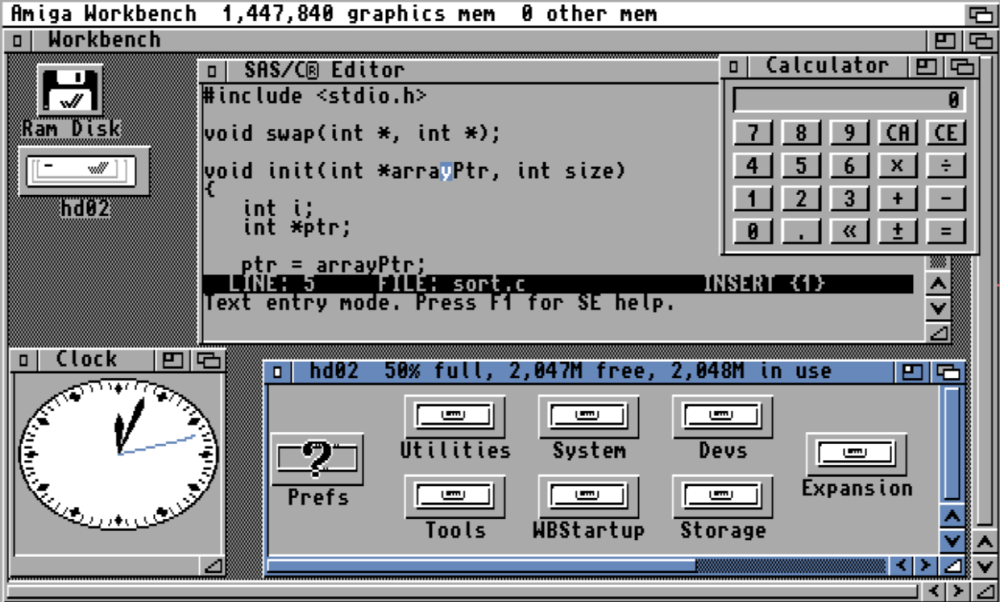
Two key co-processors deserve mention: the Blitter, which accelerates copies/fills/lines, and the Copper, synchronized to the video beam to change the palette, split the screen into bands (“raster bars”), and orchestrate effects otherwise impossible. Combined with the RAM Disk, the graphical Workbench, and joystick/mouse ports, these elements gave the Amiga a unique “creation/game” use for a home computer.
OCS, ECS, AGA: summary of capabilities (selection)
| Chipset | Period | Colors on screen | Key modes | Models |
|---|---|---|---|---|
| OCS | 1985–1990 | Up to 32 (indexed), 64 (EHB), 4096 (HAM6) | Sprites, Blitter, Copper, HAM6 | A1000, A500, A2000, CDTV |
| ECS | 1990–1992 | OCS improvements (resolutions/interop) | Increased compatibility | A500+ (revisions), A3000, A600 |
| AGA | 1992–1994 | 256 (indexed), up to 262,144 (HAM8) | 24-bit palette, 8 bpp bitplanes | A1200, A4000, CD32 |
Key models: A1000, A500, A1200/A4000
A1000 (1985). The first of the line, it introduced dedicated chip architecture and multitasking OS. Its shared “Chip” memory and the Blitter/Copper combination popularized “demo” graphical effects in consumer applications.
A500 (1987). “All-in-one” format, reduced cost, same OCS core: this was the breakthrough. The A500 became the living room machine of the years 88–92 in Europe, driven by bundles and a huge catalog of games/software (including Deluxe Paint, often included). Public sources agree: the A500 is the best-selling Amiga model, with detailed figures by country (e.g., Germany) and global estimates placing the family around 4.9 million units.
A1200/A4000 (1992). Move to AGA: 24-bit palette, up to 256 colors displayable in indexed mode, HAM8 optional, more video bandwidth. The A1200 adopts a 68EC020, a 2.5″ IDE port, and a PCMCIA slot making it an expandable base. The A4000, higher-end (up to 68040), became the ideal platform for video and 3D (LightWave), often accompanied by the Video Toaster.
Creation & video: Deluxe Paint, Video Toaster & LightWave
Deluxe Paint (Electronic Arts) structured the pixel art pipeline of the late 80s/early 90s: palettes, dithering, brushes, frame-by-frame animation. Coupled with EHB/HAM modes, it was also used for illustration, TV graphics, and gaming (sprites, tiles, title screens). Video Toaster (NewTek), a card + software suite for Amiga 2000/4000, revolutionized SD video: real-time mixer, titling, paint and effects for a fraction of the cost of traditional broadcast systems. Integrated, LightWave 3D quickly became a reference for rendering/animation, to the point of being sold separately and becoming established in many studios during the 90s.
This “painting / assembly / 3D” triangle symbolizes the promise of the Amiga: a home computer capable of professional productions (local advertising, clips, regional overlays) without renting an expensive post-production room. It also fueled the demoscene, a laboratory of effects and optimizations on OCS/ECS/AGA.
Cult games: what we owe to the Amiga
Among the essentials: Lemmings, Another World/Out of This World, The Secret of Monkey Island, Sensible Soccer, Worms, Turrican II, Shadow of the Beast, Populous, Speedball 2, Lotus III, Sim City… The “blitter + PCM audio” combination allowed smooth gameplay, a rich sound atmosphere (mods), and memorable intros. Deluxe Paint shaped the 16/32-bit aesthetic of dozens of European studios. Beyond nostalgia, replaying these titles sheds light on the evolution of game design between 1989 and 1994.
Decline of Commodore and living legacy
Despite its strengths, Commodore suffered from a confused marketing strategy, late hardware iterations, and fragile finances. On April 29, 1994, the company declared bankruptcy and was liquidated, while its assets passed into other hands. The IP fragmented (Amiga Inc., Cloanto, Hyperion, etc.) and the ecosystem reorganized: post-Commodore releases AmigaOS 3.5/3.9, AmigaOS 4.x branch for PowerPC, compatible alternatives (AROS, MorphOS). On the hardware side, accelerators, FPGA cards, and video cards modernize classic machines. Communities preserve software, ROMs, and documentation — a valuable heritage effort.
How to replay in 2025 (emulation, FPGA, mini)
Emulators: WinUAE (Windows) and FS-UAE (multi-platform) offer remarkable compatibility, with disk profiles, WHDLoad, USB controllers, display filters, and instant saves. Perfect to quickly (re)discover the entire game library, from OCS to AGA.
FPGA/cores: the Minimig core (MiSTer) hardware-reproduces OCS/ECS/AGA with faithful timings, minimal latency, and clean HDMI output (50 Hz/PAL included). Excellent for purists seeking the “hardware” feel without maintaining a vintage machine.
Official Mini: THEA500 Mini includes 25 games, a controller, a “mouse,” and 720p output. It supports adding titles via USB (WHDLoad) and emulation of the A500/A600/A1200 ranges. This is the easiest way to replay on a modern TV with plug-and-play comfort.
Amiga A6000 Apollo: See our article on the Amiga A6000
Preserving and restoring an Amiga
Electricity: check the power supply (aging of original blocks). A modern, protected PSU limits risks. Capacitors: recap (replacement) is recommended on A600/A1200 (SMD) and, with age, on other models. Drives: belts and heads wear out; a Gotek (floppy emulator) is a practical solution to preserve originals. Video: prioritize RGB (SCART) or clean HDMI adapters; avoid low-quality composite. Storage: CF/SD IDE adapters for A1200/A4000 simplify daily use.
Document every intervention, keep dumps of ROM, ADF, and configurations (Kickstart/Workbench versions). This archiving promotes the durability of the heritage and exchange within the community.
Trends & 40th anniversary events
The 40th anniversary revives events, releases, and reissues. On the “turnkey” hardware side, Retro Games Ltd. continues its effort; a full-size remake of the Amiga A1200 with a functional keyboard was shown in 2025, indicating that the offer should expand beyond the mini. On the museum and exhibition side, the Warhol/Harry episode of 1985 continues to be exhibited/commemorated, recalling the unique artistic dimension of the Amiga. Finally, the demo and retro dev scenes remain very active: competitions, new OCS/AGA productions, and modern tools to code/illustrate on historic hardware.
FAQ
function toggleFaq(n){var el=document.getElementById(‘faq’+n); if(!el)return; el.style.display=(el.style.display===’block’)?’none’:’block’;}
Conclusion — At 40 years old, the Amiga remains a milestone in personal computing: a computer for creatives ahead of its time. Whether you dig out an A500 from the attic, configure a Minimig core, or plug in a THEA500 Mini, the essence is intact: a platform that inspires creating, experimenting, and sharing.
CTA — Tell me your goal (playing, digitizing floppy disks, producing a Toaster-style video, or restoring an A1200): I will offer you a step-by-step setup kit tailored to your needs (legal ROMs, settings, controllers, display).
{ “@context”: “https://schema.org”, “@graph”: [ { “@type”: “Article”, “headline”: “Amiga a 40 ans : pourquoi ce micro a changé l’histoire (et comment en profiter en 2025)”, “description”: “L’Amiga fête ses 40 ans : innovations (multitâche, HAM/EHB), modèles clés (A1000, A500, A1200/A4000), logiciels (Deluxe Paint, Video Toaster/LightWave) et solutions pour rejouer en 2025 (émulation, FPGA, mini).”, “author”: { “@type”: “Person”, “name”: “Rédaction Article 2000” }, “publisher”: { “@type”: “Organization”, “name”: “Rédaction Article 2000” }, “datePublished”: “2025-09-25”, “dateModified”: “2025-09-25”, “mainEntityOfPage”: { “@type”: “WebPage”, “@id”: “À valider” }, “image”: [ “https://upload.wikimedia.org/wikipedia/commons/3/39/Commodore_Amiga_1000_with_modifications-8202.jpg”, “https://upload.wikimedia.org/wikipedia/commons/4/49/2019-08-04_Commodore_Amiga_personal_computer.jpg”, “https://upload.wikimedia.org/wikipedia/commons/f/f4/Amiga_Workbench_3.1_screenshot.png” ] }, { “@type”: “FAQPage”, “mainEntity”: [ { “@type”: “Question”, “name”: “L’Amiga a-t-il vraiment été le premier micro grand public multitâche préemptif ?”, “acceptedAnswer”: { “@type”: “Answer”, “text”: “Oui. AmigaOS (1985) intègre Exec, un micro-noyau multitâche préemptif, rare hors stations à l’époque.” } }, { “@type”: “Question”, “name”: “Que signifient OCS, ECS et AGA ?”, “acceptedAnswer”: { “@type”: “Answer”, “text”: “Ce sont les générations de chipsets : OCS (1985), ECS (évolution), AGA (1992) avec palette 24 bits et 256 couleurs en indexé/HAM8.” } }, { “@type”: “Question”, “name”: “Combien d’Amiga ont été vendus ?”, “acceptedAnswer”: { “@type”: “Answer”, “text”: “Les estimations publiques se situent autour de 4,9 millions d’unités (toute la famille), l’A500 dominant le parc.” } }, { “@type”: “Question”, “name”: “Quelle est la manière la plus simple de rejouer aujourd’hui ?”, “acceptedAnswer”: { “@type”: “Answer”, “text”: “Un mini (THEA500 Mini) pour le plug-and-play TV, ou WinUAE/FS-UAE pour un contrôle fin (WHDLoad, sauvegardes, manettes USB).” } }, { “@type”: “Question”, “name”: “Que valent les solutions FPGA (MiSTer/Minimig) ?”, “acceptedAnswer”: { “@type”: “Answer”, “text”: “Elles reproduisent le matériel au niveau cycle/timing pour une expérience fidèle avec HDMI moderne et faible latence.” } } ] } ] }
Sources
- Amiga — overview and history — wikipedia.org
- Amiga 1000 — model sheet — wikipedia.org
- Amiga 500 — model sheet and sales — wikipedia.org