ENT LR Login: Why the Official Portal Remains the Safest Way to Access School Services
The secure ENT LR login is not just about typing the password correctly. For a student, teacher, or administrative staff member at La Rochelle University, the real issue often begins even before authentication: making sure to arrive at the right portal, in the right place, without going through a suspicious link found in a message, a forum, or an old forgotten bookmark.
The challenge is simple but significant: the ENT concentrates sensitive services — email, timetable, educational resources, administrative documents, grades, collaborative tools — and therefore personal data. That is why the official portal remains the most logical, most clear, and above all, the most protective gateway to avoid fake sites, redirection errors, and bad digital habits.
In Brief
🔐 The primary reflex: go through the official ENT portal, especially La Rochelle University’s ENT access, rather than through a shared link without context.
🧭 A reliable connection is recognized by several signals: consistent address, institutional environment, expected request for credentials, and absence of alarming messages.
🎓 ENT LR centralizes digital services useful daily: email, timetable, educational resources, administrative services, and collaborative tools.
⚠️ Security does not rely solely on technology. It also depends on habits: checking the URL, avoiding shortened links, and asking for help in case of doubt.
Why Does Secure ENT LR Login Go Through the Official Portal?
The official ENT LR portal is the safest route because it limits link errors, controls authentication, and directs to the expected digital services. By using the institutional address, the user greatly reduces the risk of landing on a fake page designed to steal their credentials.
In practice, many login problems start with a trivial detail: a link sent in a conversation, a too-quick Google search, an old bookmark, or a copied page that looks enough like the real portal to trap a hurried user. Joking aside, it is precisely this kind of shortcut that turns a simple login into a security risk.
The ENT LR, for La Rochelle University, is a digital workspace environment accessible to students, teachers, and administrative staff. According to information published by the university on its student digital services, access is based on a personal username and password. In other words, the user does not enter a simple showcase site: they access a space that recognizes their profile and opens adapted services.
The official portal thus changes the game for a very concrete reason: it reduces ambiguity. Instead of multiplying access paths, it acts as a central gateway. It is less spectacular than a technical novelty, agreed, but it is often what best protects beginner or hurried users.
A quick login is truly useful only if it leads to the right service, through the right channel, without exposing credentials.
What Is ENT LR Used for on a Daily Basis?
ENT LR serves as a digital dashboard for common university uses: checking messages, accessing the timetable, retrieving educational resources, following certain administrative procedures, or working with other users. Its main advantage comes from centralization: fewer scattered tools, fewer improvised accesses.
The portal is not limited to displaying a login page. It organizes access to services according to the user’s profile: student, teacher, or administrative staff. This point is important because the same environment can display different functions depending on the rights associated with the account. In other words, authentication does not just open a session; it also determines what the user is allowed to see and do.
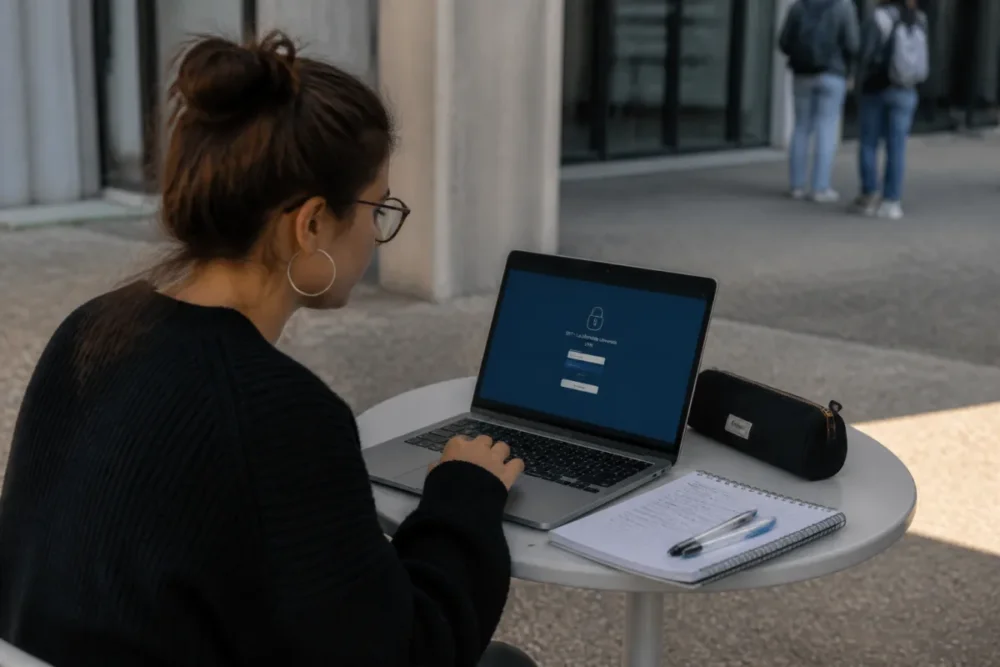
Specifically, the services mentioned around ENT LR cover several recurring needs:
- email messaging, useful for institutional exchanges;
- the timetable, often consulted several times a week;
- educational resources, such as course materials or shared documents;
- administrative procedures, notably registrations, certificates, or results depending on available services;
- collaborative tools, practical for group work and student life.
It is also mentioned that La Rochelle University offers, through its digital services, complementary functions such as a digital safe to archive certain documents and a video portal allowing to review conferences, symposiums, or key university events. The icing on the cake: the whole system gains clarity when the user goes through the same entry point rather than a collection of isolated links.
How to recognize a reliable access to ENT LR?
A reliable access to ENT LR is first recognized by the consistency of the address, the institutional context, and the type of information requested. An official page should not appear from a suspicious shortened link, request unusual data, or pressure the user to act urgently.
The right reflex is to slow down just before entering your credentials. Yes, it’s counterintuitive when you just want to quickly check your timetable. But those few seconds of verification are far better than a compromised account. ENT phishing often works because it imitates familiar interfaces and plays on habit: same logo, same vocabulary, same promise of quick access.
To spot a secure ENT access, you can apply a simple checklist. It does not replace the local instructions of the institution, but it helps avoid the most common traps:
- verify that the address corresponds to an expected institutional domain;
- avoid shortened links or URLs sent without explanation;
- check for the presence of a secure connection in the browser;
- be wary of pages that ask for unusual information;
- never enter your password after an alarming or urgent message;
- prefer using a bookmark created from the verified official portal.
In a university context, security also relies on the connection environment. A shared computer, an unidentified public Wi-Fi, or a browser already open on an unknown session add risks. If you often connect from your home, it may be useful to check who uses your home network; our guide to identify devices connected to Wi-Fi provides simple guidelines to secure this access point.
It is observed in the field that the most frequent errors do not always come from the password itself. Students report having tried to connect from an old saved link or a page found via a search engine, before returning to the official portal and resolving the problem.
| Observed situation | Signal to check | Good practice |
|---|---|---|
| Link received by message | Shortened or unknown address | Start again from the official portal |
| Unusual login page | Incoherent design or text | Do not enter your credentials |
| Urgent validation request | Alarmist tone or threat of blocking | Consult institutional help |
| Login from a shared device | Session already open or unknown browser | Log out and clear traces |
What risks are avoided by using the official ENT portal?
The official ENT portal mainly helps avoid three risks: landing on a fake page, transmitting your credentials to a third party, or wasting time with an unrecognized access. It does not make the user invulnerable, but it significantly reduces exposure to errors and phishing attempts.
The best-known risk remains ENT phishing, also called phishing. The principle is simple: a page or message imitates a legitimate service to push the user to enter their username and password. Once this information is retrieved, it can be used to view data, send fraudulent messages, or attempt to access other services.
The recommendations from Cybermalveillance.gouv.fr on phishing specifically remind the importance of verifying links, senders, and unusual requests. Applied to ENT LR, this means not treating a login page as an invisible formality. The identification form is a boundary: if it is copied or moved outside the proper framework, the danger increases.
The other, more subtle risk concerns confusion between several services. When a user searches for “ENT LR login” or “ENT LR authentication,” they may come across guides, redirect pages, or content that talks about the portal without being the portal. These pages are not necessarily malicious, but they add a step, thus a possibility of error. In short: to read explanations, an article can help; to enter your credentials, the official portal must remain the reference.
The best password does not compensate for a bad login page.
We must also mention enhanced authentication. Some sources mention the possibility of two-factor authentication to strengthen security. The principle is simple: in addition to the password, a second element may be requested, for example a validation or a code. Provided it is activated according to local instructions, this additional layer limits the impact of a compromised password.
What to do if the ENT LR login is blocked?
If the ENT LR login is blocked, first check the portal used, then verify your credentials, your browser, and the account status. If the problem persists, the “forgot password” link or the institution’s IT support are the most reliable options.
In real life, a blockage does not always have a dramatic cause. A forgotten capital letter, a copy-paste with an invisible space, a recently changed password, or an account not yet activated can be enough. Conversely, a page not found or a strange redirection should raise an eyebrow: the problem may come from the link, not the account.
Here is a reasonable order of checks, without going through ten unnecessary steps:
- return to the official ENT LR portal rather than reopening an old link;
- verify the username used and the password entry;
- try from an up-to-date browser or a private window;
- check the internet connection and avoid dubious public networks;
- use the “forgot password” link if the option is offered;
- contact IT support or institutional help if the blockage persists.
A video can be useful to visualize the good practices without turning the subject into a technical manual. The ideal is a short tutorial showing where to log in, how to verify the page, and what to do in case of an error.
The key point to remember: support should intervene after basic checks, not before. This prevents overloading support with input errors, while allowing real access problems to be reported quickly. And if you rely heavily on home Wi‑Fi to attend your classes or consult your services, a more stable network can also help; this comparison Wi‑Fi 6 or Wi‑Fi 6E can clarify usage depending on the housing.
What the ENT LR reveals about the digitalization of schools
The ENT LR shows that school and university digitalization relies on a delicate balance: centralizing to simplify, securing to protect, personalizing to make services useful. The official portal then becomes more than a technical shortcut: it structures the digital relationship between the institution and its users.
Overall, a well-identified digital workspace meets a very concrete expectation: not having to chase after tools. Comfort comes from this centralization. A single access point allows multiple services to be found, with an interface that depends on the profile. For students, this facilitates daily monitoring; for teachers and staff, it limits time lost due to wrong channels or repeated requests.
But this simplicity has a downside: the more central the portal becomes, the more it attracts fraudsters’ attention. That is why security cannot be treated as a hidden option in the settings. It must be part of the normal process: verifying the address, recognizing the correct environment, understanding why credentials should not be shared, and knowing who to turn to in case of doubt.
A family supporting a new student often observes the same paradox: the tool is designed to simplify, but the first connection can seem intimidating. This is not necessarily a design failure. It is a sign that digital access now concentrates important functions, formerly distributed among a secretary’s office, bulletin boards, separate emails, and paper documents.
The right reflex: check before entering
The secure ENT LR connection is based on an idea almost too simple: before typing your credentials, you must verify where you are. The official portal remains the safest route because it combines readability, institutional framework, and centralized access to services. Conversely, unchecked shortcuts add confusion at the most sensitive moment.
This is not an invitation to permanent distrust, but to reasonable vigilance. A good connection is not only fast; it is reliable, understandable, and protective. Provided this reflex is kept, ENT LR fulfills its role: granting access to digital services without turning every procedure into an obstacle course.
To remember
- 🔐 The official portal remains the best entry point for a secure ENT LR connection.
- 🧭 A coherent address is better than a shared link without context.
- 🎓 ENT LR centralizes messaging, schedules, resources, and administrative services.
- ⚠️ Fake sites mainly exploit haste and connection habits.
- 🛠️ In case of blockage, first check the link, then the credentials, then support.
FAQ
Why can’t I connect to ENT LR?
The most frequent causes are a wrong link, an incorrect username, an expired password, or an inactive account. The first reflex is to return to the official portal, then use the recovery option if offered.
Can a parent use a student’s credentials?
It is not recommended. Credentials are personal and give access to sensitive school or administrative data. If a parent supports a student, it is better to consult the necessary information together without sharing the password permanently.
How to know if an ENT page is a fake page?
A strange address, a shortened link, a request for unusual information, or a very urgent message should raise suspicion. If in doubt, do not enter anything and return to the official portal or the institution’s help pages.
Should two-factor authentication be enabled if it is available?
Yes, if the institution offers it and provides clear instructions. Two-factor authentication adds a second verification, which reduces risks if the password is stolen or guessed.
Can the ENT LR be accessed from a smartphone?
Yes, the ENT LR is presented as accessible from any internet-connected device, including smartphone, tablet, or computer. However, the same precautions should be taken: verify the address, avoid suspicious networks, and log out after use on a shared device.