A recent site should not start with the most general queries in its sector. To find free long-tail keywords, rather start from specific questions entered into Google, the formulations of your clients, and data already produced by your site.
The method does not necessarily require a subscription. Google Autocomplete, related searches, People Also Ask, Google Search Console, forums, customer reviews, and observing already ranked pages are enough to build a first usable list. The important work then consists of verifying the intent and the real competition, not stacking long expressions.
In brief
- 🔎 A long tail is primarily a precise query, not an expression that respects a mandatory number of words.
- 🆓 The best free sources are Google Autocomplete, related searches, People Also Ask, Search Console, forums, and customer reviews.
- 📄 Before creating a page, check that the query corresponds to an identifiable intent and that a single page can properly answer it.
- 📊 Free volumes are estimates or ranges: use them as an indicator, never as proof of future traffic.
Why are long-tail keywords suitable for recent sites?
Long-tail keywords refer to queries more specific than generic terms. Their volume and competition are often lower, while the expressed intent is easier to understand. For a site that still has few links and little notoriety, this precision reduces the number of results to face.
A definition based on intent
A query like “shoes” remains very broad. “waterproof hiking shoes for wide feet” specifies the product, the need, and a purchasing constraint. The second expression is long, but it is especially its intent that makes it interesting.
We often talk about queries composed of at least three words, but this benchmark is not an SEO rule. A two-word expression can be very precise, while a six-word phrase can remain vague or artificial. The right criterion is the query’s ability to describe a distinct need.
Authority, competition, and difficulty level
A site’s authority is not limited to a score displayed in a tool. It is manifested notably by the quality and quantity of received links, perceived seniority, editorial coverage of the subject, trust granted to the site, and its ability to properly respond to the intent.
A long tail is therefore not automatically easy. A very precise query can be targeted by powerful sites, official pages, or specialized shops. Manual analysis of results remains essential, especially when free tools provide little information.
Free sources to find ideas
Start with sources that reflect the real language of internet users. They produce directly usable formulations, without relying on a difficulty score or a monthly volume whose calculation method may change.
Google Autocomplete
Enter your main topic in Google, then progressively add modifiers: “how”, “for”, “without”, “after”, “near”, “review”, or “price”. Note only suggestions that correspond to a question or a need your site can actually address.
- “attic insulation”;
- “attic insulation without work”;
- “attic insulation old house”;
- “price attic insulation small surface”.
Also test sentence beginnings and geographic variants. Do not copy all suggestions: an expression proposed by Google indicates an observed formulation, not a guaranteed editorial opportunity.
Related searches and People Also Ask
Related searches generally appear at the bottom of the page. The People Also Ask block, when displayed, provides questions close to the initial topic. Open several questions to reveal other formulations, then group those that require exactly the same answer.
This source is particularly useful for distinguishing intentions. “How to choose a firm mattress” calls for a selection process, while “which firm mattress for back pain” adds a profile and a constraint. These queries may belong to the same editorial set, but they do not always justify two pages.
Forums, reviews, and customer questions
Specialized forums, product comments, customer reviews, and emails received by a company often contain formulations absent from SEO tools. Note the words used to describe a blockage, an objection, or a particular situation.
A review is not proof of search volume. It serves to detect vocabulary and a concrete problem. Then check on Google if other pages answer this question and if the topic falls within your editorial scope.
Merchant sites and competing pages
Online store filters reveal combinations of characteristics: material, size, use, compatibility, color, or destination. Category titles and the questions on their product sheets can provide ideas for commercial or comparative queries.
Also observe the pages well positioned on your topic. Note their subsections, recurring terms, and unanswered questions. The goal is not to copy them, but to identify an intention that you can address more clearly, more completely, or more suitably for your audience.

How to use free tools without confusing free access with accuracy?
Free tools speed up collection, but they do not all provide the same information. Some offer ideas, others data from your own site, and the free versions of specialized solutions may limit results or features.
| Source or tool | Access | What you get | Limit to check |
|---|---|---|---|
| Google Autocomplete | Free, no subscription | Formulation suggestions | No reliable volume or difficulty provided directly |
| Related searches | Free | Close variants of a topic | The presence of a suggestion does not guarantee its commercial relevance |
| People Also Ask | Free when it appears | Related questions and sub-intentions | Display depends on the query and interface |
| Google Search Console | Free for a verified site | Queries that generated impressions or clicks | Data available only for your property and its measured period |
| Keyword Planner | Access linked to Google advertising ecosystem | Ideas and search estimates | Volumes are estimates and access may have limits |
| Ubersuggest or KeywordTool | Free or freemium depending on functionality | Additional variations | Quota, export, and detailed data to check in 2026 |
Google Keyword Planner, Ubersuggest, and KeywordTool can complement native suggestions. Present them as research aids, not as independent authorities. Free features, quotas, and access conditions evolve: check the official page of each service before building a process that depends on them.
Free search volume is not a universal value. Two tools can display different estimates for the same query because they do not necessarily use the same sources, periods, or groupings of variants.
How to find free long-tail keywords step by step?
The following procedure transforms a vague idea into a prioritized list. Work in a simple spreadsheet and keep the exact wording, the source of the idea, and the page you plan to create.
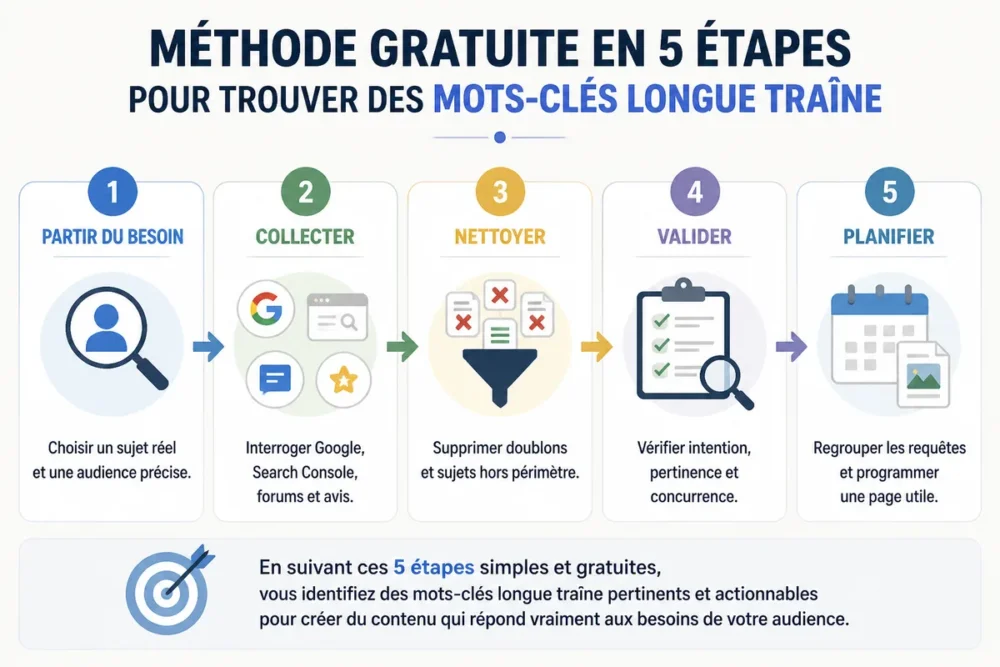
Step 1: choose a starting topic
Write down five to ten problems that your audience actually encounters. For a site selling plants, the starting topic could be “caring for a potted olive tree.” Do not start from an isolated keyword found in a tool: start from a product, a service, a question, or a known situation.
Then add details related to the audience, context, location, level of knowledge, or stage in the journey. You obtain an initial research base without needing to know the volume.
Step 2: collect the formulations
Test the topic in Google with several query beginnings. Copy the relevant suggestions, displayed questions, and related searches into your spreadsheet. Do the same with two or three lexical variants, as internet users do not always describe a problem using the terms employed by your company.
- Column A: exact query;
- Column B: source of the idea;
- Column C: assumed intent;
- Column D: existing page or page to create;
- Column E: decision after analysis.
Step 3: clean and group
Remove errors, variants that do not change the intent, and queries your site cannot answer. Group “repair roof leak yourself” and “how to repair a roof leak” if both naturally lead to the same answer.
Conversely, do not merge an informational query with a transactional query just because they contain the same topic. “Billing software comparison” and “free billing software for associations” may require different content.
Step 4: verify intent and competition
Search each expression in a private or logged-out window when possible. Examine the top results, their titles, formats, and level of specialization. An official page, a large recognized site, or several very comprehensive contents indicate competition that can remain strong despite a detailed query.
Ask four questions before keeping an idea:
- Does the query describe an identifiable need?
- Does my site have a legitimate and sufficiently precise answer?
- Do the current results match the format I can produce?
- Could the page help the reader or only repeat what already exists?
Step 5: assign a page and next action
For each group of queries, choose a main query and some natural variants. Then decide whether to create a new page, enrich an existing page, or publish nothing.
An interesting query without a distinct angle does not necessarily deserve a new article. The best decision may be to improve an already indexed page to avoid cannibalization and multiplication of weak content.
How to evaluate a query without relying solely on volume?
A query may have few searches and remain useful if it corresponds to an offer, a specific audience, or an important stage in the journey. Conversely, a high volume may attract visitors who will never find what your site offers.
Identify the intent
Classify each idea according to its main objective:
- Informational: understand, learn, solve a problem;
- Commercial: compare, evaluate, read reviews;
- Transactional: buy, book, request a quote;
- Local: find a professional, a service, or a nearby place.
A page must have a dominant intent. You can answer several secondary questions, but the title, introduction, and structure must remain consistent with the main request.
Measure relevance for your site
Assign each query an internal score from 0 to 2 on three criteria: alignment with your activity, usefulness for your audience, and ability to produce an original answer. A low score on any of these axes should encourage you to discard the idea, even if it seems low competition.
| Criterion | 0 points | 1 point | 2 points |
|---|---|---|---|
| Relevance | Out of scope | Indirectly related | Directly related to the offer |
| Usefulness | Unclear need | Plausible need | Concrete and frequent problem in your audience |
| Editorial value | Generic answer | Some distinctive elements | Documented, practical or specialized answer |
This score does not predict a ranking. It is used to compare your own ideas with a consistent rule and to avoid choices dictated solely by an estimate of volume.
Free, freemium or paid tools: what to choose?
Start for free when your site has little data and you are mainly looking for topics. A paid tool becomes relevant when the search volume, analysis of many competitors, exports, or position tracking justify its cost.
The free foundation
Google Autocomplete, related searches, People Also Ask, forums, reviews, and Search Console form a sufficient foundation to publish the first pages. Search Console is particularly useful after launch: it reveals queries that already generate impressions, even when they were not planned in the content.
These sources require more manual sorting. This is a constraint, but also a safeguard: you do not fully delegate editorial choice to a score or an automated list.
Freemium solutions
Ubersuggest, KeywordTool, and other services can produce more variants. Their free access may be limited by the number of searches, exports, or detailed data. The distinction between free, freemium, and free trial should be clearly stated in your method.
Do not build your strategy around a feature whose permanent free status is not explicitly confirmed. In 2026, check the conditions displayed by the service at the time of use.
When to consider a subscription?
A subscription can save time for a team that must analyze many queries, monitor several domains, or produce reports. However, it does not fix a poor understanding of the audience and does not automatically turn a competitive query into an opportunity.
Turning ideas into a long-tail content strategy
Collection only produces results if it leads to distinct, useful, and monitored pages. Group queries by intent, assign a priority, and plan a measurement after publication.
Grouping similar queries
Create a group when several expressions can be handled with the same content without forcing the writing. The main query should guide the title, while variants enrich subtitles, examples, and vocabulary.
Avoid publishing five articles that answer the same question with slightly different wording. This approach disperses signals, complicates navigation, and can produce pages too poor to be useful.
Building a realistic schedule
Rank topics according to their proximity to your activity and available production capacity. For a small site, a schedule composed of truly documented pages is better than an impossible pace to maintain.
| Priority | Type of topic | Editorial action |
|---|---|---|
| 1 | Specific question directly related to the offer | Create a complete page with a practical answer |
| 2 | Query already visible in Search Console | Update or enrich the relevant page |
| 3 | Useful related question but less close to conversion | Schedule after priority topics |
| 4 | Variant without distinct intent | Merge with an existing page |
Integrating the keyword into the page
Place the main query in the title, H1, introduction, and a subheading when it truly corresponds to the content. Use variants in paragraphs, examples, and answers to questions, without mechanically repeating the same wording.
A page dedicated to free long-tail keywords must provide a method, criteria, and limits. A simple list of suggestions is not enough to meet the search intent.
Example of selection for a low-authority site
Let’s take a fictional example: a small site specialized in indoor plant care. The starting topic is “ficus losing its leaves.” The goal is not to immediately target the general query, but to look for more specific situations that the site can properly address.
- “ficus loses its leaves after repotting”;
- “ficus loses its leaves in winter in a heated apartment”;
- “why ficus leaves turn yellow and fall off”;
- “watering ficus when leaves fall”.
These ideas should not automatically become four pages. The two queries about leaf loss can be covered in the same article if the content separately addresses repotting, heating, watering, and light. A separate page is justified only if the intent and the response truly differ.
The manager can prioritize the query related to a specific and frequent situation in their audience, then observe impressions in Search Console after publication. The appearance delay and progress cannot be guaranteed: they depend on the site, competition, indexing, and the quality of the response.
Common mistakes with free long-tail keywords
Free methods become counterproductive when they are used to produce pages without strategy. The following mistakes often occur on beginner sites.
Focusing on volume
An estimated high volume says nothing about the relevance of the traffic nor your page’s ability to rank. First compare the intent, the level of results, and the value of the topic for your business.
Creating a page for each variant
Close queries can have exactly the same intent. Publishing a page for each vocabulary variation creates editorial duplicates and dilutes your efforts.
Confusing displayed low competition with actual low difficulty
A free indicator may ignore the quality of existing pages, their authority, or the presence of key players. Open the results and examine them before concluding that a query is accessible.
Copying already visible pages
Reusing their titles and paragraphs creates no reason to choose your page. Use the observation of results to identify expectations, then add a method, an example, a limit, or better-structured information.
Publishing without measuring
Without Search Console or impression analysis, you ignore the formulations actually associated with your page. Check the queries that appeared after publication and improve the content when they reveal a relevant question that is missing or poorly addressed.
A simple pace to start
Reserve a collection session, a validation session, and a writing session. This separation avoids publishing the first idea that comes to mind and allows time to check search results.
The verdict is clear: free long-tail keywords are sufficient to start a serious strategy, provided you replace the race for volume with an analysis of intent. Paid tools can speed up the work later, but they do not replace knowledge of the audience nor the quality of the page.
Frequently Asked Questions
Can good keywords be found without a subscription?
Yes. Google Autocomplete, related searches, People Also Ask, Search Console, forums, and customer reviews allow you to build a relevant list. Manual sorting remains necessary, as these sources do not guarantee either precise volume or ranking.
How many words should a long-tail query contain?
There is no universal threshold based solely on the number of words. A long tail is mainly recognized by the precision of its intent, its context, and the clearly expressed need.
Should only queries with low volume be targeted?
No. An estimated low volume may indicate a small audience, but it can also reflect imprecise data. Keep a query if it is relevant, accessible, and useful for your business, even when the tool does not provide an exploitable figure.
How many keywords should be included in an article?
Choose one main query and use only the variants that serve understanding. Adding many exact expressions degrades readability and can lead to addressing multiple intents in the same page.
How to know if a topic is accessible to a recent site?
Manually analyze the top results: type of sites, content depth, freshness, relevance to the question, and quality of answers. A precise query is not necessarily easy if the results are dominated by very authoritative sources.
Useful sources to consult
- Google Search Console: queries that generated impressions or clicks for your site; useful for discovering already visible opportunities.
- Google Autocomplete, related searches, and People Also Ask: formulations and related questions; useful for broadening an idea without a subscription.
- Google Keyword Planner: suggestions and search estimates; to be interpreted as indicative data.
- Official documentation of the tools used: features, quotas, and access conditions; to check before qualifying a service as free.