On the Internet, each request is sent with an identifiable IP address, a bit like a name on a letter. When visits accumulate, some sites end up spotting and blocking this name. IP rotation then acts as a digital mask: each request appears under a new identity. With Proxyium, this mechanism becomes smooth, configurable, and robust. Let’s dive into the details of their system, its concrete benefits, and how to leverage it to enrich your online experience.
In Brief
🔒 Proxyium offers a global IP pool, automatically alternating your addresses to preserve anonymity and limit tracking.
🚀 Thanks to configurable rotation (interval, session, number of IPs), you gain efficiency, especially for web scraping or competitive intelligence.
🌐 Geoblocks? Effortlessly bypassed, you access foreign content as if you were physically there.
⚙️ Between random and fixed rotation, Proxyium offers fine-tuned settings for every use, from A/B testing to programmatic advertising.
What is IP Rotation at Proxyium?
The Fundamental Principle
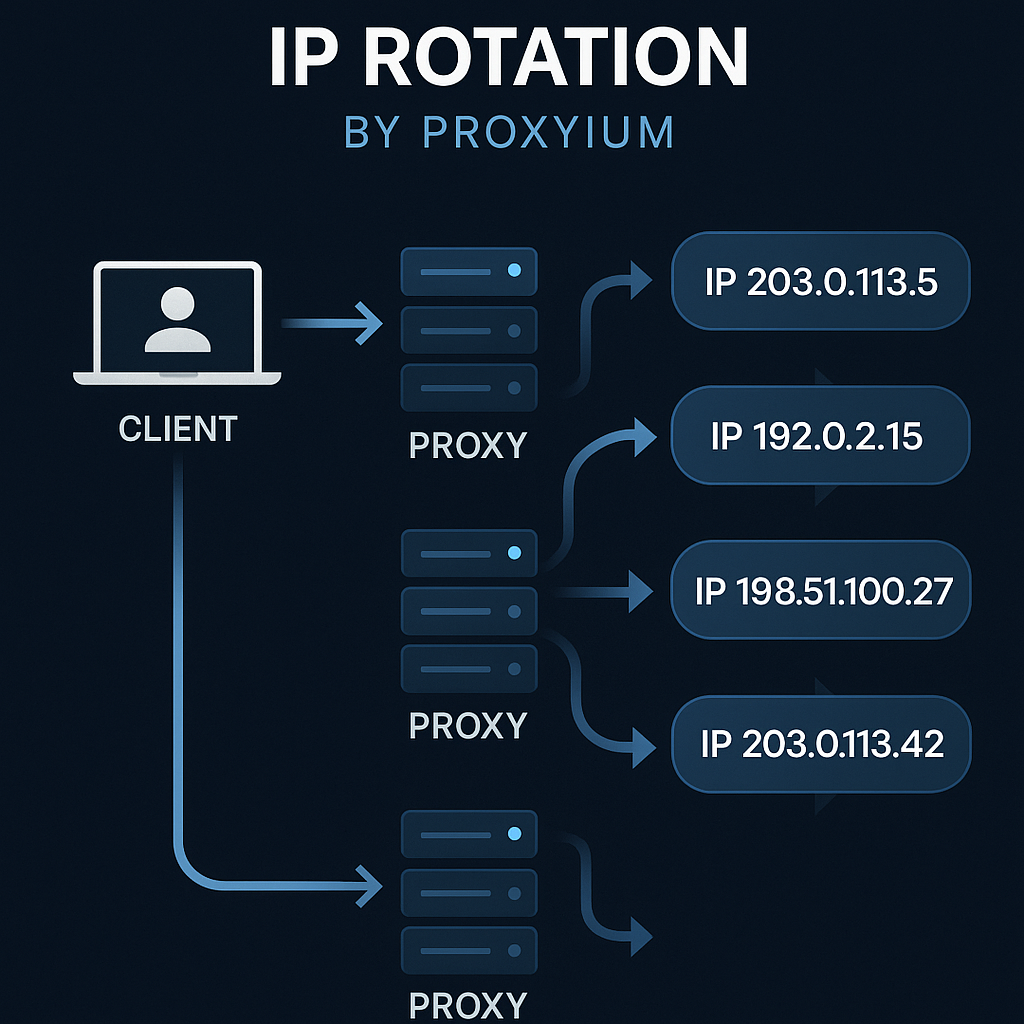
In essence, IP rotation consists of regularly changing the IP address used for your HTTP or HTTPS requests. Imagine an agent who, at every street corner, puts on a different mask: that’s the idea. Concretely, your script or browser adds a parameter to each call, triggering the provision of a new IP from a pool of thousands of addresses. The target site perceives a new user each time, reducing the risk of blocking.
How Does Proxyium Implement Rotation?
Proxyium relies on a network of servers distributed across multiple continents. Each server hosts a pool of addresses from data centers or residential providers. When you configure your client, you specify:
- The rotation frequency (in seconds or per number of requests).
- The session mode (persistent or disposable).
- The desired geographic zone.
Under the hood, an internal service intercepts your requests and reassigns the IP before sending. The switch is almost instantaneous, with no packet loss or noticeable jitter. This mechanism can be compared to a semaphore that opens and closes access to a new tunnel as soon as a condition is met.
The Benefits of IP Rotation for Your Online Activity
Enhancing Anonymity and Privacy
Browsing without leaving a trace? Mission impossible if your IP remains fixed. Malicious or advertising actors collect your history, profile your habits, and restrict your digital freedom. With IP rotation, each session becomes a new start, disrupting tracking systems and muddying the trail. You regain control over your online footprint.
Improving Data Collection Performance (Web Scraping)
Massive scraping requires alternating origin points to avoid bans. A simple Python script targeting the same domain is quickly likely to be detected and blocked after a few dozen requests. By distributing these requests across varied IPs, Proxyium reduces the apparent load on each address, spreads the pressure, and maximizes the success rate. Result: you reach your goals in record time, without interruption.
Bypassing Geographic Blocks
Spotify, Netflix, or certain news sites filter content based on your IP location. When your address changes to a given region, these gates open like magic. Proxyium offers you this flexibility: select an exit node in the United States to access a local version of a service, then switch to Asia in a few milliseconds. It’s a digital passport to explore the web without borders.
Choosing the Right Rotation Strategy
Random Rotation vs Fixed Rotation
In random mode, each request can be addressed via a different IP. This is perfect for light scraping or anonymous testing. In fixed mode, the same IP persists over a determined period, useful for simulating a stable user (UX tests, login sessions). The choice depends on the scenario: do you want each action to have its own distinct face, or do you prefer continuity for a given browsing window?
Setting Frequency and Session
The rotation frequency is generally expressed in number of requests or time. At 1 request = 1 IP, you maximize anonymity but risk extra cost (each new IP engages resources). At 30 seconds, you limit turnover while avoiding blocks. Proxyium offers sliders or API endpoints to adjust these parameters, letting you fine-tune your cost/efficiency balance.
| Criterion | Random Rotation | Fixed Rotation |
|---|---|---|
| Anonymity | High | Medium |
| Session Stability | Low | High |
| Cost | Variable | Predictable |
| Use Cases | Intense Scraping | UX Tests, API Login |
Concrete Use Cases
- Price Monitoring: monitor price fluctuations without being detected.
- Programmatic Advertising: test your ads from different regions to refine your campaigns.
- UX Testing: simulate real sessions in each country, validate content consistency.
- Access to Restricted Content: unlock articles or videos blocked outside a certain territory.
FAQ
- What are the differences between residential and datacenter IPs at Proxyium?
- Residential IPs emulate regular users, making them hard to detect. Datacenter IPs offer more bandwidth and a reduced cost, preferred for intensive data collection.
- Can IP rotation be combined with SOCKS5 proxies?
- Absolutely. Proxyium supports HTTP/S and SOCKS5, allowing you to combine encryption and rotation for enhanced security.
- How can I measure the effectiveness of my rotation?
- Monitor your 200 vs 403/429 response rates, latency, and data consistency. Proxyium provides dashboards to analyze these metrics in real time.
- Are there usage limits?
- It all depends on your plan. Quotas for simultaneous IPs or requests per second are detailed in your client area.
{
“@context”: “https://schema.org”,
“@type”: “WebPage”,
“about”: {
“@type”: “Thing”,
“name”: “Rotation d’IP Proxyium”
},
“keywords”: [“rotation IP”, “Proxyium”, “anonymat”, “web scraping”, “contournement géographique”]
}