.en-bref { max-width: 640px; margin: 2em auto; padding: 1.5em 1.8em; color: #3a2d0d; font-family: “Inter”, “Segoe UI”, sans-serif; text-align: left; position: relative; box-sizing: border-box; background: #f7f9f9; border: 1px solid #10b58b; border-left: 6px solid #10b58b; border-radius: 12px; box-shadow: 0 8px 24px rgba(251, 191, 36, 0.15); }
.en-bref h2, .en-bref .en-bref-header { font-size: 1.15em; font-weight: 700; margin-bottom: 0.6em; color: #d97706; }
.en-bref p, .en-bref li { font-size: 1em; line-height: 1.65; margin: 10px; }
.en-bref strong { color: #1c1917; }
.key-takeaways { max-width: 640px; margin: 2em auto; padding: 1.5em 1.8em; color: #3a2d0d; font-family: “Inter”, “Segoe UI”, sans-serif; text-align: left; position: relative; box-sizing: border-box; background: #f7f9f9; border: 1px solid #10b58b; border-left: 6px solid #10b58b; border-radius: 12px; box-shadow: 0 8px 24px rgba(251, 191, 36, 0.15); }
.key-takeaways h2, .key-takeaways .key-takeaways-header { font-size: 1.15em; font-weight: 700; margin-bottom: 0.6em; color: #d97706; }
.key-takeaways p, .key-takeaways li { font-size: 1em; line-height: 1.65; margin: 10px; }
.key-takeaways strong { color: #1c1917; }
.key-takeaways ul { list-style: none; padding-left: 0; }
.key-takeaways li { margin: 0.45em 0; padding-left: 0.2em; }
.magic-pdf-download{margin:2em 0;padding:1.25em 1.5em;border:1px solid #e3e6ea;border-left:4px solid #0ea5e9;border-radius:10px;background:#f8fafc;display:flex;align-items:center;gap:1.2em;flex-wrap:wrap}.magic-pdf-download .mpd-txt{flex:1;min-width:220px}.magic-pdf-download .mpd-txt strong{display:block;font-size:1.05em;color:#0f172a;margin-bottom:.15em}.magic-pdf-download .mpd-txt span{color:#64748b;font-size:.92em}.magic-pdf-download a.mpd-btn{display:inline-block;background:#0ea5e9;color:#fff;text-decoration:none;padding:.7em 1.5em;border-radius:8px;font-weight:600;white-space:nowrap}.magic-pdf-download a.mpd-btn:hover{background:#0284c7}
.magic-lb-overlay{position:fixed;inset:0;background:rgba(15,23,42,.92);display:none;align-items:center;justify-content:center;z-index:99999;cursor:zoom-out;padding:20px}
.magic-lb-overlay.open{display:flex}
.magic-lb-overlay img{max-width:95vw;max-height:95vh;object-fit:contain;border-radius:8px;box-shadow:0 8px 32px rgba(0,0,0,.5)}
.magic-lb-close{position:absolute;top:16px;right:20px;color:#fff;background:rgba(0,0,0,.5);border:none;width:40px;height:40px;border-radius:50%;font-size:24px;cursor:pointer;display:flex;align-items:center;justify-content:center}
.magic-lb-close:hover{background:rgba(0,0,0,.8)}
.wp-block-image img{cursor:zoom-in;transition:transform .15s ease}
.wp-block-image img:hover{transform:scale(1.01)}
.magic-img-link{display:inline-block;text-decoration:none}
(function(){
var ov=document.getElementById(‘magic-lb’);if(!ov)return;
var img=ov.querySelector(‘img’),btn=ov.querySelector(‘.magic-lb-close’);
function open(src){img.src=src;ov.classList.add(‘open’);document.body.style.overflow=’hidden’}
function close(){ov.classList.remove(‘open’);img.src=”;document.body.style.overflow=”}
document.addEventListener(‘click’,function(e){
var a=e.target.closest(‘a.magic-img-link’);
if(a){e.preventDefault();open(a.getAttribute(‘href’));return}
var i=e.target.closest(‘.wp-block-image img’);
if(i&&!e.target.closest(‘a’)){e.preventDefault();open(i.currentSrc||i.src)}
});
ov.addEventListener(‘click’,function(e){if(e.target===ov||e.target===btn)close()});
document.addEventListener(‘keydown’,function(e){if(e.key===’Escape’)close()});
})();
192.168.1.254: Open the Router Interface and Adjust Useful Settings
The address 192.168.1.254 is often used as a local gateway to the administration interface of a router or modem-router. To open it, you must be connected to the correct network, enter the address in the browser’s address bar, then use the administrator credentials of the device. If the page does not respond, most often the address is incorrect or access is blocked by the network configuration.
This guide goes straight to the point: verify the correct IP address of the router, enter the administration page, identify the truly useful settings, then troubleshoot the most common issues without randomly changing sensitive parameters. The goal is not to change everything, but to know what to open, what to check, and what to leave alone.
In Brief
🔎 192.168.1.254 is a private address used by some routers as a gateway to their local interface.
🧭 Access is done from a device already connected to the network by typing the address in the browser’s address bar, not in a search engine.
🔐 The administrator password is not necessarily the Wi-Fi password: you often need to read the label, the manual, or the operator’s portal.
🛠️ If the page does not open, the first useful check remains the local gateway displayed by the device.
What is the purpose of the address 192.168.1.254?
192.168.1.254 is a private IP address that can identify the local gateway of a router, box, or modem-router. It belongs to the private range defined by RFC 1918, so it is used for the local network and not for the public Internet. If your device uses it, this IP often opens the administration page.
This address does not work like a regular website. It points to the internal interface of the device, provided you are connected to the correct network and using an authorized device. If the page does not respond, the problem rarely comes from the browser alone; the local gateway, the active network, or the address itself are often the cause.
How to open the administration page of 192.168.1.254?
The simplest method is to stay connected to the router, open a browser, then type 192.168.1.254 in the address bar. If the device indeed uses this gateway, the login page appears. If the browser launches a search, the address was entered in the wrong place.
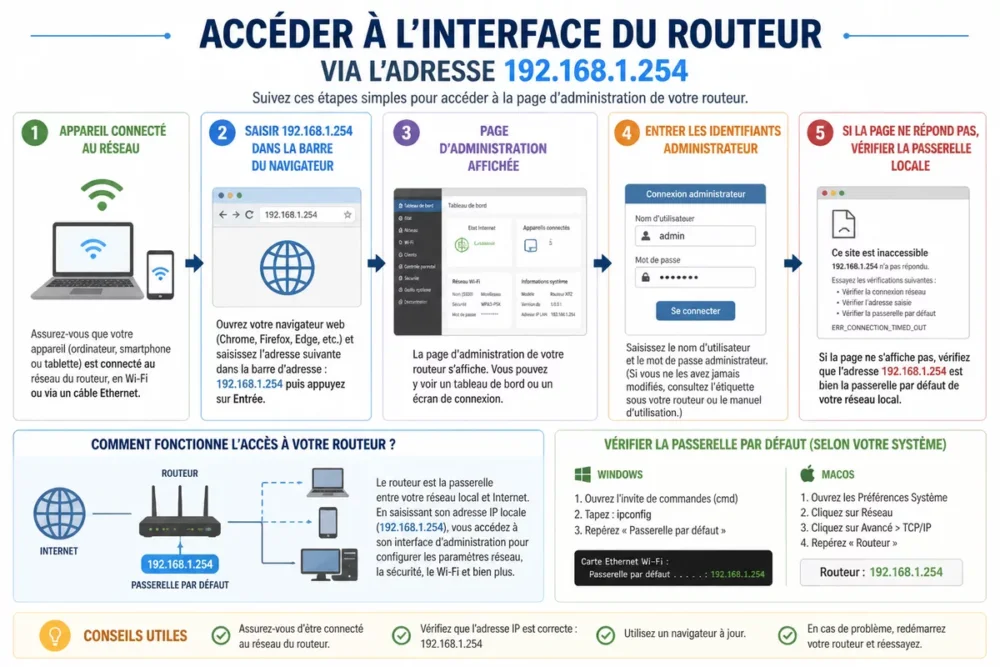
How to open the administration page, step by step?
- Connect the device to the router’s Wi-Fi or, better, connect it via Ethernet if possible.
- Temporarily disable VPN or proxy if an external connection is active.
- Open a browser and type http://192.168.1.254 in the address bar.
- Wait for the router or box login page.
- Enter the administrator credentials provided on the label, manual, or by the operator.
Once connected, change only one setting at a time and confirm before moving on to the next. This precaution prevents accidentally blocking Wi-Fi, the local network, or remote access.
How to know if 192.168.1.254 is really your router’s address?
The best practice is to read the local gateway displayed by the connected device. This address is often that of the router, but it can also be 192.168.1.1, 192.168.0.1, or another private IP depending on the model and the provider. The administration page depends on this data, not on a guess.
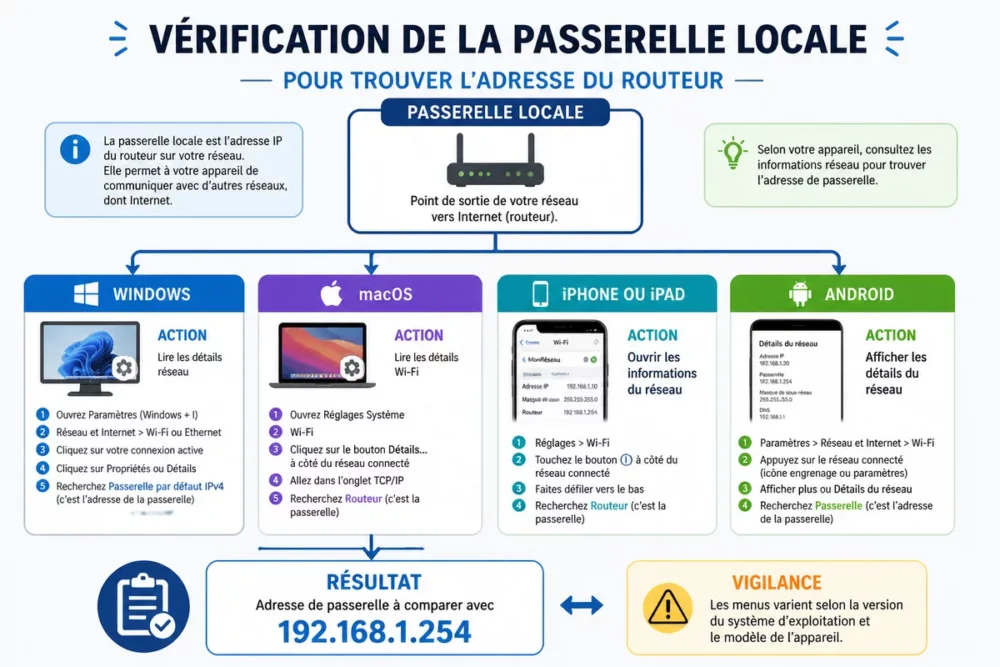
On Windows, macOS, iPhone, iPad or Android, look for the active network details and spot the line gateway or router. This address is more reliable than a random guess, especially when several boxes or repeaters coexist in the same home.
- Windows: open the Wi-Fi or Ethernet properties and look for the gateway.
- macOS: check the Wi-Fi network details in system settings.
- iPhone or iPad: open the connected Wi-Fi network information.
- Android: display the active Wi-Fi network details.
Accessing the configuration interface
The login page often requires an administrator username different from the Wi-Fi password. The safest is to read the router’s label, the manual, or the provider’s customer area before trying random combinations. A Wi-Fi password accepted does not prove that administrator access is open.
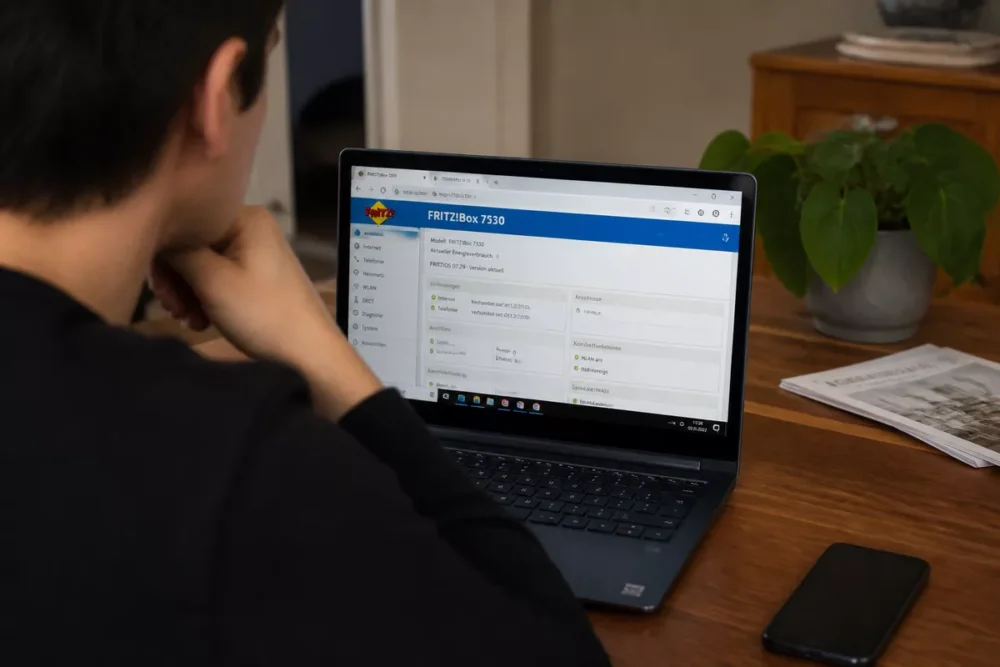
Finding the administrator credentials
Administrator credentials may be on a label, in the original box, in the startup guide, or in the provider’s app. If access has already been customized, look for a password created during installation. If nothing is documented, you must follow the official procedure for recovery or resetting the device.
Logging in without error
The login field must receive the correct credentials, without extra spaces or confusion between uppercase and lowercase letters. If the page refuses access several times, avoid insisting repeatedly; some devices temporarily lock after too many attempts. The right approach is to check the address, then the username, then only the password.
The administrator password must be changed at the first useful access, especially if the device is newly installed or reset.
What can be changed in the router?
Once inside the interface, the most useful settings mainly concern Wi‑Fi, security, and network visibility. The goal is not to browse all the menus, but to identify the settings that truly improve the connection or basic protection.
- Wi‑Fi network name: useful for recognizing the box in the list of networks.
- Wi‑Fi password: useful for strengthening access without touching anything else.
- Radio channel: useful if the neighborhood creates interference.
- Guest network: useful to separate visiting devices.
- Parental control: useful to limit certain uses on the network.
- Remote administration: should be left off if you do not need it.
- DHCP, NAT, firewall: only to be changed if the need is clear.
- Firmware update: to be done only from the interface or official support.
Making only one change at a time simplifies reverting back if something worsens. This rule avoids hard-to-diagnose failures, especially when Wi‑Fi configuration, local network, and operator restrictions are linked.
What errors block access to 192.168.1.254?
Blockages often come from a wrong address, a device connected to the wrong network, an active VPN, or a browser that turns the IP into a search. Troubleshooting becomes easier when you classify the symptom before acting. The problem is not always the router; the error is sometimes in the access path.
| Symptom | Likely cause | Quick action |
|---|---|---|
| Search page instead of the router | The address was typed in the search field | Retype the IP in the browser’s address bar |
| Blank page or very long delay | Wrong gateway, active VPN, wrong network | Check the local gateway and disable the VPN |
| Password refused | Unknown or changed administrator credentials | Re-read the label, manual, or operator space |
| Access blocked after several attempts | Temporary security lockout | Wait then try again with the correct credentials |
If 192.168.1.254 opens nothing, first check the local gateway displayed by the device; it is more reliable than trying several private IPs at random.
192.168.1.254 or another address: which one to try?
192.168.1.254 is not the only access address for routers. The right choice depends on the gateway actually assigned to your device, so the most reliable address remains the one read in the network settings. If this data does not exist, test only common private addresses methodically, not randomly.
| Address | When to try it | What it indicates | Caution |
|---|---|---|---|
| 192.168.1.254 | When the device’s local gateway points to this IP | Compatible router, box, or modem-router | Nothing is guaranteed without verification |
| 192.168.1.1 | When the device shows this gateway | Another very common administration address | Do not confuse with a DNS address |
| 192.168.0.1 | When the local gateway explicitly indicates it | Another frequent private range | To be confirmed in the network details |
| Address displayed in network settings | Always as a priority | Exact address of the local gateway | The most reliable source to open the interface |
This method avoids confusing the router’s address, the box’s address, and a repeater’s address. When multiple devices coexist, the gateway displayed by the device remains the only truly useful reference.
Security Best Practices
The most cost-effective best practice is simple: change the administrator password, keep track of the local gateway, and limit options exposed remotely. The rest follows, especially if the router manages multiple devices or if access has been configured by an operator.
- Replace the original administrator credentials as soon as possible.
- Keep a strong password different from the Wi-Fi password.
- Disable remote administration if it is not used.
- Update the firmware only from the official source.
- Note the gateway address and the location of the router’s label.
The same habit of verifying addresses also applies elsewhere on the web, especially when a link changes or looks like a fake site; a useful reminder is offered in this article on avoiding fake sites. In the router interface, caution is the same: verify before entering credentials.
Changing a setting only makes sense if the need is identified. Without a specific goal, the router interface quickly becomes a place where more things are broken than fixed.
Useful Sources to Consult
Network settings vary by model, but some sources allow you to verify the basics without improvising. This section helps cross-check the local gateway, administrator credentials, and the most common system menus.
| Source | Useful Data | Practical Use | Caution |
|---|---|---|---|
| IETF RFC 1918 | Private IPv4 address ranges | Understand why 192.168.1.254 remains local | Does not provide password or router model |
| Windows, macOS, iPhone, iPad, Android Help | Display of the local gateway | Read the exact router address | Menus vary by version |
| Manufacturer or Operator Documentation | Credentials, access, reset, firmware | Enter the correct interface and secure access | Procedures differ by model |
Key Takeaways
- 🔧 192.168.1.254 is a local gateway, not a public Internet address.
- 🧪 The correct address is read from the gateway displayed by the connected device.
- 🔐 The administrator password is not always the Wi-Fi password.
- 🧭 One change at a time avoids difficult-to-diagnose failures.
- 🛡️ Useful security starts by changing the original credentials.
Frequently Asked Questions
Why does this address not always respond?
The most common reason is simple: 192.168.1.254 is not the gateway of the hardware you are using. A VPN, a wrong Wi-Fi network, or entering it in the search field instead of the address bar can also block access.
How do I know if my router uses a different gateway?
The reliable method is to read the gateway in your device’s network settings. If the displayed address is not 192.168.1.254, test that one first in the browser. This check avoids random attempts and configuration errors.
Can I access the interface from a phone?
Yes, provided the phone is properly connected to the router’s network. A mobile browser is sufficient, as long as the address is entered correctly and access is not blocked by a VPN or operator configuration.
What should I do if I forgot the administrator password?
Start by checking the router’s label, the installation guide, or the operator’s client area. If access has been customized and no recovery is planned, a reset may be necessary, with loss of personalized settings.
Is it dangerous to modify the router’s settings?
Changing a setting is not dangerous in itself, but some settings can cut Wi-Fi, block remote access, or disrupt connected devices. The safest approach is to change one setting at a time and note the original value.