Quarters for retirement: how many you need according to your situation and how to retire at the right time
The number of quarters for retirement mainly depends on your year of birth, your legal retirement age, and the date you obtain the full rate. In 2026, the key figure to remember is simple: for the most recent generations, 172 quarters are required, and the legal age is 64 for people born from January 1, 1969.
The correct calculation is not just about looking at your age. You also need to check your insurance duration, distinguish between contributed, validated, and assimilated quarters, and then compare your career statement with the official rules. It is this trio that allows you to know if you can retire now, wait longer, or correct an error before setting your retirement date.
In brief
🔎 The full rate depends first on your generation: the thresholds range from 167 to 172 quarters depending on the cases recalled by Service-Public and the State Retirement Service in 2026.
🧭 Retiring at the legal age does not mean retiring at the full rate. Before age 67, a lack of quarters can lead to a reduction; at 67, the full rate can apply even without a complete duration.
📄 The career statement remains the most useful control point. A forgotten period, a year incorrectly recorded, or an uncounted assimilated quarter can delay your retirement by several months.
💶 Buying back quarters can help, but only if the gain on the pension offsets the cost. Without simulation, you often buy complexity rather than a real solution.
How many quarters are needed for retirement?
The practical rule is as follows: to retire with a full rate pension, you must have reached the number of quarters required by your generation. This number varies according to the year of birth and must be read together with the legal age, not in place of it. At 67 years old, the full rate can be granted even if the insurance duration is not complete.
The retirement fund therefore does not only look at your birthday. It also verifies the validated duration in your career statement, the assimilated periods, and, depending on the case, specific schemes such as long careers.
The right reflex is not to ask “at what age can I retire?”, but “at what age can I retire without unnecessarily losing part of my pension?”.
What do contributed, validated, and assimilated quarters mean?
These three concepts are similar, but they do not mean the same thing. The retirement calculation is based on the total insurance duration, whereas the validation of a quarter can come from a salary, a compensated period, or a special right recognized by retirement rules.
- Contributed quarter: period during which you paid contributions on professional activity.
- Validated quarter: quarter counted in your insurance duration, even if you did not work three full months.
- Assimilated quarter: quarter granted for certain non-working periods, such as compensated unemployment, illness, maternity, or national service.
The key point is simple: a retirement quarter is not always equivalent to three months of actual work. This distinction prevents misreading your statement and wrongly believing that a whole year is missing when only a few quarters are absent.
| Category | What it measures | Practical use | Warning |
|---|---|---|---|
| Contributed quarters | Activity that generated contributions | Measure the part actually worked | Do not cover all recognized periods |
| Validated quarters | Duration counted for retirement | Used to calculate the full rate | May include non-working periods |
| Assimilated quarters | Periods recognized by retirement rules | Compensate certain absences | Are not automatically granted in all cases |
How many quarters are required according to your year of birth?
The official thresholds depend on your generation and sometimes on the month of birth. The table below summarizes the public benchmarks recalled by Service-Public and the State Retirement Service for 2026. The logic is always the same: the more recent the generation, the higher the number of quarters required, up to the ceiling of 172 quarters.
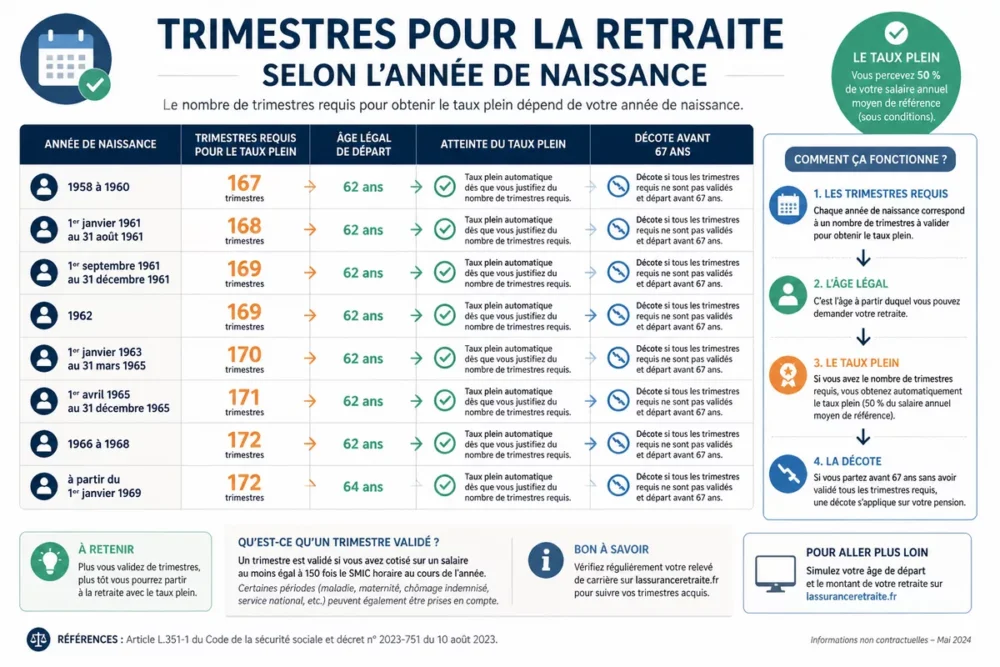
| Year or period of birth | Quarters required | Useful reading |
|---|---|---|
| 1958 to 1960 | 167 | Threshold still lower than subsequent generations |
| January 1, 1961 to August 31, 1961 | 168 | Gradual transition to higher thresholds |
| September 1, 1961 to December 31, 1961 | 169 | The month of birth changes the number of quarters required |
| 1962 | 169 | Stable benchmark for the entire year |
| January 1, 1963 to March 31, 1965 | 170 | The level rises by one step |
| April 1, 1965 to December 31, 1965 | 171 | Intermediate situation before the final threshold |
| 1966 to 1968 | 172 | The ceiling reached for recent generations |
| From January 1, 1969 | 172 | Legal retirement age of 64 and 172 quarters for full rate |
This chart does not replace a personal simulation, but it gives the right order of magnitude. If you were born between 1961 and 1965, the month of birth can change your threshold; this is the detail that many retirement letters make unclear if read too quickly.
The classic trap is to believe that the legal age is enough. In reality, the retirement age and the insurance duration are two separate locks.
How to validate a retirement quarter?
Validating a quarter is not just about three months of presence in a position. In practice, retirement schemes consider income subject to contributions or periods recognized as assimilated. You can therefore validate a quarter without having worked a full quarter, but you do not automatically validate four quarters just because the calendar year lasted twelve months.
The useful reflex is to check, year by year, what has actually been recorded in the career statement. This is often where discrepancies hide between professional memory and recorded data.
| Situation | Possible effect | Point of attention |
|---|---|---|
| Employee or self-employed work | Validation by contributed income | The salary or income counts, not just the time spent |
| Unemployment benefits | Possible assimilated quarters | Uncompensated unemployment follows other rules |
| Illness or long stoppage | Possible assimilated quarters | The period must be recognized by the scheme |
| Maternity or adoption | Possible assimilated quarters and increases | Rights are not read like a simple employment contract |
| National service | Possible assimilated quarters | It is necessary to verify the correct recording on the statement |
What to do if you are missing quarters?
Three main options dominate: wait, retire with a reduction, or fill part of the gap. The right choice depends on the number of missing quarters, your age, and the amount of pension you lose or gain by changing the retirement date.
A simple example helps to understand the situation: if your generation requires 172 quarters and your statement shows 168, you are missing 4 quarters. You can then continue working, consider buying back quarters, or check if a forgotten period can be reinstated.
| Option | When it makes sense | Advantage | Limit |
|---|---|---|---|
| Wait for full rate | When a few months are enough to complete the duration | Avoids reduction and secures the pension | Delays the retirement date |
| Retire with reduction | When retirement must happen despite the gap | Allows earlier retirement | Reduced pension until full rate is reached |
| Buy back quarters | When a small number of quarters are missing and the expected gain is real | Can accelerate access to full rate | Cost must be simulated before any decision |
| Correct the statement | When a period is missing or has been incorrectly recorded | Can restore rights already acquired | Requires supporting documents |
Buying back quarters is not a good default answer. It becomes relevant if the gap is limited, if the career is stable, and if the difference between early retirement and full rate compensates for the buyback cost. Without simulation, one judges too quickly based on impression, not on the result.
Which special cases can change the rule?
The standard rule does not cover all career paths. Long careers, disability, certain hardship situations, and increases related to children can modify the retirement date or the counted duration. These provisions do not mechanically add up: each responds to its own conditions, often stricter than the general rule.
- Long career: useful if activity started early and the contributed duration is sufficient.
- Disability: can open specific rights, subject to recognition and insured duration.
- Hardship: some rights depend on the professional prevention account and applicable rules.
- Parents and education: duration increases may exist, especially if children were raised under conditions recognized by the scheme.
In these cases, the most frequent mistake is to apply the standard calculation to a situation that falls under another retirement scheme. Personalized verification avoids gaining time on paper only to lose it at the time of the file.
How to check your situation on the career statement?
The career statement is the most useful document to know how many quarters are already validated and what is still missing. It allows spotting forgotten periods, incomplete years, and assimilated quarters that have not always been correctly recorded. Verification must be done before setting a retirement date, not after submitting the file.

Step 1: open the career statement
Log in to your retirement space or retrieve the summary document sent by your fund. The goal is to read, year by year, the number of quarters recorded, the salaries or income considered, and the periods noted as assimilated.
Step 2: compare actual periods and recorded periods
Take your contracts, pay slips, unemployment certificates, sickness or maternity proofs, then compare them to the statement. This step helps identify gaps, duplicates, or misclassified periods, especially if you have changed employer, status, or country.
Step 3: report omissions and keep proof
Contact the competent fund with the necessary supporting documents as soon as a year is missing or a quarter seems absent. The best practice is to keep dated copies of all exchanges, as a retirement file is easier to correct when the evidence is complete and legible.
- First check the total number of quarters, then the details by year.
- Verify non-working periods that may count as assimilated quarters.
- Never confirm a departure date without having fully reviewed the statement.
What mistakes to avoid before setting your departure date?
Most unpleasant surprises come from simple mistakes, not complex calculations. Confusing legal age, required quarters, and full rate remains the most costly error, because it gives the impression that a possible departure is necessarily an optimal departure.
- Relying on age alone: retiring at the legal age does not guarantee the full rate.
- Forgetting assimilated quarters: a compensated period can change the count.
- Not correcting the statement: a misrecorded year can create an artificial shortage.
- Buying back without simulation: buying back may cost more than it yields if the file is poorly calibrated.
- Ignoring special rules: long career, disability, or child-related increases can modify the calculation.
These mistakes are avoidable if you start from the official document, then only afterwards from the personal calendar. The reverse logic often results in departures postponed by a few months or a pension less clear than it could have been.
Useful sources to consult
The practical guidelines above rely on official or institutional sources, to be checked when you prepare your departure. Since rules may evolve, the final word always belongs to your career statement and the fund managing your file.
- Service-Public — number of required quarters, full rate, and departure age.
- State Retirement Service — table of thresholds by generation.
- Retirement Insurance — career statement, validation of quarters, and correction of missing periods.
- Code.travail — useful reference on the minimum quarters and certain rights linked to contributions.
To remember
- 🧾 The right calculation combines birth year, legal age, and insurance duration.
- 📊 The threshold ranges from 167 to 172 quarters depending on the generation.
- ⏳ Leaving at 64 years old is not always enough to have the full rate.
- 🔍 The career statement must be checked before setting the departure date.
- 💼 Buying back quarters is only worthwhile with a serious simulation.
Frequently Asked Questions
How many quarters are needed to retire with a full pension?
The number depends on your year of birth. For recent generations, up to 172 quarters are required, while some older generations have a lower threshold. The best reference remains your date of birth and your official career statement.
Can you retire before having all your quarters?
Yes, but this can lead to a reduction if you retire before age 67 without the required duration. Retirement is possible at the legal age, but the pension amount may not be optimal. So the question is not only “can I retire?” but “under what conditions?”.
Do periods of unemployment count towards retirement?
Certain periods of compensated unemployment can count as assimilated quarters. Uncompensated unemployment follows different rules and does not automatically have the same effect. You should therefore review your career statement and verify the exact nature of the period.
How do I know how many quarters I am missing?
You need to compare the number of quarters already validated with the number required for your generation. The career statement provides the most reliable basis, then an official simulation allows you to see if a missing period, a buyback, or a correction can change the retirement date.
Is buying back quarters worthwhile?
Buyback can be useful if the shortage is small and the pension gain offsets the cost. Profitability depends on your age, the number of missing quarters, and the expected pension increase. Without a simulation, no serious conclusion can be drawn.