How to motivate teens to move in the era of screens and digital entertainment
The phone captures attention in seconds, whereas a sports session often requires effort, a trip, sometimes even a bit of courage. To motivate teenagers to do sports, the real issue is not just discipline or willpower: it is the gap between immediate digital rewards and a lasting desire to move. When we understand this gap, we can act much more subtly, without guilt, without pushing back, and above all without foolishly opposing screens and physical activity.
During adolescence, the body changes, others’ opinions weigh more, school fatigue accumulates, and habits settle quickly. That’s why overly simple advice like “go run a little” often fails. What works better is a concrete method: identify the real obstacles, choose the right activity format, reduce pressure, and rebuild a realistic routine that makes you want to start again.

Why do teens move less today?
A teenager moves less when physical activity seems costly and the screen much more rewarding. Fatigue, self-image, fear of being judged, travel, busy schedules, and lack of immediate pleasure hinder more than simple “lack of motivation.”
The decline in activity does not come from a character flaw. In practice, we mostly observe an accumulation of small obstacles: homework, transportation, insufficient sleep, sessions perceived as too competitive, memories of failure in PE, or simply the impression of not being “made for this.” A teen who feels clumsy at basketball, out of breath after five minutes, or uncomfortable with their body does not read an invitation to sports as an opportunity; they often perceive it as exposure.
Digital adds an extra difficulty: it offers instant, frequent, social, and personalized rewards. A short video, a quick game, a message, a like, progress in a game: everything is designed to make you want to come back. We also find mechanisms close to the desire to return in games, with short gratification loops. Joking aside, fighting this with an abstract injunction to “do sports” is already starting late.

- The emotional barrier: fear of ridicule, comparison, body shame, or fear of not being good enough.
- The logistical barrier: complicated schedules, lack of transport, club fees, equipment to buy.
- The cognitive barrier: the screen mentally rests you short-term, whereas moving requires a harder start.
- The social barrier: if friends don’t move, the activity immediately seems less attractive.
In adolescence, one doesn’t stick to an activity because it is “good for health,” but because one feels free, competent, and accepted in it.
How to motivate a teenager to move without pushing them away?
To motivate a teenager without conflict, you need to replace pressure with guided autonomy. You suggest, test, listen, break down goals, and celebrate small victories. Motivation arises more from pleasure and the feeling of progress than from moralizing speeches.
The strongest lever is co-construction. In other words, the teenager must have a say in the activity, the pace, the schedule, and even the way to start. If they feel they are being imposed a ready-made model, they will often resist on principle. Conversely, a simple question like “what would make you move without getting bored?” opens many more doors than “you should get back into sports.”
According to Health Insurance via Ameli, the positive approach is as important as the practice itself: you support, encourage, and avoid associating movement with punishment or criticism of weight. In real life, a teenager restarts more easily with a short session than with an ambitious program. Fifteen to twenty well-accepted minutes are better than an hour refused three times in a row.
- Start by listening. Ask what exactly they hate: the effort, the locker room, competition, the commute, others’ looks, or simply boredom.
- Identify the right format. Some teenagers refuse clubs but accept brisk walking, cycling, dancing, skating, climbing, or street workout very well.
- Make the goal tiny. Aiming for 2 outings of 20 minutes per week is often smarter than aiming for “a real fitness comeback.”
- Create a fixed appointment. Wednesday at 5 p.m. or Sunday morning works better than the famous “we’ll see.”
- Associate an immediate pleasure. Music, a friend, a light challenge, a nice spot, favorite drink afterward: the reward matters.
- Measure useful progress. Not just performance: less breathlessness, better mood, better sleep, more energy.
- Leave exit doors. A two-week trial reassures more than a one-year commitment.
Sleep, precisely, is often underestimated. A teenager who goes to bed late because of series, social networks, or video games not only has less time: they also have less physical and mental availability. Before looking for the perfect session, sometimes you need to repair the ground: more stable schedules, screens turned off a little earlier, less fragmented mornings. It’s less spectacular than a subscription, but often more effective.
You don’t build lasting desire with pressure; you build it with repeated small victories.
Which activity formats work according to the teenager’s profile?
There is no “good sport for teenagers,” there is a good entry point. That’s why a truly personalized approach works better than a standardized solution, somewhat like a truly tailor-made approach. A shy adolescent, a competitive teen, a girl who doesn’t like mixed locker rooms, or a boy who dropped out after an injury do not have the same barriers or the same triggers.
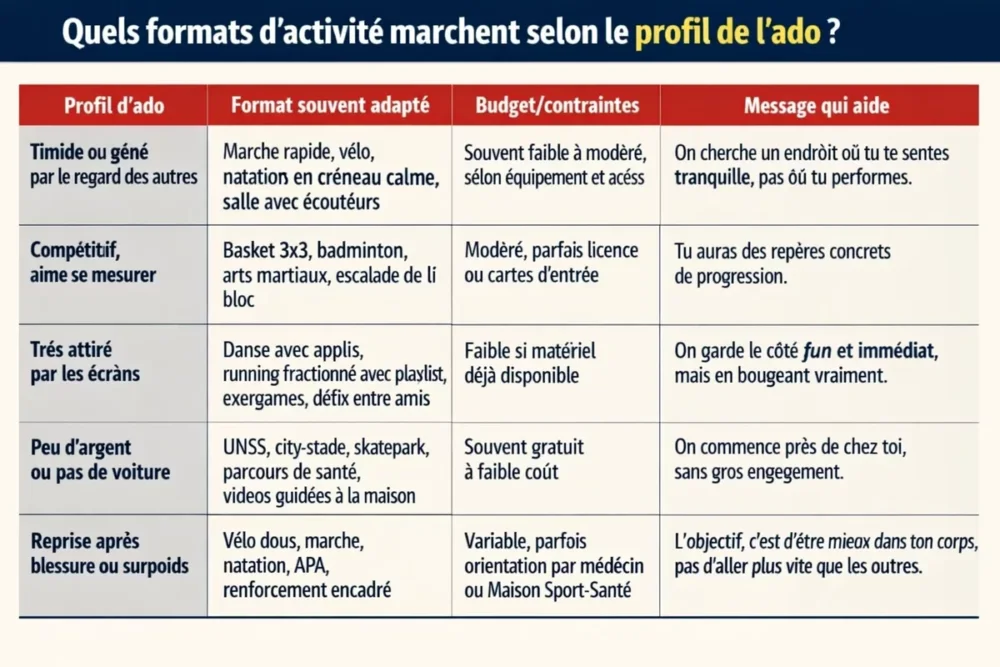
| Teen Profile | Often Suitable Format | Budget/Constraints | Helpful Message |
|---|---|---|---|
| Shy or embarrassed by others’ gaze | Brisk walking, cycling, swimming in quiet slots, gym with headphones | Often low to moderate, depending on equipment and access | “We’re looking for a place where you feel comfortable, not where you perform.” |
| Competitive, likes to measure themselves | 3×3 basketball, badminton, martial arts, bouldering | Moderate, sometimes license or entry cards | “You will have concrete markers of progress.” |
| Very attracted to screens | Dance with apps, interval running with playlist, exergames, challenges among friends | Low if equipment already available | “We keep the fun and immediate aspect, but by really moving.” |
| Little money or no car | UNSS, city stadium, skatepark, fitness trail, guided videos at home | Often free to low cost | “We start near your home, without major commitment.” |
| Resuming after injury or overweight | Gentle cycling, walking, swimming, adapted physical activity, supervised strengthening | Variable, sometimes guided by doctor or Sport-Health House | “The goal is to feel better in your body, not to go faster than others.” |
In France, entry points exist outside the traditional club: the UNSS in many middle and high schools, the Sport-Health Houses for adapted resumption, city stadiums, skateparks, or fields with free access. In Lyon as in Bordeaux, it is clear that flexible formats — 3×3 basketball, skateboarding, running along the quay, sessions with friends — attract young people who would never have signed up for a full season in September.

On the ground, an activity officer observes that many “non-sporty” teens agree to move as soon as three barriers are removed: annual commitment, imposed level, and group judgment. A family also reports that a simple Saturday bike meeting held up better over time than a club chosen too quickly in September.
How to manage screens without conflict at home?
The most effective approach is not to directly oppose screens and physical activity, but to organize their coexistence. We reduce screen time that eats into sleep and use digital tools as support: music, simple tracking, challenges among friends, short guided videos.
Completely banning screens rarely works for long. However, setting clearer times can really change the game: no screens just before leaving for an activity, gradual cut-off in the evening, and recreational screen time that does not encroach on sleep or already scheduled slots. The idea is not to moralize, but to reduce the direct competition between immediate gratification and an effort that requires a start.
In practice, teenagers accept the rule better when it is clear and symmetrical. If the whole family puts down their phones during dinner, if the adults themselves move a bit, if walking to school or the bus stop is valued, the message becomes credible. Conversely, asking a teen to disconnect when the whole environment remains sedentary often means forcing motivation.
- Turn the screen into an ally: special outing playlist, simple pedometer app, family step challenge, 8-minute warm-up video.
- Preserve sleep: charging the phone outside the bedroom or at least away from the bed can already reduce prolonged bedtimes.
- Create a transition: 10 minutes to change clothes, take a water bottle, start the music, then leave without renegotiating.
- Value active travel: walking, non-electric scooter, bike, stairs. Not everything has to go through a club.
If your teenager already spends a lot of time on phones, tablets, or consoles, the right reflex is often to look for an activity that resembles their attention habits: short, fun, social, progressive. This is exactly why dance videos, ping-pong, casual basketball, skateboarding, or mini home sessions sometimes hold up better than a long and very supervised training.
A simple 7-day plan to rekindle lasting motivation
To create a lasting desire, the first week must be ridiculously doable. No question of aiming for a big reset. The right approach is to put movement back on the agenda with minimal load and an acceptable feeling. If you are looking for other ways to motivate teenagers to exercise, keep this rule in mind: the pleasure felt in the first 10 minutes counts more than the ideal program on paper.
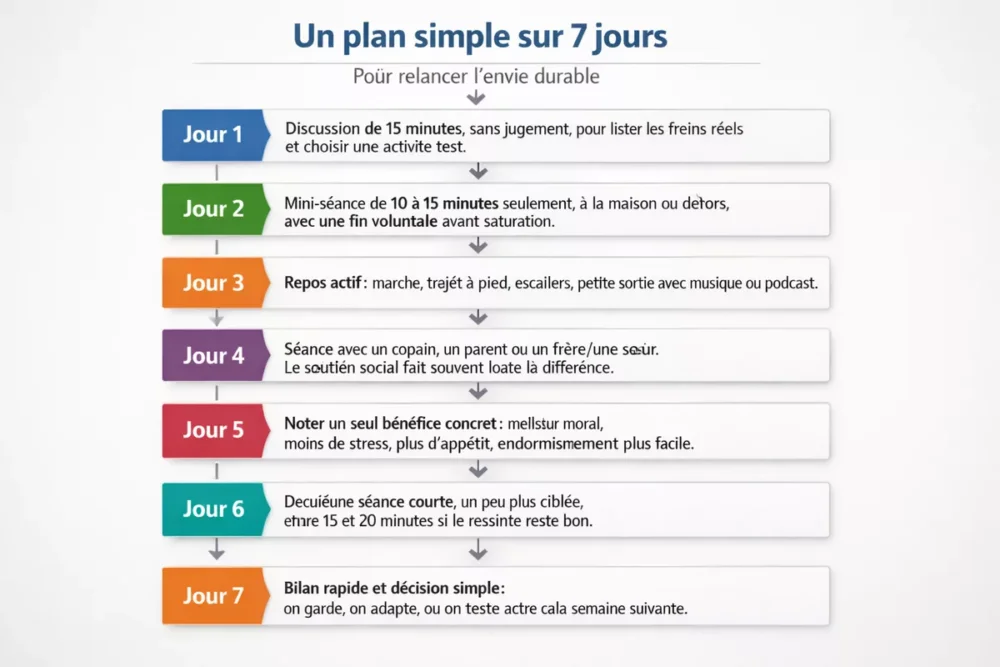
- Day 1: 15-minute discussion, without judgment, to list real obstacles and choose a test activity.
- Day 2: mini-session of only 10 to 15 minutes, at home or outside, ending deliberately before saturation.
- Day 3: active rest: walking, walking commute, stairs, short outing with music or podcast.
- Day 4: session with a friend, a parent, or a sibling. Social support often makes all the difference.
- Day 5: note one concrete benefit: better mood, less stress, more appetite, easier falling asleep.
- Day 6: second short session, a bit more targeted, between 15 and 20 minutes if the feeling remains good.
- Day 7: quick review and simple decision: keep it, adapt it, or try something else the following week.
This plan seems modest, and that is precisely its strength. A demotivated teenager does not need to be convinced by a big speech, but to experience that they can move without suffering socially or mentally. The repetition of small successes rebuilds confidence. Only then can duration be increased, a club explored, or a real weekly rhythm established.
Motivation-breaking mistakes, and when to adapt
Motivation quickly drops when adults confuse support with control. Comparing to a sibling, commenting on weight, promising rapid physical results, or imposing a sport “because it’s good” kills momentum. The same goes for choosing an unrealistic time slot, too late in the evening, too far from home, or incompatible with school workload. A good activity plan is first and foremost a sustainable plan.
- Mistake #1: talking about the body before talking about feelings.
- Mistake #2: confusing sport with performance, when moving can also mean walking, dancing, or cycling.
- Mistake #3: starting an annual subscription before confirming genuine enjoyment.
- Mistake #4: forgetting the fatigue-screens-sleep trio, which sabotages regularity.
- Mistake #5: considering quitting as a failure, when it often signals a bad format.
Some cases also require clear adaptation. If the teen experiences pain when moving, complains of unusual breathlessness, avoids any activity due to severe bodily discomfort, or goes through a marked period of malaise, it is better to rely on the primary care physician, school nurse, a trained educator, or a structure like a Sport-Health House. For overweight, injured, or very anxious adolescents, the right strategy is gradual, reassuring, and often non-competitive at the start.
The key point, ultimately, is not to win against screens. It is to restore movement to a credible, feasible, and sufficiently enjoyable place so that a teen wants to come back the following week. And yes, that can be built.
To remember
🎯 Motivation returns more through pleasure and autonomy than through pressure.
📱 Directly opposing screens and physical activity works less well than organizing their coexistence.
🧩 The right sport is mainly the right format for the right teen profile.
⏱️ Starting short and regular is better than a big program impossible to maintain.
🤝 Micro-victories, social support, and sleep create lasting desire.
FAQ
My teen says they hate sports: should I insist?
It is especially important to dig into what they really hate. Often, it is not the movement itself, but competition, others’ gaze, boredom, or a bad memory of a poorly chosen activity. Start with a short, free, and commitment-free format, then observe the reaction over two weeks.

Is it bad if the activity is limited to walking or utility cycling?
No, that is already a very good base. The WHO reminds that an average of 60 minutes of daily activity is recommended for 5-17 year olds, and active commuting can count towards this total. For a very sedentary teen, walking every day is often the best entry point.

What to do if I have neither budget nor car for a club?
First, look at the local options: UNSS, city stadium, skatepark, fitness trail, municipal gymnasium, cycling, guided videos at home. In France, many solutions cost little or nothing, whereas a club often costs between €120 and €350 per year, not including equipment sometimes.

When should one worry about fatigue or a total refusal to move?
If the fatigue is persistent, if the teen complains of pain, unusual shortness of breath, or avoids any activity due to significant discomfort, a medical opinion is useful. Refusal to move can sometimes be related to sleep, anxiety, an injury, or distress about body image.
Are active video games or fitness apps really useful?
Yes, if they serve as a stepping stone and not as a gadget. A guided 12-minute session, a step challenge, or a dance game can help a teenager move from passive screen time to real movement. It is not always sufficient in the long term, but it is often a very good start.