.en-bref { max-width: 640px; margin: 2em auto; padding: 1.5em 1.8em; color: #3a2d0d; font-family: “Inter”, “Segoe UI”, sans-serif; text-align: left; position: relative; box-sizing: border-box; background: #f7f9f9; border: 1px solid #10b58b; border-left: 6px solid #10b58b; border-radius: 12px; box-shadow: 0 8px 24px rgba(251, 191, 36, 0.15); }
.en-bref h2, .en-bref .en-bref-header { font-size: 1.15em; font-weight: 700; margin-bottom: 0.6em; color: #d97706; }
.en-bref p, .en-bref li { font-size: 1em; line-height: 1.65; margin: 10px; }
.en-bref strong { color: #1c1917; }
.key-takeaways { max-width: 640px; margin: 2em auto; padding: 1.5em 1.8em; color: #3a2d0d; font-family: “Inter”, “Segoe UI”, sans-serif; text-align: left; position: relative; box-sizing: border-box; background: #f7f9f9; border: 1px solid #10b58b; border-left: 6px solid #10b58b; border-radius: 12px; box-shadow: 0 8px 24px rgba(251, 191, 36, 0.15); }
.key-takeaways h2, .key-takeaways .key-takeaways-header { font-size: 1.15em; font-weight: 700; margin-bottom: 0.6em; color: #d97706; }
.key-takeaways p, .key-takeaways li { font-size: 1em; line-height: 1.65; margin: 10px; }
.key-takeaways strong { color: #1c1917; }
.key-takeaways ul { list-style: none; padding-left: 0; }
.key-takeaways li { margin: 0.45em 0; padding-left: 0.2em; }
.magic-pdf-download{margin:2em 0;padding:1.25em 1.5em;border:1px solid #e3e6ea;border-left:4px solid #0ea5e9;border-radius:10px;background:#f8fafc;display:flex;align-items:center;gap:1.2em;flex-wrap:wrap}.magic-pdf-download .mpd-txt{flex:1;min-width:220px}.magic-pdf-download .mpd-txt strong{display:block;font-size:1.05em;color:#0f172a;margin-bottom:.15em}.magic-pdf-download .mpd-txt span{color:#64748b;font-size:.92em}.magic-pdf-download a.mpd-btn{display:inline-block;background:#0ea5e9;color:#fff;text-decoration:none;padding:.7em 1.5em;border-radius:8px;font-weight:600;white-space:nowrap}.magic-pdf-download a.mpd-btn:hover{background:#0284c7}
.magic-lb-overlay{position:fixed;inset:0;background:rgba(15,23,42,.92);display:none;align-items:center;justify-content:center;z-index:99999;cursor:zoom-out;padding:20px}
.magic-lb-overlay.open{display:flex}
.magic-lb-overlay img{max-width:95vw;max-height:95vh;object-fit:contain;border-radius:8px;box-shadow:0 8px 32px rgba(0,0,0,.5)}
.magic-lb-close{position:absolute;top:16px;right:20px;color:#fff;background:rgba(0,0,0,.5);border:none;width:40px;height:40px;border-radius:50%;font-size:24px;cursor:pointer;display:flex;align-items:center;justify-content:center}
.magic-lb-close:hover{background:rgba(0,0,0,.8)}
.wp-block-image img{cursor:zoom-in;transition:transform .15s ease}
.wp-block-image img:hover{transform:scale(1.01)}
.magic-img-link{display:inline-block;text-decoration:none}
(function(){
var ov=document.getElementById(‘magic-lb’);if(!ov)return;
var img=ov.querySelector(‘img’),btn=ov.querySelector(‘.magic-lb-close’);
function open(src){img.src=src;ov.classList.add(‘open’);document.body.style.overflow=’hidden’}
function close(){ov.classList.remove(‘open’);img.src=”;document.body.style.overflow=”}
document.addEventListener(‘click’,function(e){
var a=e.target.closest(‘a.magic-img-link’);
if(a){e.preventDefault();open(a.getAttribute(‘href’));return}
var i=e.target.closest(‘.wp-block-image img’);
if(i&&!e.target.closest(‘a’)){e.preventDefault();open(i.currentSrc||i.src)}
});
ov.addEventListener(‘click’,function(e){if(e.target===ov||e.target===btn)close()});
document.addEventListener(‘keydown’,function(e){if(e.key===’Escape’)close()});
})();
Alternative Marketing 2026: Which Strategies to Choose to Stand Out Without a Big Budget?
Alternative marketing 2026 encompasses unconventional actions that aim less to buy reach and more to create useful attention: recommendation, community, experience, proximity, and sharper content. For a small organization, the right question is not “how to get people talking about me?” but “which lever can produce a memorable signal with a controlled budget?”
The topic matters because attention is more expensive, audiences are more selective, and classic formats quickly saturate. This article helps choose between community, partnerships, word-of-mouth, experiential marketing, and content creativity, then test an idea on a small scale without confusing surprise effect with real results.
In Brief
🧭 Alternative marketing 2026 works when it solves a real visibility problem: locally, in a niche, or within a community. It loses strength as soon as it copies a classic advertisement with a more original setting.
🤝 The most robust levers remain recommendation, smart partnership, and lived experience. They often cost less than repeated media buying but require more precision in execution.
📍 A short, clear, and measurable action is better than a spectacular idea impossible to follow up. Without indicators, buzz can mask a weak result.
🧪 The right trade-off in 2026 is to test small, measure quickly, and amplify only what proves its value. The rest must be discarded, even if it seems creative on paper.
Understanding Alternative Marketing in 2026
Alternative marketing is a visibility approach that breaks dominant codes to create difference, memorability, and sharing. The detailed definition of alternative marketing remains useful, but the real question in 2026 is simpler: which device can still capture attention without wasting the budget?
Alternative marketing becomes relevant when the brand must exist with few resources, in a local area, in a niche, or facing an audience wary of overly smooth messages. The useful difference does not come from the “original” side of the idea, but from its ability to trigger a measurable reaction.
Alternative marketing does not replace distribution. It makes it more visible, more memorable, and more shareable.
Simple Definition and Difference with Classic Approaches
Alternative marketing is not limited to street marketing or guerrilla marketing. It encompasses all tactics that seek attention differently: direct relationship, co-creation, light event, recommendation, social proof, brand experience, or content designed to circulate without a heavy budget.
Classic approaches mainly buy reach. Alternative marketing often seeks a finer combination: a better-chosen audience, a stronger message, and a more reasonable contact cost if the execution holds up.
Contexts Where It Becomes Particularly Relevant
Alternative marketing in 2026 gains value when the brand must stand out from a noisy market, launch a new offer, or create initial word-of-mouth. It also becomes useful when paid advertising costs more than the available margin, or when the target responds better to proximity than repetition.
A small organization especially benefits when it can rely on a place, a community, a partner, or a simple recommendation mechanism. In these cases, the strength of the device comes less from volume than from precision.
How to Choose the Right Strategy According to Your Objective?
The right choice depends first on the main objective and where you can reach your audience. For awareness, look for a visible and shareable mechanism; for prospects, favor an action that captures a useful contact; for loyalty, bet on a repeated relationship and concrete proof of value.
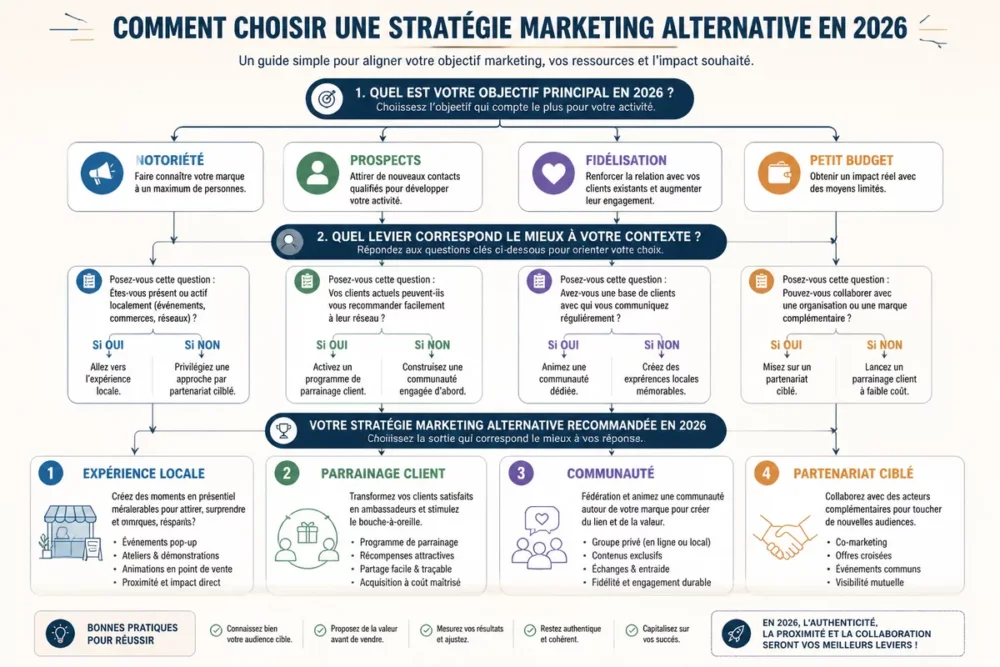
The right test is to link the idea to a single promise, a single relay channel, and a clear indicator. Without this trio, the campaign becomes difficult to understand, even if it attracts visible reactions.
- Local awareness: a visible, filmable, and easy-to-share action.
- Prospects: a mechanism that collects a contact or a registration.
- Loyalty: a repeated, useful, and recognized experience.
- Small budget: a simple, reusable format that is not very dependent on a large team.
The main 2026 marketing strategies to prioritize
In 2026, the levers that best resist saturation are those that combine utility, proximity, and social proof. The following five families do not work because they are “creative,” but because they encourage a real person to talk, share, or return.
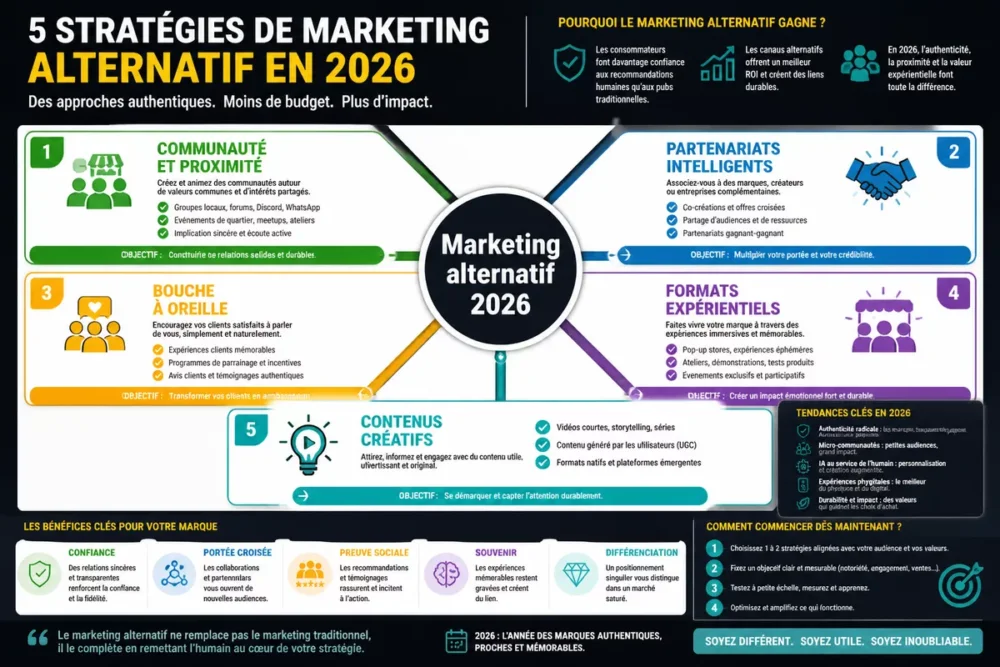
Bet on community and proximity
A community is not built with a logo on a page. It is built with a useful frequency: appointments, quick responses, helpful content, client circle, workshop, local group, or exchange space.
The right sign is not the number of followers, but the proportion of people who return without a new campaign. When the relationship exists, the brand spends less to be remembered.
Develop smart partnerships
An effective partnership connects two audiences that already have a reason to cross paths: neighboring business, complementary brand, cultural venue, association, local creator, or credible supplier. The goal is not to multiply logos, but to pool an already qualified audience.
The best agreements are simple to execute: cross-offer, co-signed content, joint event, or relay in an existing contact base. The shorter the mechanism, the more likely it is to be truly activated.
Activate word-of-mouth and recommendation
Word-of-mouth remains one of the most effective levers when the brand offers a clear and easy-to-tell experience. A referral mechanism, a clear reward, or a well-defined customer benefit turns isolated satisfaction into more regular acquisition.
The most common weak point is complexity. If the recommendation requires three steps, a long registration, or an obscure rule, the majority of customers do not pass it on.
Use experiential formats
Experiential marketing works when the person experiences something, not just when they look at a visual. Demonstration, micro-event, workshop, product test, pop-up, or local activation can create a stronger memory than repeated advertising.
This lever requires greater vigilance regarding authorization, safety, image rights, and logistics. When in doubt, check with the town hall, the property owner, the CNIL if data is collected, and the platform rules if the scene is filmed.
Harnessing Creativity in Content
Useful creativity is not about making things “pretty.” It is about producing a format that is quickly understood, easily shared, and strengthens brand differentiation: short series, before/after contrast, mini-case studies, behind the scenes, customer reactions, or participatory formats.
To extend this effect in terms of acquisition and lasting visibility, also see our complementary digital strategies. The right alternative content does not replace the digital strategy: it gives it a livelier and more distinctive angle.
Alternative Marketing, Paid Advertising, or Organic Content?
Alternative marketing is used to create a spike in attention and memorization, paid advertising is used to buy reach, and organic content is used to build credibility over time. A small business often benefits from combining all three, but with a clear role for each.
| Option | What it brings | Its limitation | When to choose it |
|---|---|---|---|
| Alternative marketing | Strong attention, memorization, differentiation | Requires a clear idea and clean execution | Launch, local visibility, saturated market |
| Paid advertising | Speed, targeting, scaling volume | Costs rise quickly if the offer or page is weak | Need for quick traffic or short test |
| Organic content | Credibility, longevity, cumulative effect | Slower results | Building expertise, SEO, reassurance |
For a small brand, the best trade-off often consists of doing a short alternative action, then extending it with content and a bit of paid promotion. The spectacular lever without follow-up rarely produces a lasting asset.
How to Set Up a Test Without a Big Budget?
A test without a big budget starts with a simple hypothesis, a single format, and a predefined measurement. The goal is not to do everything, but to check if a mechanism creates enough interest, contacts, or sales to justify a broader rollout.
- Set a single objective. Choose awareness, leads, or loyalty, not all three at once. A test that is too broad quickly becomes impossible to interpret.
- Limit the scope. Work on a single location, audience, or offer to isolate the effect of the action.
- Plan the follow-up. Add a dedicated page, a code, a form, a registration, or a simple contact point.
- Check feasibility. Measure the need for human time, production, authorizations, and distribution before launching.
- Measure useful signals. Track incoming requests, visits, shares, codes used, and attributed sales.
Indicative example: a local operation with €500 production, €200 materials, and €200 distribution already represents €900 excluding internal time. If the action must support a profitable activity, cross-check it with the break-even calculation to know how many sales or leads must offset the test.
- Incoming requests: direct conversion signal.
- Traffic on dedicated page: curiosity and relay signal.
- Codes used: clearer signal than a simple like.
- Mentions or shares: organic reach signal.
- Attributed sales: final signal, to be related to actual cost.
What Mistakes to Avoid in Alternative Marketing?
The most costly mistakes rarely come from the idea itself. They come from a poorly framed format, a forgotten authorization, absent digital relay, or too weak measurement to know if the action really served the brand.
Without authorization, without measurement, and without relay, a spectacular operation remains a one-off expense.
- Confusing surprise with usefulness. An idea can catch the eye without helping the brand. Fix this by linking each action to a specific objective.
- Neglecting compliance. An activation in public space, data collection, or image broadcasting may require checks. Verify with the town hall, CNIL, ARPP, and the venue’s rules.
- Forgetting the follow-up. A good scene without content, a dedicated page, or follow-up quickly loses its value. Prepare the next steps before the big day.
- Multiplying mechanics. A brand testing five ideas at once no longer knows what works. Start with a single hypothesis.
- Measuring only engagement. Views and reactions are useful, but not enough. Add at least one indicator of contact, traffic, or sales.
Examples of concrete alternative marketing actions
Alternative marketing yields better results when the action remains simple to explain and easy to repeat. A small business often gains more with a clear mechanic than with a sophisticated concept it cannot sustain over time.
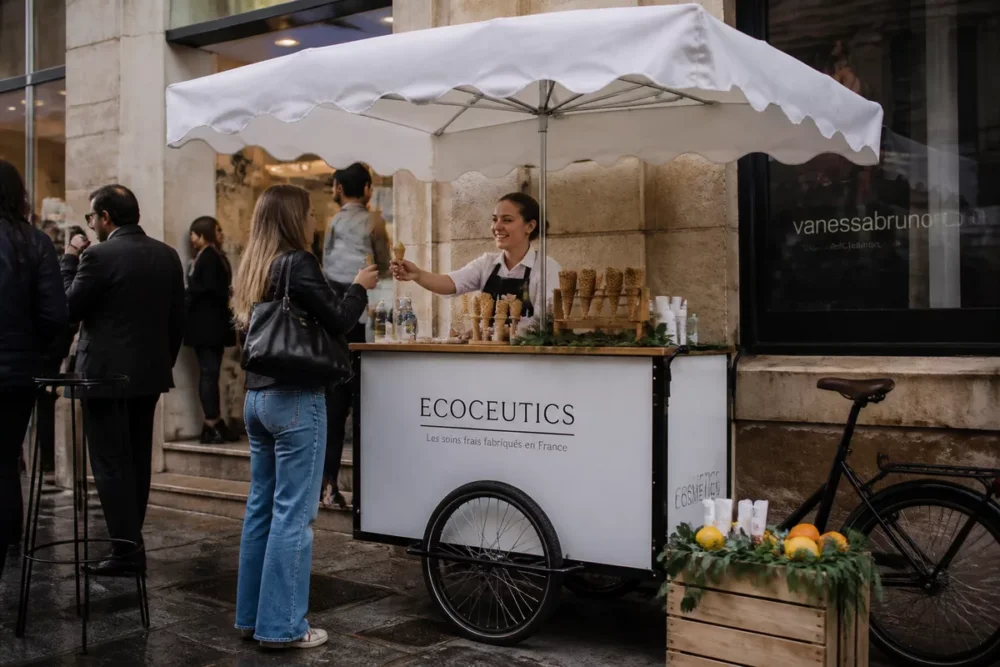
Ideas suited to a small business
A small business can start with short, local, and repeatable actions. The right angle is often one that creates a direct exchange with existing customers or the immediate neighborhood.
- Mini discovery workshop: let people try a product or service in a short format.
- Simple referral card: a clear reward, a short rule, easy tracking.
- Participative window display: ask for a customer vote or photo contribution.
- Neighborhood partnership: cross the audience of a complementary business.
- Customer return offer: reward already acquired customers with a concrete benefit.
Ideas suited to an online brand
An online brand benefits from creating formats that share well without relying solely on advertising. The most useful mechanics are those that produce reusable content, social proof, or easy-to-share interaction.
- Community challenge: have customers produce content around a specific use.
- Behind-the-scenes series: show the making, selection, or sorting of a product.
- Micro-creator collaboration: work with a smaller, but more engaged audience.
- Filmmable welcome pack: turn unboxing into useful content, not just packaging.
- Contrast content: show a common mistake, then the correct practice.
Key takeaways
- 🎯 Choose the lever based on the measurable objective, not on the trend.
- 🤝 Partnerships and recommendations reduce attention costs.
- 📍 Local formats work when distribution is simple and authorized.
- 📈 Measure traffic, leads, usage, and shares, not just views.
- 🧪 Test small, then only amplify mechanics that prove their usefulness.
Frequently asked questions about alternative marketing
Is alternative marketing reserved for small brands?
No. Small brands often use it because they need to optimize every euro, but a larger company can also use it to test a message, create a local activation, or revive brand differentiation. The logic remains the same: produce attention more useful than simple advertising repetition.
What budget should be planned to start?
The budget depends on the format, location, and production level. An action can remain light if it relies on a partnership, simple content, or a recommendation mechanic, but the real cost also includes human time, materials, and distribution.
How to measure return on investment?
Return on investment is measured by linking the total cost to useful results: sales, leads, registrations, qualified traffic, codes used, or repurchases. Views and likes can complement the analysis, but they are not sufficient to judge the effectiveness of a system.
Which strategies yield the fastest results?
Partnerships, recommendations, and certain local activations often produce quicker effects because they rely on an already existing audience. Organic content and the community can be more powerful in the medium term, but their growth is more gradual.
Can it be integrated into a classic digital strategy?
Yes, and it is often the best option. Alternative marketing can create the entry point, then digital takes over with a dedicated page, content, emailing, or more precise tracking of conversions. The idea is not to oppose the levers, but to give them a clear role.