.en-bref { max-width: auto; margin: 2em auto; padding: 1.5em 1.8em; color: #78350f; font-family: “Inter”, “Segoe UI”, sans-serif; text-align: left; position: relative; box-sizing: border-box; background: #fff2d7; border: 0; border-left: 0px solid #b45309; border-radius: 0; box-shadow: none; }
.en-bref h2, .en-bref .en-bref-header { font-size: 1.15em; font-weight: 700; margin-bottom: 0.6em; color: #b45309; }
.en-bref p, .en-bref li { font-size: 1em; line-height: 1.65; margin: 10px; }
.en-bref strong { color: #451a03; }
.mg-callout{margin:1.5em 0;padding:.9em 1.1em;border:1px solid;border-left-width:4px;border-radius:10px;font-size:.97em;line-height:1.65}.mg-callout>:first-child{margin-top:0}.mg-callout>:last-child{margin-bottom:0}.mg-callout__label{display:block;margin:0 0 .35em;font-weight:700;font-size:.82em;letter-spacing:.03em;text-transform:uppercase}.mg-callout__label::before{margin-right:.45em;font-size:1.05em;vertical-align:-.06em}.mg-callout–info{background:#eff6ff;border-color:#bfdbfe;color:#1e3a5f}.mg-callout–info .mg-callout__label{color:#2563eb}.mg-callout–info .mg-callout__label::before{content:”\2139\FE0F”}.mg-callout–tip{background:#f0fdf4;border-color:#bbf7d0;color:#14532d}.mg-callout–tip .mg-callout__label{color:#15803d}.mg-callout–tip .mg-callout__label::before{content:”\1F4A1″}.mg-callout–warning{background:#fffbeb;border-color:#fde68a;color:#7a4a10}.mg-callout–warning .mg-callout__label{color:#b45309}.mg-callout–warning .mg-callout__label::before{content:”\26A0\FE0F”}.mg-callout–danger{background:#fef2f2;border-color:#fecaca;color:#7f1d1d}.mg-callout–danger .mg-callout__label{color:#dc2626}.mg-callout–danger .mg-callout__label::before{content:”\1F6D1″}.mg-proscons{display:grid;grid-template-columns:1fr 1fr;gap:16px;margin:1.5em 0}@media(max-width:560px){.mg-proscons{grid-template-columns:1fr}}.mg-proscons__col{padding:.9em 1.1em;border:1px solid;border-radius:10px}.mg-proscons__title{display:flex;align-items:center;gap:.4em;margin:0 0 .5em;font-weight:700;font-size:.9em;letter-spacing:.02em}.mg-proscons__col ul{margin:.3em 0 0;padding-left:1.15em}.mg-proscons__col li{margin:.3em 0;line-height:1.55}.mg-proscons__col–pro{background:#f0fdf4;border-color:#bbf7d0;color:#14532d}.mg-proscons__col–pro .mg-proscons__title{color:#15803d}.mg-proscons__col–pro .mg-proscons__title::before{content:”\2705″}.mg-proscons__col–con{background:#fef2f2;border-color:#fecaca;color:#7f1d1d}.mg-proscons__col–con .mg-proscons__title{color:#dc2626}.mg-proscons__col–con .mg-proscons__title::before{content:”\274C”}ol.mg-steps{list-style:none!important;counter-reset:mgstep;margin:1.6em 0;padding-left:0!important}ol.mg-steps>li.mg-steps__item{counter-increment:mgstep;list-style:none!important;padding-left:0!important;padding-bottom:1.4em}ol.mg-steps>li.mg-steps__item:last-child{padding-bottom:0}ol.mg-steps>li.mg-steps__item>:last-child{margin-bottom:0}ol.mg-steps>li.mg-steps__item>.mg-steps__title{margin:0 0 .25em;font-weight:600}ol.mg-steps>li.mg-steps__item>.mg-steps__title::before{content:counter(mgstep) “. “;opacity:.45;font-weight:500;font-variant-numeric:tabular-nums}ol.mg-steps>li.mg-steps__item:not(:has(.mg-steps__title))::before{content:counter(mgstep) “. “;opacity:.45;font-weight:500;font-variant-numeric:tabular-nums}.mg-kpis{display:grid;grid-template-columns:repeat(auto-fit,minmax(140px,1fr));gap:14px;margin:1.5em 0}.mg-kpi{padding:1em .9em;border:1px solid #e5e7eb;border-radius:12px;background:#f9fafb;text-align:center}.mg-kpi__value{display:block;font-size:1.7em;font-weight:800;line-height:1.15;color:#111827}.mg-kpi__label{display:block;margin-top:.35em;font-size:.85em;color:#6b7280;line-height:1.35}
.wp-block-image,.ai-image{margin-bottom:1.75em}.wp-block-image>figcaption,.ai-image>figcaption{margin-top:.5em}
.magic-lb-overlay{position:fixed;inset:0;background:rgba(15,23,42,.92);display:none;align-items:center;justify-content:center;z-index:99999;cursor:zoom-out;padding:20px}
.magic-lb-overlay.open{display:flex}
.magic-lb-overlay img{max-width:95vw;max-height:95vh;object-fit:contain;border-radius:8px;box-shadow:0 8px 32px rgba(0,0,0,.5)}
.magic-lb-close{position:absolute;top:16px;right:20px;color:#fff;background:rgba(0,0,0,.5);border:none;width:40px;height:40px;border-radius:50%;font-size:24px;cursor:pointer;display:flex;align-items:center;justify-content:center}
.magic-lb-close:hover{background:rgba(0,0,0,.8)}
.wp-block-image img{cursor:zoom-in;transition:transform .15s ease}
.wp-block-image img:hover{transform:scale(1.01)}
.magic-img-link{display:inline-block;text-decoration:none}
(function(){
var ov=document.getElementById(‘magic-lb’);if(!ov)return;
var img=ov.querySelector(‘img’),btn=ov.querySelector(‘.magic-lb-close’);
function open(src){img.src=src;ov.classList.add(‘open’);document.body.style.overflow=’hidden’}
function close(){ov.classList.remove(‘open’);img.src=”;document.body.style.overflow=”}
document.addEventListener(‘click’,function(e){
var a=e.target.closest(‘a.magic-img-link’);
if(a){e.preventDefault();open(a.getAttribute(‘href’));return}
var i=e.target.closest(‘.wp-block-image img’);
if(i&&!e.target.closest(‘a’)){e.preventDefault();open(i.currentSrc||i.src)}
});
ov.addEventListener(‘click’,function(e){if(e.target===ov||e.target===btn)close()});
document.addEventListener(‘keydown’,function(e){if(e.key===’Escape’)close()});
})();
A page without SEO traffic should not be automatically deleted. You must first check its impressions, queries, indexing, conversions, links, and usefulness for the user journey. Depending on the diagnosis, the right action will be to improve it, merge it, redirect it, delete it, or keep it.
A page may receive no clicks while appearing on Google, supporting internal linking or generating an indirect conversion. Conversely, a URL indexed for a long time may remain without identifiable demand, address an outdated topic, or duplicate another page. The decision therefore relies on several signals, observed over a period consistent with seasonality and the site’s history.
In brief
🔎 A page without clicks is not necessarily useless: distinguish between the absence of impressions, low result attractiveness, and lack of demand.
🧭 Improve a page that has a clear intent or useful signals, and merge two competing contents when they meet the same need.
🗑️ Delete a page only after checking its links, conversions, backlinks, history, and the absence of a relevant equivalent.
📊 Measure before and after the action in Google Search Console, your analytics tool, and your business tracking.
Short answer: traffic alone is not enough to decide
A page without SEO traffic is a URL that receives few or no visits from search engines during the studied period. The low number of clicks is a diagnostic signal, not proof of uselessness. A page may respond to a rare search, convert directly, pass internal links, or serve as a campaign support.
Four decisions are possible: keep and observe, improve, merge then redirect, or delete. The decision must cross visibility, relevance, commercial value, and technical dependencies. A page without organic visits may also receive direct, referral, social, or shared link traffic.
A legal page, a confirmation page, a page intended for existing clients, or a support page does not necessarily aim to attract visitors from Google. Its lack of SEO traffic is therefore not a fault if its main function lies elsewhere.
The threshold of fewer than 10 monthly clicks is sometimes used as an editorial benchmark, but it is not a universal rule. A local site, technical documentation, and a national catalog are not judged by the same scale. Analyze several months when the volume is low, taking into account seasonality and publication date.
Diagnosing why a page receives no traffic
A page without traffic may be invisible, visible but unattractive, poorly aligned with demand, or replaced by another URL. Google Search Console is used to examine impressions, clicks, queries, and positions. A tool like Google Analytics 4 or Matomo complements this reading with sessions, journeys, and conversions.
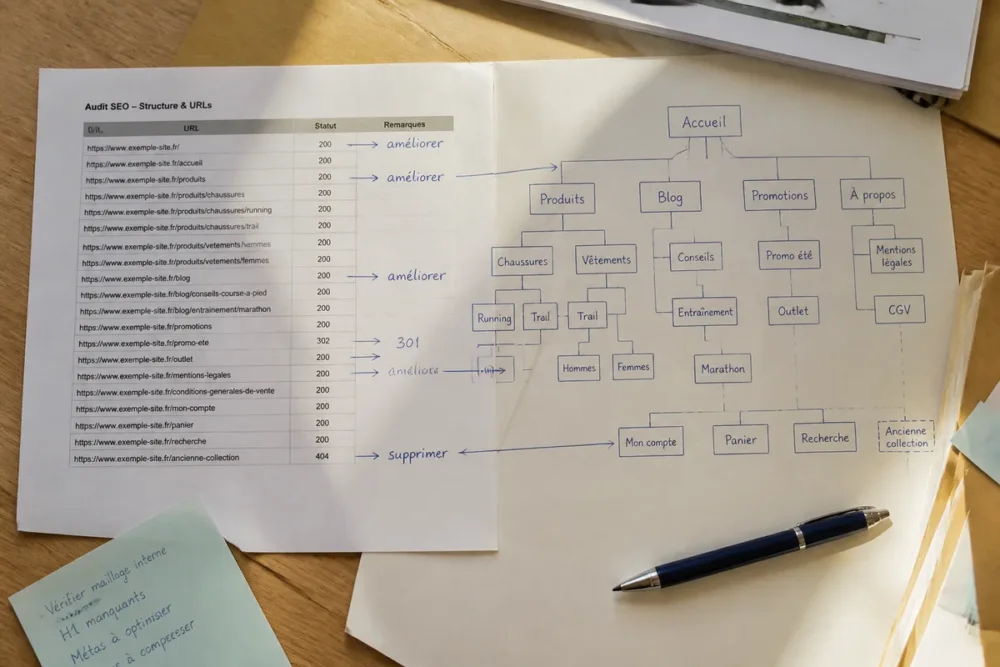
The page is absent from results: indexing, accessibility, and internal linking
A page without impressions is not equivalent to a page with impressions but zero clicks. In the first case, start by checking the effective indexing in Google Search Console, the possible presence of a noindex tag, the directives of the robots.txt file, the HTTP status, and crawl errors.
An indexed page but absent from queries can also be orphaned. An orphan URL receives no usable internal links from the accessible pages of the site. Check its depth, links from strategic content, menus, categories, and any URL changes.
The canonical tag deserves a separate check. A canonical pointing to another URL tells search engines which version should be prioritized, while a redirect, a server error, or a blocked page can prevent access to the content. Google describes the different methods of consolidating duplicate URLs. To delve deeper into this specific case, see this diagnosis of an indexed page missing from Google.
The page has impressions but no clicks: positioning and result promise
Impressions prove that Google displayed the URL for certain searches, not that the page correctly meets the intent. Analyze the associated queries, average position, SEO title, and displayed description. A page can be visible on searches that are too general, too competitive, or unrelated to its content.
A precise title is not enough if the page promises an answer that the content does not provide in the first paragraphs. Check the definition, price, procedure, comparison, or the response expected by the user. A poorly positioned page must be distinguished from a page whose snippet does not entice clicking.
The topic is rarely requested, seasonal, or covered by another page
A web page without traffic may target a rare or temporary demand. Compare the same months over several years when the activity is seasonal, then observe query variants in Search Console. A recently published page should also be separated from older content before drawing any conclusions.
Cannibalization appears when several URLs cover a similar intent. Compare their queries, positions, internal links, and conversions. If a single page already concentrates the useful signals, two competing contents can be merged rather than artificially maintained.
A site that does not rank for an important query may suffer from a broader problem than this single URL: confusing architecture, too weak content, technical defect, or lack of relevance. In this case, this diagnosis of a site absent from Google helps broaden the analysis without automatically attributing the cause to the inactive page.
Evaluate SEO, commercial, and editorial value before any intervention
A page without visits must be evaluated as an asset of the site, not as an isolated line in a report. Examine its direct and assisted conversions, backlinks, internal links received, its role in the journey, its freshness, uniqueness, and ability to meet an identifiable intent.
A page may have few sessions but assist a quote request, reassure before a purchase, or transmit internal authority to a strategic page. Analysis reports must therefore be linked to business objectives and conversion events, not just the number of visitors.
Signals that justify keeping or reworking a page
A page generally deserves editorial work when it has relevant impressions, consistent queries, inbound links, conversions, or a clear function in the linking structure. Obsolete but still useful content can be updated instead of deleted.
The potential must remain concrete. A page dedicated to a still searched process, but which poorly meets the intent, offers an exploitable base. A page that is too broad can be refocused on a main query, then enriched with questions actually observed in the data.
Natural referencing does not require purchasing pay-per-click advertising space, but it involves time, production, monitoring, and sometimes external skills. Maintaining a useless page therefore has a maintenance cost, but improving it without an identifiable request also has one.
Signals indicating a truly weak page
A page is harder to defend when it combines outdated content, shallow depth, duplication, lack of useful links, lack of conversion, and absence of a semantically close destination. None of these criteria should be interpreted alone, but their accumulation makes improvement less rational.
A page also becomes problematic when its information can no longer be properly verified or updated. An old price, a finished offer, or a replaced procedure can create a bad experience, even if the URL still receives some residual visits.
The belief that “a page without traffic necessarily degrades all referencing” is incomplete. The crawl budget, weak pages, and overall quality may warrant an audit on large sites, but no universal threshold allows a conclusion without examining the size, update frequency, and crawl logs.
Decision tree: improve, merge, redirect, delete, or wait
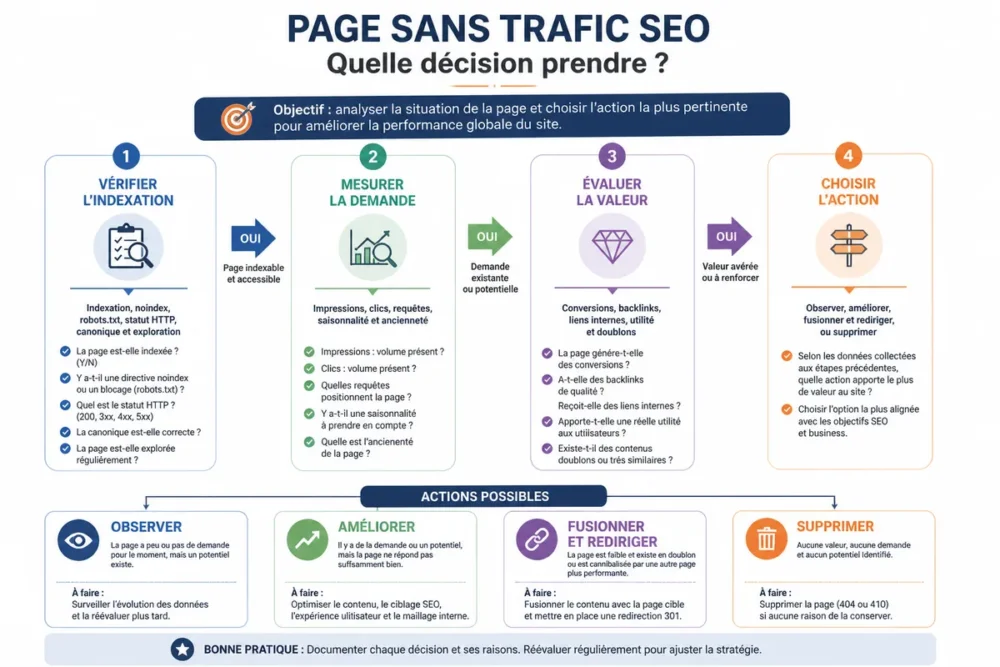
The decision starts with indexing, continues with demand, and ends with the real value of the page. A recent, seasonal, or insufficiently documented page should be kept temporarily. A duplicated page calls for consolidation, while a page without function or equivalent can be removed.
The following table avoids confusing situations that nevertheless produce the same symptom: zero visits.
| Observed signal | Probable diagnosis | Appropriate action | Control point |
|---|---|---|---|
| No impressions | Indexing, accessibility or request absent | Check the technique and relevance before acting | Inspection of URL, robots, noindex, canonical and linking |
| Impressions without clicks | Low position, inadequate query or unattractive snippet | Improve targeting and response | Queries, position, title and fit to intent |
| Two close pages | Cannibalization or scattered information | Merge then redirect the old URL | Choose a truly equivalent target |
| Obsolete page without equivalent | Resource that no longer serves a function | Properly delete with an HTTP response adapted to the context | Internal links, backlinks, paths and HTTP response |
| Temporary removal from results | The page must remain accessible without appearing in results | Implement a noindex if this choice matches the need | Page accessibility and consideration of the directive |
| Insufficient data | Recent, seasonal or little explored page | Keep and observe | Set a review date and indicators |
Improve if the topic and intent remain relevant
Choose improvement if the page has an identifiable demand, impressions, links, conversions or a useful place in the architecture. This option only makes sense if a better, clearer and more targeted response can actually be produced.
Merge and redirect if two pages respond to the same intent
Merging is suitable when two URLs compete for the same need and their information can be combined without losing a distinct intent. Keep the most coherent or strongest URL, consolidate the useful elements and redirect the old address to this precise destination.
A redirect to the homepage is not a merge. It does not replace a specialized response and can confuse the user. The target must address the need expressed by the old URL, with accessible and relevant content.
Delete if the page no longer has a reason to exist
Deletion is justified when the content is obsolete, useless, unverifiable, without lasting demand, without commercial value and without a relevant equivalent. Removing a web page should not serve to mechanically reduce the number of URLs on a site.
Before deleting, look for incoming links, references in menus, forms, campaigns, downloaded documents and important paths. A deleted page without verification can break a useful step even if Google did not bring it any visits.
How to improve a poorly positioned page without starting from scratch
Improving an inactive page starts with a main search intent. The content must quickly respond to this intent, then address useful secondary details. Update facts, clarify structure, add evidence and strengthen internal links before multiplying keywords.
-
Choose the intent
Analyze the queries that already generate impressions and define the main need: understand, compare, buy, solve, or carry out a procedure.
-
Correct the answer
Place the expected answer early on the page, remove digressions, and complete missing, outdated, or insufficiently sourced information.
-
Strengthen the structure
Rewrite the title, subtitles, section introductions, and internal links to make the journey understandable to readers and search engines.
-
Check the technical aspects
Verify accessibility, canonical tags, indexing, HTTP errors, speed, and mobile display. Core Web Vitals can complement this review, without replacing relevance analysis.
-
Reassess the data
Compare impressions, clicks, positions, sessions, and conversions after going live, with a period adapted to the age and seasonality of the page.
Refocus the page on a clear query and promise
A page that tries to answer five different intents often becomes vague on each. Select a main request from existing queries or a validated keyword research, then align the title, first screen, and subtitles with this request.
Long-tail keywords can reveal a more realistic opportunity than a very general query. Use them to specify the content, not to produce a series of artificial variants. Keyword stuffing techniques and guaranteed first position promises should be avoided.
Enhance perceived quality and discoverability
Add examples, sources, limitations, answers to objections, and practical information specific to the topic. A page about a procedure must specify the documents and steps; a commercial page must clarify the offer, conditions, and conversion path.
Insert contextual links from strong pages, but only when they truly help navigation. A content audit also benefits from checking broken links, navigation depth, and orphan pages. Technical performance can be examined with this guide on Core Web Vitals, keeping in mind that a fast site does not compensate for an off-intent answer.
Properly redirect or delete a page
A permanent redirect replaces one URL with another, while deletion removes the resource when no content should take over. Deindexing via noindex aims to prevent a page from appearing in results while possibly leaving it accessible. These actions are therefore not interchangeable: Google documents redirects, not found pages, and indexing blocking.
Choose a relevant permanent redirect
Use an HTTP 301 redirect when the replacement or merger is permanent. The destination must meet the same need with a comparable level of precision. Google recommends redirecting to a relevant destination in its documentation on 301 redirects. A 301 redirect alone does not guarantee an SEO result; it must be integrated into a coherent migration or consolidation.
After implementation, replace internal links that still point to the old URL. Check the HTTP status, the final destination, any loops, and important external links. A technical migration or URL change must be prepared separately; the no-downtime migration method covers a broader context than just deleting a page.
Managing a deletion without equivalent
When no page can take over the need, remove the content and correct internal links, navigation entries, and references in associated content. According to Google’s documentation on not found pages, 404 and 410 codes indicate that a resource is no longer available; the 410 code signals that the resource has been permanently deleted. Their handling nevertheless depends on crawling and context, without guaranteed automatic results in search engines.
The choice between 404 and 410 must be validated with the server’s technical documentation and the site’s architecture. Then monitor crawl errors, residual backlinks, user bookmarks, and paths that might still call the old address.
Measuring the effects of the decision in a content audit
An SEO decision must leave a trace: URL, diagnosis, action, date, possible target, and responsible party. The monitoring then compares visibility, behavior, and conversion data. No single timeframe suits all pages, as crawling, seasonality, site authority, and the extent of the change differ.
Google Search Console data allows tracking impressions, clicks, queries, and positions. Google Analytics 4 or Matomo add sessions, events, and conversions. Server logs, a crawling tool, and link reports complete the technical check.
Indicators to monitor according to the applied action
After an improvement, look for progress on targeted queries, but also examine session quality and conversions. After a merge, verify that the target page recovers the need without creating chains. After a deletion, check expected errors and the absence of impact on useful paths.
| Action | Main indicators | Additional control |
|---|---|---|
| Improve | Impressions, clicks, positions, sessions, conversions | Query relevance and response quality |
| Merge | 301 status, target traffic, queries, and conversions | Absence of chains and update of internal linking |
| Delete | 404 or 410, crawl errors, and residual traffic | Backlinks, navigation, and user paths |
| Observe | Impressions, clicks, indexing, and query evolution | Re-examination date adapted to seasonality |
Monitoring should not be triggered by an arbitrary traffic threshold. Compare a homogeneous period before and after the action, document other changes made on the site, and avoid automatically attributing an evolution to a single modification.
Checklist before and after an action on a page without traffic
- Check impressions, clicks, queries, and indexing.
- Verify direct and assisted conversions.
- Identify backlinks and internal links received.
- Examine internal linking, menus, and paths that use the URL.
- Determine if a truly relevant equivalent exists.
- Document the chosen action: improvement, merge, redirection, deletion, noindex, or observation.
- After deployment, check HTTP responses, possible destination, indexing, and monitored indicators.
Frequently asked questions about pages without traffic
The following answers cover the most common decisions when a page receives no organic visits. They do not replace examining the data of the concerned property nor validating a technical change on an active site.
Can we delete a page that has never received a click?
Yes, but only after checking its impressions, inbound links, conversions, its role in internal linking, and the existence of an equivalent. A page without clicks can still respond to a rare search or support a journey outside of search engines.
Is a page without traffic necessarily bad for SEO?
No. The absence of SEO traffic can come from low demand, a recent page, an indexing issue, or poor targeting. Traffic alone does not measure the editorial or commercial value of a URL.
Should a 301 redirect always be done after deleting a page?
No. A 301 redirect is relevant when another URL sustainably addresses the same need, especially after a merge. Without a close equivalent, an artificial redirect may degrade the experience; deletion can then be managed with an HTTP status code appropriate to the context. See Google’s documentation on 301 redirects and not found pages.
Can an old page be redirected to the homepage?
The homepage should not be used as a default destination. Redirect to a page that meets the same need, and do not set any redirect if no truly equivalent content exists.
How long should you wait after improving a page?
There is no universal timeframe valid for all sites. Set a review date based on the page’s age, seasonality, crawl frequency, and the extent of changes, then compare consistent periods.
What is the difference between de-indexing, deleting, and redirecting a page?
Noindex aims to prevent a page from appearing in results while potentially leaving its content accessible. Deleting removes the resource when it no longer serves a purpose; a 404 or 410 response then indicates it is no longer available. Redirecting with a 301 permanently sends the user and the engine to another URL, which must be relevant.
Useful sources to consult
Google Search Console: URL Inspection Tool allows you to check indexing, impressions, clicks, queries, and positions. Use these reports to distinguish a page without impressions from a visible but rarely clicked page.
Google Search Central documents robots.txt directives, noindex, canonical URLs, redirects, and 404 and 410 responses. Use this documentation to validate technical choices before deployment.
Google Analytics 4 or Matomo are used to link the URL to sessions, events, and conversions. Cross-reference this data with configured goals, as low traffic does not necessarily mean low commercial contribution.
Server logs and a crawling tool complement the audit by showing HTTP responses, crawling, broken links, and redirects. These checks are especially useful on large sites or after an architecture change.