ChatGPT Plus or Claude Pro: Choosing the Most Effective Tool to Write Faster in French
Choosing between ChatGPT Plus or Claude Pro seems simple on paper: two AI assistants, two subscriptions around $20 per month, two promises of productivity. Except that in French writing, the real issue is not just the speed of generation. It’s the time saved until the text is publishable: fewer revisions, fewer empty phrases, fewer back-and-forths to get the right tone.
That’s why the comparison deserves more than a marketing duel. One tool may respond faster but require more guidance. Another may seem more measured but produce a first draft that already holds better on a long article, a summary, or a delicate reformulation. In short: the best writing assistant is the one that truly reduces your editing time.
In Brief
⚡ ChatGPT Plus is very suitable for fast workflows: ideas, outlines, title variations, short posts, emails, successive reformulations, and content requiring multiple iterations.
✍️ Claude Pro often stands out for long-form writing in French: fluency, argumentative continuity, tone consistency, and a less mechanical feel to the text.
💸 Both individual subscriptions are generally priced around $20/month, according to the public pricing pages of OpenAI for ChatGPT and Anthropic for Claude. Price alone is therefore not enough to decide.
🔐 For professional use, confidentiality, handling of long documents, and prompt quality matter as much as the choice of tool. Good to know before pasting a complete client brief.
How to Choose Between ChatGPT Plus or Claude Pro to Write Faster?
To write faster in French, choose ChatGPT Plus if your priority is rapid iteration and versatility. Choose Claude Pro if you mainly produce long, nuanced, editorial texts. The right choice depends less on raw power than on the number of corrections needed before publication.
The classic trap is to confuse response speed with production speed. If an assistant delivers a paragraph in seconds but you then have to remove vague phrases, tighten the style, and check coherence, the real gain melts away like snow in the sun. Conversely, a slightly slower but more consistent tool can save time on the most tedious phase: editorial revision.
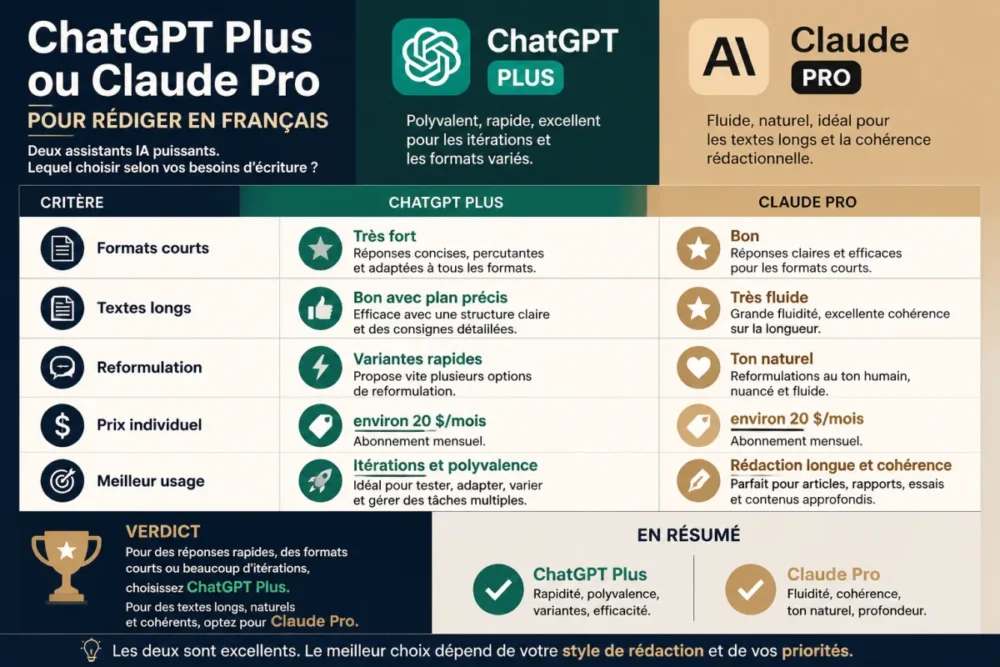
In a French writing workflow, we therefore compare five very concrete criteria: the first draft, French quality, brief adherence, reformulation flexibility, and reliability on professional texts. This is where the differences between ChatGPT Plus and Claude Pro become interesting.
What We Really Compare When Talking About Assisted Writing
For a useful ChatGPT Claude comparison, you have to start from real tasks. Not from a vague prompt like “write me an article.” In practice, a writer, consultant, or marketing manager rather requests a structured base, then refines: angle, tone, length, expertise level, examples, titles, reformulations, LinkedIn version, newsletter version, more direct version… In short, the AI assistant becomes a co-pilot, not a magic text machine.
- First draft: ability to quickly produce a usable base, without going off-topic or filler.
- Quality of French: natural phrasing, lexical precision, rhythm, absence of overly translated expressions.
- Respect for the brief: adherence to tone, structure, length, and target constraints.
- Rewriting: ability to improve a text without flattening it or losing the original intent.
- Professional reliability: caution with facts, clarity of limits, consistency from start to finish.
The best writing assistant is not the one who writes the fastest, but the one who leaves the least editorial waste behind.
Does ChatGPT Plus really speed up writing work?
ChatGPT Plus mainly speeds up the startup, ideation, and quick rewriting phases. It is very effective at generating multiple angles, transforming a text into different formats, and testing variants. However, a final text in French often requires precise management to avoid a generic tone.
ChatGPT, developed by OpenAI and launched at the end of 2022, has established itself as the most well-known consumer AI assistant. Its strength, in the context of writing in French, lies in its versatility. It can switch from an SEO plan to a commercial email, from a meeting summary to a warmer reformulation, then to a series of headlines. This agility is valuable when producing many short formats.

In practice, it is observed in the field that ChatGPT Plus is often very practical for “unblocking” a blank page. A writer can ask it for ten article angles, three introductions, a more direct version, then a detailed plan. This Swiss army knife aspect saves time, especially when the problem is not literary quality but starting and structuring.
It is observed in the field that marketing teams often use ChatGPT Plus as an iteration workshop: titles, hooks, social posts, email follow-ups, tone variants. The gain comes less from a perfect text on the first try than from the speed of exploring several options before choosing the right one.
Its strengths for writing faster
ChatGPT Plus shines when writing is done in short loops. You request a version, correct it, prompt again, compare. This logic works very well for content where clarity, structure, and speed of execution are first sought: product sheets, video scripts, LinkedIn posts, emails, customer responses, or web page drafts.
- Quick brainstorming: useful for finding angles, titles, plans, or objections.
- Multi-format reformulation: transforming a long paragraph into an email, a post, or a summary.
- Multimodal versatility: depending on available offers and features, ChatGPT can handle text, image, audio, and video in a broader logic than just writing.
- Usage ecosystem: the tool easily integrates into varied work routines, from content to customer support.
Its limits for a final text in French
The downside is that ChatGPT can sometimes produce very clean French… but a bit too smooth. Phrases like “in a world where,” “it is essential to,” or “in conclusion” quickly recur if the prompt is not framed. Joking aside, this is not dramatic, but it requires specifying the style level: shorter sentences, concrete examples, fewer generalities, everyday register, professional vocabulary.
For an editorial article of 1,200 to 2,000 words, ChatGPT Plus can be very effective provided the work is broken down: plan, section by section, then harmonization. If asked to do everything in one block without a detailed brief, the text risks being superficially coherent but less solid in argumentation. In other words: it goes fast, but you have to hold the wheel.
Is Claude Pro better for writing long texts in French?
Claude Pro is often more convincing for long texts, summaries, and editorial content that require a consistent tone. Its main strength is not just the length of context, but its ability to maintain a readable argumentative thread. However, it remains less ideal if your priority is ultra-fast iteration on many small formats.
Claude, developed by Anthropic, is generally positioned as an assistant focused on reasoning, writing, and coherence. For writing in French, this is especially noticeable in developed texts: the tone often seems more natural, transitions less mechanical, and paragraphs better connected. It’s not magic either, but the output may require less stylistic surgery.
Its strengths in fluidity and style consistency
Claude Pro appeals to many users who write articles, long notes, analyses, or branded content. Its main quality lies in continuity: it seems better at preserving the intention of a text over several paragraphs, with fewer abrupt breaks. For a French editorial style, this matters a lot, because a good text is not just about correct sentences. It must breathe, progress, and nuance.
One family of tasks suits it particularly well: starting from an imperfect human draft and making it more readable without sterilizing it. This is valuable for professionals who do not want to delegate all the writing but want to speed up the formatting of an already existing thought. Cherry on the cake, Claude often respects tone instructions quite well when they are formulated precisely.
Its limits in a very fragmented workflow
Claude Pro is not necessarily the smoothest choice if your day looks like a succession of micro-tasks: two emails, five headlines, an ad hook, a quick reformulation, a reply to a comment, then a meeting summary. It can do it, obviously, but its advantage becomes less clear compared to ChatGPT Plus, which often gives an impression of responsiveness and flexibility in these short exchanges.
Claude also needs to be framed with a clear brief. If the instruction remains vague, it can produce an elegant but too broad text, sometimes more developed than necessary. For short content, this requires cutting. For long content, however, this tendency can become an advantage.
What does a comparative test on the same instruction in French show?
A useful test consists of giving both tools the same instruction, the same format, and the same criteria: for example, an article of 900 to 1,200 words, a professional but accessible tone, imposed outline, concrete examples, then a request for a more natural reformulation. The goal is not to time to the tenth of a second, but to count the necessary revisions.
To make the comparison reproducible, the test “by feel” must be avoided. Same subject, same brief, same level of requirement. Then, the result is observed as an editor would: structure, accuracy, fluidity, weak sentences, repetitions, respect for tone, and ability to improve the text after feedback.
| Writing Criterion | ChatGPT Plus | Claude Pro | To Watch |
|---|---|---|---|
| Short first draft | Very fast and versatile | Good, sometimes more developed | Avoid overly vague prompts |
| Long article | Effective with precise outline | Often more fluid | Check coherence section by section |
| Rephrasing | Excellent for multiple variants | Very good for natural tone | Compare several versions |
| Long brief | Good if well structured | Strong on continuity | Limit contradictory instructions |
| Professional text | Sometimes requires more editing | Often more composed | Verify facts and promises |
The method that changes everything
In a properly conducted editorial test, the instruction must specify the audience, tone, format, length, style prohibitions, and the expected output type. For example: “write a 1,000-word article for French freelancers, clear and direct tone, no jargon, with concrete examples, short sentences, no generic conclusion.” It’s less flashy than a magic prompt, but much more reliable.
It is also useful to test both tools on five identical tasks: first draft, correction, rephrasing, synthesis, and tone rewriting. In this type of workflow, ChatGPT Plus proves very strong at multiplying options, while Claude Pro often stands out better for final reading comfort. The cherry on top: the result also depends on your own ability to give clear feedback.
A precise prompt is not meant to restrict the AI: it is meant to avoid having to manually fix corrections that could have been prevented from the start.
Which tool to choose according to your writing use?
The choice between ChatGPT Plus or Claude Pro becomes much simpler when related to your dominant use. If you mainly produce short content, variants, and quick drafts, ChatGPT Plus often has the advantage. If you write long, argued content sensitive to style, Claude Pro clearly deserves to be tested first.
For emails, social posts, short commercial content, or campaign ideas, ChatGPT Plus offers obvious comfort. It allows quick exploration, requesting ten versions, changing angles along the way. For a web writer, community manager, or entrepreneur who must produce many small contents, this speed of iteration is very appreciated.
For in-depth blog articles, document syntheses, strategic notes, or brand texts, Claude Pro can reduce rewriting time. Its advantage is less visible at the moment of clicking “send” than when proofreading: fewer breaks, fewer catalog effects, a better overall impression. It is true that this remains subjective, but that is precisely what matters in writing.
The verdict by profile
To summarize, the right choice depends on your workflow. A freelancer alternating prospecting, newsletters, sales pages, and LinkedIn posts does not have the same needs as a consultant writing long syntheses for clients. Same starting price, but not the same return on investment.
- SEO web writer: Claude Pro for long articles, ChatGPT Plus for outlines, angles, and title variants.
- Community manager: ChatGPT Plus, thanks to rapid iteration and short formats.
- Consultant or trainer: Claude Pro to structure long notes, ChatGPT Plus to transform into varied supports.
- Solo entrepreneur: ChatGPT Plus if you are looking for a versatile daily assistant.
- Author or ghostwriter: Claude Pro if the priority is natural style and continuity.
Price, confidentiality, and limits: criteria we too often forget
At an equivalent price around $20 per month, the economic criterion is not enough. You need to look at what you put into the tool: client texts, internal information, personal data, strategic documents. Data usage policies evolve, and it is wise to check privacy settings before any sensitive professional use.
According to publicly available information, Claude emphasizes not training its models on user conversations by default, while ChatGPT offers settings to disable certain data usages. The official pages remain the references to consult, notably the OpenAI Privacy Policy and the Anthropic Privacy Policy.
Another limitation: features change quickly. Context windows, available models, office connectors, multimodal capabilities, and usage limits can evolve from month to month. A comparison is therefore an editorial snapshot, not a truth set in stone.
Editorial Verdict: ChatGPT Plus or Claude Pro?
If the question is “which responds the fastest?”, ChatGPT Plus often gives an impression of speed and flexibility. If the question is “which helps me publish a good French text faster?”, Claude Pro takes the lead in many long and editorial scenarios. Important nuance: with a good prompt, both can produce excellent results.
The most honest verdict is therefore this: ChatGPT Plus is the best choice if your productivity relies on versatility, idea generation, short formats, and many iterations. Claude Pro is the best choice if your productivity relies on the quality of the first long draft, style fluidity, and reducing revision time.
Overall, the choice depends less on the AI than on your method. Give a vague brief, you will get an average text. Give a precise framework, tone examples, clear constraints, and an editorial objective, and both subscriptions become real writing assistants. That is why the best test is to entrust them with your own content for a week, not to read twenty contradictory rankings.
Key Takeaways
- ⚡ ChatGPT Plus wins on short formats, ideas, and quick reformulations.
- ✍️ Claude Pro is more convincing on long, fluid, and editorial texts.
- 💸 Both individual offers hover around $20/month, excluding advanced subscriptions.
- 🔐 Confidentiality must be verified before importing client or sensitive content.
- 🧭 The best tool is the one that reduces the number of back-and-forths before publication.
FAQ
Which is more performant between ChatGPT Plus and Claude Pro for writing in French?
For short texts and quick variants, ChatGPT Plus is often more comfortable. For long texts, analyses, and content with a natural tone, Claude Pro is frequently more convincing. The most performant therefore depends on the type of text, not just the model.
ChatGPT Plus or Claude Pro: which to choose for an SEO blog?
For an SEO blog, ChatGPT Plus is very useful for plans, titles, briefs, and metadata variants. Claude Pro may be preferable for writing or rewriting long sections with more fluidity. In an ideal workflow, ChatGPT structures quickly and Claude refines the text.
Does Claude Pro really write more naturally?
On long texts in French, Claude Pro often gives a more fluid and less standardized impression. But this depends greatly on the prompt, the subject, and the level of constraint. A bad brief can make Claude too long or too cautious.
Is ChatGPT Plus sufficient for professional use?
Yes, ChatGPT Plus can suffice for many professional uses: emails, summaries, short content, marketing materials, ideas, and reformulations. For sensitive documents, however, privacy settings must be checked and confidential data should not be sent without a clear framework.
Should you pay for both subscriptions?
Not necessarily. If your budget is limited, choose according to your main use: ChatGPT Plus for daily versatility, Claude Pro for long writing. Paying for both can be justified only if you produce a lot of content and the time saved compensates about $40/month.