Coflix: Is It Legal? Complete Guide and Reliable Alternatives to Know in 2026
| 📌 | Definition: Coflix is a free streaming service that broadcasts protected content without authorization. |
| ⚖️ | Legality: in France, making works available without rights is not compliant with copyright law. |
| 🔒 | Main risk: the address changes frequently, which multiplies clones, traps, and unstable players. |
| 🛑 | Blocks: ARCOM and DNS blocking measures make access more fragile and unpredictable. |
| ✅ | Alternatives: free and legal services exist, as well as paid subscriptions starting at around €7 per month. |
| 🎯 | Goal: choose a stable, safe, and legal service rather than a site that survives by evasion. |
Coflix attracts because it promises free streaming, no registration, and a large catalog. But the real question is not only whether the offer is convenient: in 2026, it is above all necessary to decide on its legality, assess the concrete risks, and look at alternatives that hold up without pretending. The setting is familiar: shifting addresses, proliferating copies, and promises of comfort that poorly mask instability.
The issue is therefore not a purist debate. It is a question of usage, security, and law. A site may seem convenient for five minutes and become a nest of broken links, fake mirrors, and unauthorized content. For a user, the right method remains simple: understand the legal framework, identify the risks, then choose a stable solution rather than a trick that wears out quickly.
Is Coflix legal in France in 2026?
No. If Coflix broadcasts protected works without authorization, the site is not legal in France in 2026. Changing address or switching to another domain does not alter the nature of the offense. For the user, the question is therefore not about catching the right URL, but about knowing if the content offered is broadcast within the law.
French law is clear: broadcasting protected works without authorization constitutes counterfeiting. Coflix operates precisely in this gray area that becomes black as soon as it concerns content subject to copyright. The service promises free access to movies, series, documentaries, or anime, sometimes in French or with French subtitles, but this convenience does not create any exploitation rights. An offense is not legalized by ease of use.
Changing address does not change the law: an illegal site remains illegal, even when its domain name moves.
It is also necessary to distinguish marketing speech from actual operation. Coflix does not necessarily store the videos itself; it redirects to external players. This architecture makes the service more unstable and opaque, without solving the underlying issue. In practice, the user navigates between third-party hosting, variable URLs, and copied interfaces, with a very low level of trust.
- The content is offered without the rights holders’ authorization.
- The address change mainly serves to bypass blocks.
- The broadcast remains outside the legal framework, even if access seems simple.
- The site’s status is not saved by a pseudo “new domain.”
Why does Coflix change address and why is it a warning sign?
Coflix regularly changes address to bypass blocks, notably to extensions like .space. This is a classic warning sign of sites operating under judicial or regulatory pressure. When a service must move constantly to remain visible, it means its stability relies less on a sound base than on avoidance.
This mechanism has a very concrete consequence: it opens the door to fraudulent copies. Some sites resemble Coflix, adopt a similar interface, then inject malicious scripts, aggressive pop-ups, or forms designed to collect personal data. The problem is not only illegality; it is the confusion it creates. The user thinks they recognize a site, but sometimes they land on a clone that is much riskier than the original.
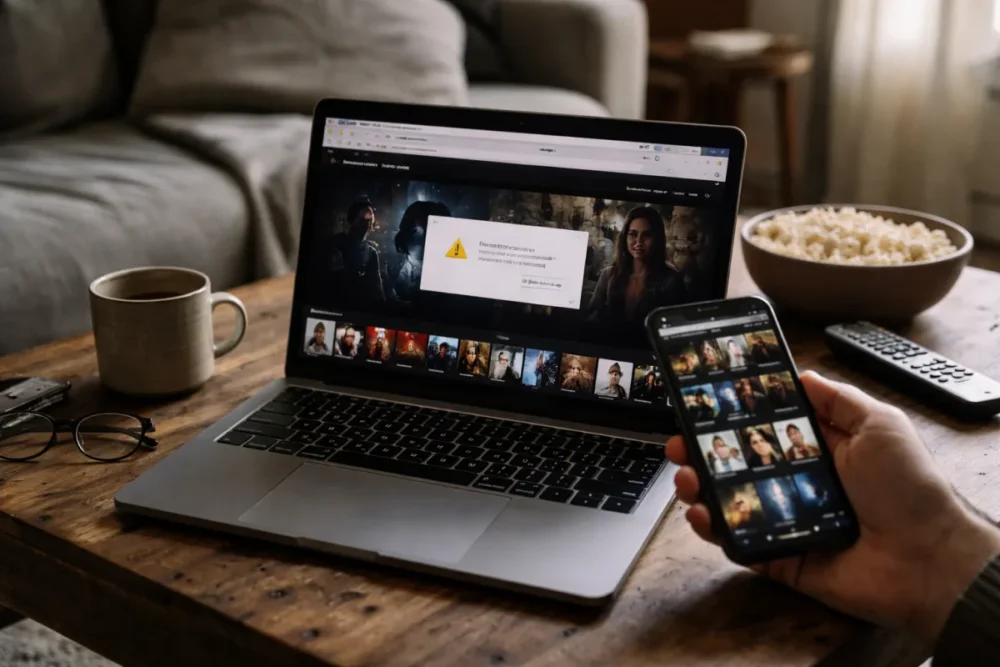
Blockages further reinforce this instability. Since 2026, surveillance around illegal streaming has tightened, and dynamic DNS blocking can quickly neutralize access to sites like Coflix. The result: a service that promised smoothness ends up functioning like a series of detours. For the user, the initial gain quickly turns into wasted time, technical risks, and approximate navigation.
The real cost of illegal streaming is not visible on the screen: it is paid in risks, instability, and lost time.
- External links change quickly and sometimes become unusable.
- Fraudulent mirrors exploit the notoriety of the name to deceive.
- Video quality varies greatly from one player to another.
- Advertisements and redirects can expose users to dangerous pages.
- Using a VPN neither eliminates the risk nor the illegality.
What are the best legal alternatives to Coflix in 2026?
The best legal alternatives already exist, and they cover different uses: free, cultural, family-oriented, or premium catalog. If the goal is to avoid illegal streaming without losing comfort, one must think in terms of real needs. For some, a free platform is enough. For others, a stable subscription is far better than unstable and risky access.
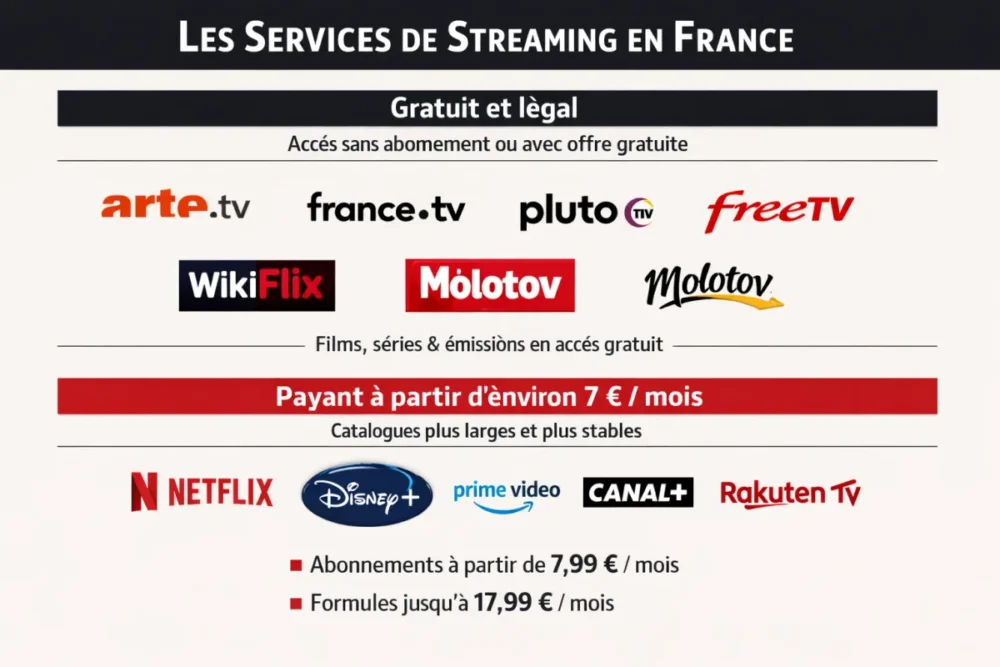
Free and legal platforms
There is no shortage of free and legal services. Some rely on replay, others on thematic channels funded by advertising, and others still on open catalogs. They do not replace a large premium service covering everything, but they respond very well to daily use without legal risk.
| Platform | Model | Main asset | Recommended profile |
|---|---|---|---|
| Arte.tv | Free | Documentaries, cinema, culture, solid editorial selection | Curious, lovers of demanding content |
| France.tv | Free | Replay, French programs, simple access | Family use and catch-up TV |
| Pluto TV | Free with advertising | Thematic channels and consumption without subscription | Quick viewing, channel surfing, light on-demand content |
| WikiFlix | Free | Open content and a more open logic | User sensitive to content under free license |
| Molotov / Free TV | Freemium | Live TV and replay functions depending on the offer | Those who want to centralize their channels |
| Rakuten TV | A la carte or according to the offer | Rental, purchase, or legally offered content | Occasional need rather than heavy subscription |
Premium subscriptions and hybrid offers
When the need concerns a larger catalog, better playback quality, and a more stable experience, paid platforms remain the most coherent. Subscriptions start around €7 per month depending on the services, which remains lower than the hidden cost of an illegal site: lost time, ads, broken links, and exposure to dubious clones.
- Netflix: large catalog, smooth usage, mainstream profile.
- Disney+: strong brand with franchises, series, and family content.
- Prime Video: good balance between catalog, rental, and integration into the Amazon ecosystem.
- Canal+: more focused on cinema, sports, and bundled offers.
The right reflex is not to look for a free copy of everything, but to build a usage basket. A free platform for catch-up TV, a cultural service for documentaries, and a premium subscription if a large catalog is needed. This logic is more flexible than an “all or nothing” approach and avoids confusing a tight budget with risky browsing.
How to choose the right streaming service?
The right service depends on three simple criteria: the type of content you watch, the expected level of comfort, and your actual budget. If you mainly watch catch-up or occasional programs, a free offer may suffice. If you want a stable experience, a subscription remains more rational than an unstable site.
To decide properly, you need to stick to a method rather than a habit. The useful question is not “what is free?”, but “what is reliable for my usage?”. This is where legal streaming makes all the sense: less tinkering, more continuity, fewer unpleasant surprises with each viewing.
- Define your main uses: movies, series, documentaries, television, anime.
- Choose between free, freemium, or subscription based on your viewing frequency.
- Check interface stability, video quality, and mobile compatibility.
- Avoid sites that change address too often or multiply pop-ups.
- For occasional use: favor Arte.tv, France.tv, or Pluto TV.
- For a richer experience: look towards premium subscriptions.
- For security: refuse clones, dubious players, and forced downloads.
- For privacy: keep in mind that a VPN protects the IP address, not the legality of the service.
What changes in the streaming market in 2026?
The streaming market in 2026 is characterized by clearer fragmentation, more visible ad-supported free offers, and increased pressure against illegal sites. Users want to pay less, but they also want less friction. This is precisely where legal platforms improve: simpler interfaces, more stable access, and better segmented catalogs.
At the same time, anti-piracy measures become more responsive. ARCOM and dynamic DNS blocking complicate the survival of sites like Coflix, especially when their address changes frequently. Clones proliferate, but they do not offer more stability. The market rewards services that last, not those that survive by circumvention. On the usage scale, this is a useful evolution: fewer false promises, more services that assume their model.
A reliable streaming service is judged by its stability, not by its ability to disappear and reappear under another name.
This evolution also affects user expectations. Many no longer accept pages saturated with ads, players that break in the middle of an episode, or catalogs that change without warning. The value of a service is no longer only about the displayed price. It depends on regularity, quality, and trust—three things an illegal site manages very poorly by design.
Key Takeaways
- 🔒 Coflix is not legal in France as soon as it broadcasts works without authorization.
- 🧭 Frequent address changes indicate high instability and risks of clones.
- 🛡️ A VPN does not make an illegal service legal; it only changes confidentiality.
- 📺 Free and legal alternatives exist for simple and regular use.
- 💳 Premium subscriptions often remain safer and more stable than illegal streaming.
FAQ
Is Coflix legal in France?
No, if the service broadcasts protected content without authorization. Changing the address or having a new domain does not change this point. In France, broadcasting protected works without rights remains a copyright infringement.
What risks are taken when using Coflix?
The risks are legal and technical. Legally, the user may be subject to civil and criminal penalties related to counterfeiting. Technically, external links, clones, and variable quality increase the risk of a poor experience or exposure to dubious sites.
Does a VPN make Coflix legal?
No. A VPN can mask your IP address and enhance your privacy, but it does not turn an unauthorized service into a legal one. The core issue remains the same: if the content is broadcast without rights, its use remains illegal in France.
What free and legal alternatives to choose in 2026?
For free and safe use, Arte.tv, France.tv, Pluto TV, WikiFlix, Molotov, or Free TV are good starting points depending on your needs. They do not cover all uses in the same way, but they avoid the risks associated with illegal streaming sites.
Why does Coflix often change its address?
Because the site tries to bypass blocks. This is a classic strategy of services under pressure, but it creates instability and encourages fake mirrors. For the user, this is not a sign of reliability; on the contrary, it is a warning signal.