Improving a Site’s SEO: Complete Checklist and Step-by-Step Method to Gain Visibility
Improving a site’s SEO is not about randomly stacking keywords. It is first about removing the obstacles that block indexing, then strengthening the pages that truly meet a search intent, and finally gaining authority with quality links. If you follow the method below, you will know what to audit, what to fix, and in which order, without getting lost in the technicalities.
The important point to keep in mind: Google uses automated crawling bots continuously, and the effects of optimization can appear in a few hours or several months. In other words, the right task is not just to “write better,” but to address blockages, align each page with its objective, and monitor the right indicators.
In brief
🔎 Start with the SEO audit: indexing, crawl, duplicate content, page depth, and mobile performance.
🧱 First fix the blockages: non-indexed pages, inconsistent canonical tags, 404 errors, unnecessary redirects.
✍️ Work on the already visible pages: titles, search intent, internal linking, and useful answer blocks.
📈 Measure the right signals: impressions, clicks, CTR, positions, organic traffic, and conversions, not just rankings.
What concrete result should you aim for?
The right goal is not to “do SEO,” but to obtain a site that is more understandable for Google and more useful for the user. In practice, this translates into better-indexed pages, more clickable titles, a clearer architecture, more organic traffic, and ideally, more leads or sales.
- Cleaner Google indexing: useful pages rise, parasitic pages disappear from the radar.
- Better ranking on priority queries thanks to more precise SEO content.
- Higher CTR in the SERP because title tags and meta descriptions finally speak to the user.
- Better conversion management: the traffic obtained becomes more qualified.
Prerequisites before starting the audit
Before improving a site’s SEO, you need some very concrete basics. Without access to the right tools and visibility on important pages, you correct blindly, and that is the best way to waste time.
- Google Search Console: to see indexed pages, queries, impressions, and detected errors.
- Google Analytics 4: to link organic traffic to engaged sessions and conversions.
- CMS access: WordPress, Drupal, Wix, or other, with the ability to modify titles, content, and internal links.
- Realistic working time: allow a few hours for a first audit, then several days to fix priority pages.
- A tracking sheet: simple table to classify problems by impact and effort.
Where to start to improve a site’s SEO?
Start with the signals that block visibility, not with cosmetic details. Check indexing, identify pages that already have impressions, fix content that is too weak or cannibalized, then tackle technical issues and internal linking. This is the most cost-effective path when you want to improve a site’s SEO without scattering your efforts.
- Check indexing: are the key pages well visible in Search Console?
- Identify pages with potential: those that already have impressions but a low CTR or average position.
- Fix titles: a good title can gain clicks without changing the content.
- Strengthen internal linking: link an important page from already performing pages.
- Address technical blockages: slowness, errors, noindex, canonical, or shaky structure.
1. Conduct a complete SEO audit before taking action
A serious SEO audit is not just for show in a file. It serves to identify what truly hinders organic visibility. In a field audit, you often find the same winning trio of problems: important pages poorly indexed, overlapping content, and deep pages that Google poorly crawls.
Check indexing and crawl capacity
Open Search Console and see which pages are indexed, which pages are excluded, and why. If a useful page is not indexed, it cannot generate SEO traffic. Also check directives that block crawling, noindex tags, inconsistent canonicals, and orphan pages.
Analyze site architecture and page depth
The deeper a page is in the structure, the more likely it is to be undervalued. A pillar page should be quickly accessible from navigation and receive internal links from satellite content. If an important page is four clicks away from the homepage, there is often a hierarchy problem.
Identify weak, duplicated, or cannibalized content
Weak content is not just lacking words. It lacks a clear answer to the search intent. Cannibalization occurs when multiple pages target the same query and neutralize each other. This is very common on blogs, e-commerce categories, and service sites that publish without an editorial plan.
Evaluate technical performance and mobile experience
Speed, visual stability, and responsiveness matter for user experience, and thus for a page’s ability to perform. On mobile, a heavy or poorly aligned site often ends up losing clicks, conversions, and visibility. The Core Web Vitals serve here as a practical benchmark, not an SEO gimmick.
Observe the popularity and quality of inbound links
Popularity remains a lever of natural referencing. It is not about adding backlinks like lottery points, but understanding which pages receive links, in what context, and from what types of sites. A quality link to a strategic page is worth much more than a handful of weak links scattered randomly.
The right order is not “fix everything.” It is first to remove what blocks indexing, then strengthen pages that already have real potential.
2. Prioritize actions to focus on the essentials
In a real SEO project, prioritization changes everything. Corrections are not handled in the order they appear, but in the order of their impact. A blocked page, massive duplication, or poorly thought-out title can yield faster results than a complete overhaul of ten average articles. As a cherry on top, this method also avoids unnecessary work.
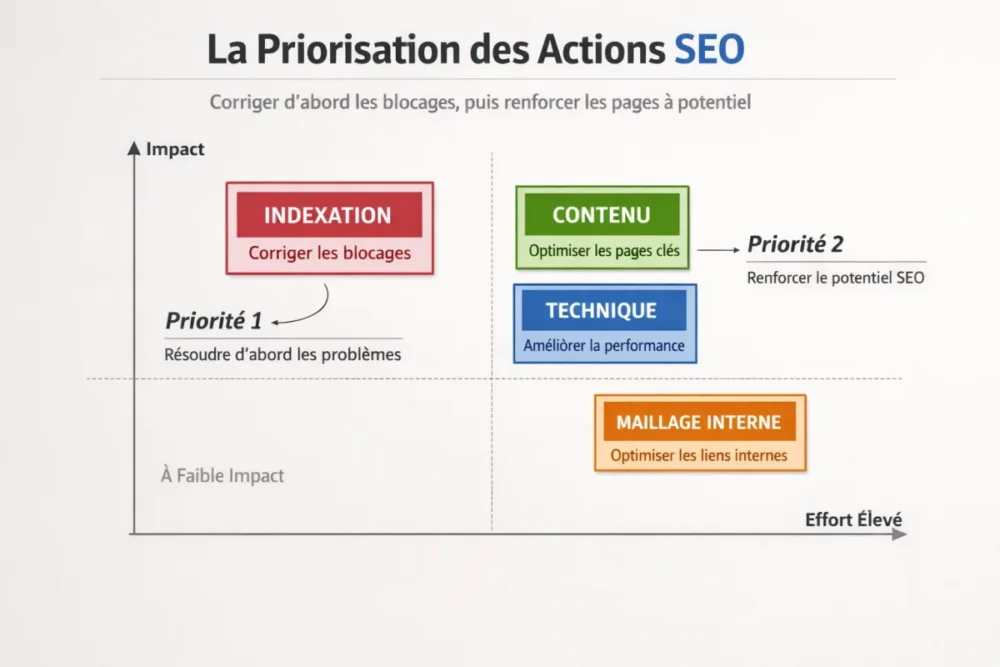
In practice, tasks are ranked along two simple axes: impact and effort. Quick wins are visible, low-cost, and immediately useful fixes. Structural problems require more work but protect the site’s performance in the long term.
| Priority | Observed signal | SEO interpretation | Action to take |
|---|---|---|---|
| Very high | Key page not indexed | Google cannot properly value it | Fix the blockage, canonical, or noindex |
| High | Strong impressions but low CTR | The title or meta description is not enticing | Rewrite the page’s promise |
| Medium | Multiple pages on the same query | Risk of cannibalization | Merge, redirect, or reposition content |
| Structural | Important pages too deep | Internal linking too weak | Add links from pillar pages |
- Quick wins: titles to review, internal linking to strengthen, already visible content to update.
- Structural blockages: indexing, duplication, architecture, canonicals, and redirects.
- Major technical fixes: speed, mobile, scripts, media weight, and page generation.
3. On-page SEO checklist for each important page
A well-optimized page is not recognized by the repetition of a keyword. It is recognized by its ability to respond quickly, clearly, and completely to the targeted query. On a product page, a service page, or a pillar article, on-page remains the most visible layer for the user and the most readable for search engines.
Work on the title and meta description
The title tag indicates the main subject of the page and the targeted keywords. It must be unique, descriptive, and benefit-oriented. The meta description does not by itself boost the page ranking, but it strongly influences the click. If the title promises a clear answer, the CTR often improves without any other magic.
Structure content with H1, H2, and H3
A page must have only one H1. Then, H2 and H3 serve to logically divide the content. When the structure reflects how the user reads and compares information, the content becomes easier to understand, more pleasant to browse, and easier to leverage for natural referencing.
Strengthen semantic relevance and search intent
You need to answer the real question behind the query. If someone searches for “improve a site’s SEO,” they expect a method, a hierarchy of actions, and prioritization criteria, not a dictionary definition. That is why the content must cover related questions, objections, and concrete implementation steps.
Optimize images, internal links, and useful blocks
Images must be compressed, properly named, and described with a relevant alt. Internal links must point to strategic pages, not to secondary pages out of habit. Also add useful blocks: summary, steps, table, proof, or contact. These elements enhance readability and conversion.
Add reassurance and conversion elements
Good SEO content is not only informative. It also supports action. A service page often benefits from displaying proof of reliability, a clear path, a well-placed call to action, and answers to objections. Content that reassures converts better, and a page that converts better often ends up performing better.
Useful content without internal linking is an excellent page placed in a hallway without a sign.
4. Technical SEO checklist to remove blockages
The technical part is not there to scare. It serves to ensure that Google can crawl, understand, and retain your pages without friction. A slow, poorly redirected, or badly tagged site can very well publish good content and remain invisible. It’s frustrating, but fixable.
Improve speed and Core Web Vitals
The weight of images, unnecessary scripts, too many fonts, and overloaded themes often slow down pages. On mobile, this slowdown weighs even more heavily. Your goal is not to aim for an abstract performance but to remove what truly degrades the perceived experience.
Check robots.txt, sitemap, and canonical tags
The robots.txt file must allow crawling of useful sections. The sitemap must reflect important pages, not everything that exists. Canonicals must point to the correct version of each page. When these three elements tell the same story, the site becomes much more readable for crawling robots.
Fix redirects, 404 errors, and unnecessary chains
Technical errors are not just details. They waste crawl budget, dilute authority, and confuse the experience. Redirect chains, loops, and untreated 404s create an impression of a neglected site. On an SEO project, these are often quick-win fixes.
Secure the site and ensure a good mobile version
The site must be served over HTTPS and function properly on mobile. A truncated page, an unclickable button, or a form that breaks on small screens sabotage performance. SEO is not limited to being visible on Google; it must also avoid losing the user at the key moment.
Add structured data when relevant
Structured data help search engines better interpret certain content: product, article, FAQ, business, event, depending on the case. They should not be added just for decoration, but to clarify the information. When used well, they improve site readability without replacing the substance.
5. Build a content strategy that attracts traffic
Creating content on the fly rarely results in solid organic growth. A real content strategy starts from a simple logic: a pillar page for the central topic, satellite content for sub-questions, and an internal linking structure that connects everything. This scheme makes the site more coherent in Google’s eyes and more useful for the user.
Define pillar pages and satellite topics
The pillar page covers the main subject in depth. Satellite pages address specific angles. For example, around “improving a site’s SEO,” one can break down technical audit, title writing, speed, internal linking, or link building. Each content has its place, and this place must be clear.
Answer precise search intents
A good content idea is worthless if it misses the mark. The intent can be informational, commercial, or transactional. The right reflex is to look at the SERP: what formats does Google already highlight? Guides, comparisons, lists, product pages? The format must follow the intent, not the other way around.
Update existing content before creating new ones
Many sites already have pages generating some impressions but not enough results. Reworking them is often more profitable than publishing blindly. Update the substance, improve the title, strengthen internal links, complete weak sections, then measure the evolution. It’s basic but incredibly effective.
Plan a coherent and useful editorial calendar
The editorial calendar should follow the site’s needs, not an arbitrary pace. It’s better to publish less but with a solid cluster logic than to multiply posts without links between them. If your site also has a local dimension, add pages by area, service, or city only when it truly serves the user.
The best content strategy is not the one that publishes the most. It’s the one that connects the right pages together and makes them progress together.
How long does it take to see results?
The first effects of an indexing fix or a better-targeted title can appear quickly. However, to improve a site’s SEO in a stable way, it often takes several weeks, sometimes several months. Timelines depend on the site’s history, competition, and the volume of pages to correct.
The right reflex is to follow a trend, not an isolated day. A page can gain impressions before gaining clicks, then positions. This lag is normal. The important thing is to check if the corrections produce a coherent trajectory on organic traffic, CTR, and conversions.
6. Develop the site’s authority
When the technical and content aspects hold up, popularity becomes an accelerator. Authority is not built overnight. It is built through the quality of incoming links, brand consistency, and the ability to be naturally cited by other useful sites.
Obtain quality inbound links
A good link is not just a “dofollow” or “strong” link. It is a contextual, logical link placed on a relevant and useful page. We look for credible editorial relationships, natural mentions, content that invites citation, and pages that deserve this support.
Betting on editorial partnerships and brand visibility
Content partnerships, interviews, opinion pieces, original studies, and useful resources generate more authority than mechanical netlinking. The brand also matters: the more your site is recognized as useful and reliable, the easier it is to get references without forcing it.
Avoid risky netlinking practices
Massive link purchases, artificial networks, and over-optimized anchors can give a short-term boost, then a big headache afterward. Netlinking must remain clean, progressive, and consistent with the site’s subject. Joking aside, it’s better to have a few good links than many bad ones.
7. Monitor results and adjust the method
SEO is not a project you launch and then forget. You have to monitor, compare, and adjust. Google Search Console and Google Analytics 4 are the two basic benchmarks to measure what is really happening. Without this, one often confuses a rise in impressions with a real progression of useful visibility.
SEO indicators to watch as a priority
- Impressions: is the page appearing more in the results?
- Clicks and CTR: does the snippet make you want to click?
- Average position: is the progress stable or accidental?
- Indexed pages: are the important pages well taken into account?
- Conversions: does organic traffic produce a concrete result?
How to read Search Console and Analytics without getting lost
Start with a single logic: which page has the most profitable potential? A page with many impressions and few clicks can often be improved quickly. Conversely, a page without visibility does not need the same treatment as a page already well ranked. So you have to read the data with an intention, not with panic.
When to correct, consolidate, or amplify a page
If the page already receives impressions, first correct the title, content, and internal links. If the page is weak but strategic, consolidate it. If it already performs well, amplify it with updates, additional links, and possibly satellite content. This logic avoids wasting SEO effort.
Common mistakes that hinder SEO
Most SEO failures come less from a lack of effort than from a wrong order of priority. You publish, wait, see few results, then change everything. Result: lots of energy, little progress. Here are the mistakes most often encountered in audits.
- Publishing without a clear target: the page exists, but no one knows which query it should answer.
- Neglecting technical aspects: a fast and clean site performs better than a beautiful broken site.
- Multiplying pages without interlinking: each content works alone, so it weighs less.
- Only tracking positions: a rising position does not mean that traffic or conversions follow.
- Rewriting without measuring: you change the substance, but you don’t know if the site really progresses.
Concrete example: a service site publishes three articles on the same query, each targeting “SEO optimization.” The pages cannibalize each other, traffic remains scattered, and none dominates. The right answer is not to publish a fourth, but to merge duplicates, designate the main page, and strengthen the interlinking around it.
Optimizations and best practices
When the basics are in place, the details make the difference. The most profitable optimizations are often the simplest: keep one intention per page, work on pages already visible, and circulate internal authority to the right URLs. That’s why a well-structured site often wins before a site that is just “richer.”
- Start with pages that already have impressions: they have immediate growth potential.
- Refine your titles based on CTR: a clearer promise attracts more clicks.
- Strengthen internal links from strong pages: this is often the least costly lever.
- Update content every 2 to 3 months if the topic evolves quickly.
- Keep a “one page = one intention” logic to limit cannibalization.
Simple action plan for the next 30 days
Here is a simple, realistic, and actionable plan. The idea is not to redo the entire site in one month, but to unlock the points that really move the needle. On an existing site, this sequence is often more effective than a large vague project.
- Week 1: audit of indexing, pages with potential, duplicates, and technical blockages.
- Week 2: correction of titles, meta descriptions, H1/H2, internal links, and priority technical errors.
- Week 3: improvement of key content, addition of useful sections, semantic enrichment, and updating of pillar pages.
- Week 4: measurement of results, before/after comparison, then preparation of the next batch of optimizations.
Conclusion
If you have to remember only one logic to improve a site’s SEO, it is this: remove blockages, clarify each page, then strengthen what already works. Natural referencing does not advance randomly. It progresses when technique, content, and popularity work in the same direction, with regular monitoring behind it.
To remember
- 🔎 Check indexing before touching content or design.
- 🧠 Work on a clear search intent for each important page.
- 🧱 Fix technical blockages that slow down crawling and speed.
- 🔗 Strengthen internal linking before chasing backlinks.
- 📊 Measure impressions, clicks, CTR, and conversions to decide what to do next.
FAQ
Where to start to improve a site’s SEO?
Start with Search Console, then identify non-indexed pages, pages that already have impressions, and content that cannibalizes each other. Next, address the quick wins: titles, internal linking, and poorly positioned strategic pages. This is the most cost-effective order to move forward quickly without getting distracted.
How long does it take to see SEO results?
Some technical fixes can produce a quick effect, but most SEO gains are seen over several weeks. On an existing site, expect often one to three months to observe a solid trend, sometimes longer if competition is strong or if the redesign is heavy.
Should content or technique be worked on first?
Technical issues that block visibility must be addressed first, then work on content on the most useful pages. If Google cannot crawl or properly understand a page, even excellent text will remain underutilized. The right reflex is therefore to fix the obstacles, then enrich the substance.
Is link building essential to progress?
It remains an important popularity lever, but it does not replace content or technique. A poorly structured site with bad content will not be saved by a few links. However, clean and coherent inbound links can accelerate the progress of an already solid site.
How to know which page to optimize first?
First choose pages that already have impressions, an average position in the middle, or strong commercial potential. These are often the easiest pages to improve quickly. A page that already attracts some visibility is easier to convert into real organic performance.