Retro Nintendo Switch 2 Games: The Classics That Are Truly Worth It in 2026
Updated: April 22, 2026
In 2026, the retro Nintendo Switch 2 games still worth buying are not simply the most famous ones: they are those that remain playable, responsive, enjoyable in portable mode as well as on TV, and offered in a coherent format. To get straight to the point, the safest bets are Super Mario World, The Legend of Zelda: A Link to the Past, Castlevania Advance Collection, Metroid Prime Remastered, and Final Fantasy Pixel Remaster.
The real question is therefore not “which games were great in their time?”, but which ones still feel good to play today, with a good value for money, clear availability, and comfort that does not betray the original hardware. The Switch 2 makes access easier. It does not automatically turn a lazy old port into a good purchase. This is where the sorting begins.
In Brief
🎯 In 2026, the best entry point remains a mix of Nintendo retro catalog via Nintendo Switch Online and well-edited retro collections. The right approach: pay for the subscription to explore, buy only the compilations that add real comfort options.
🕹️ The titles that age best are those with immediate playability: 2D platformers, action, turn-based RPGs, beat’em ups. 3D games from the 1996-2003 era remain more variable depending on the camera, original framerate, and quality of the remaster.
💶 The classic trap remains the simple port sold at too high a price. In 2026, a relevant retro purchase should ideally offer instant save, remapping, display filters, clean loading, and, if possible, real work on smoothness or ergonomics.
⚠️ Regarding Switch 2 compatibility, the rule is simple: most Switch games run, but not all under the same conditions. Between Nintendo backward compatibility, compilations, remasters, and subscription services, one must distinguish access to the game from its actual quality on the machine.
Information verified on April 22, 2026. Availability facts, subscriptions, and support were cross-checked from official Nintendo pages, support, eShop listings, and publisher patch notes when available. The recommendations below are based on an editorial opinion founded on actual use in portable and on TV: reading comfort, responsiveness, loading times, interest of any patch, and price coherence. Some offers may vary depending on region, physical or digital edition, and updates published after this date.
Quick Top: The 10 Most Relevant Purchases or Accesses
- Super Mario World — the simplest test to know if a classic still holds up without crutches.
- The Legend of Zelda: A Link to the Past — a model of pacing, always clear, always right.
- Castlevania Advance Collection — exemplary compilation, useful options, real value.
- Metroid Prime Remastered — a rare case where modernization truly serves the game.
- Final Fantasy Pixel Remaster — perfect for portable, less perfect for full price.
- Mega Man Legacy Collection — short sessions, intact precision, frequent promotions.
- Donkey Kong Country 2 — still brilliant, provided you accept its challenge.
- TMNT: The Cowabunga Collection — very strong locally, uneven solo depending on episodes.
- Atari 50 — best entry point for those wanting context, not just a simple ROM dump.
- Mario Kart 64 — still fun with multiple players, less convincing solo than often said.
What Does Backward Compatibility Really Change on Switch 2?
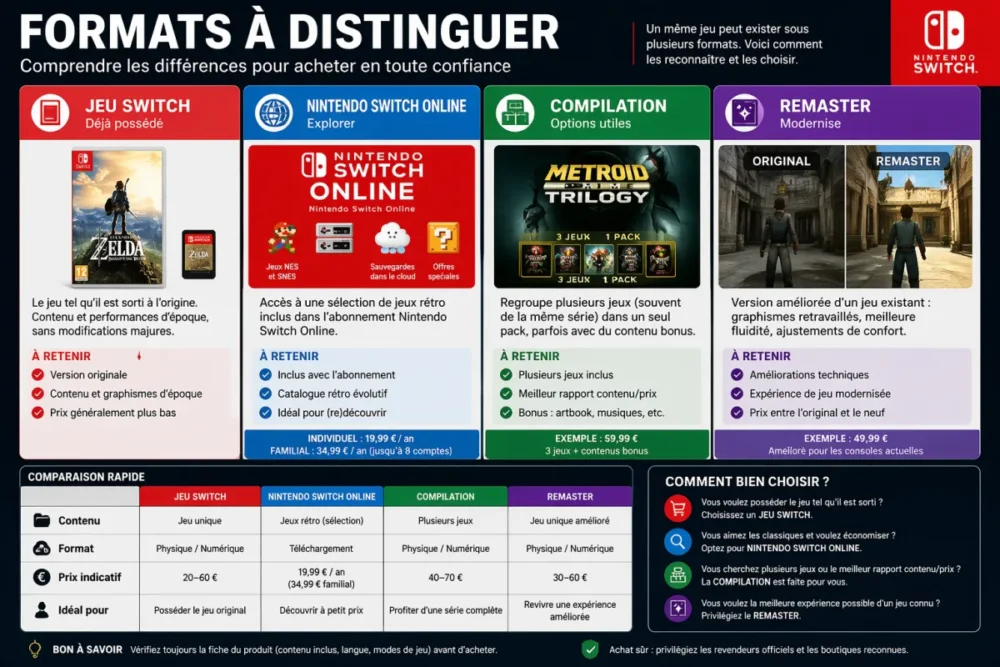
Switch 2 backward compatibility mainly changes access, not the intrinsic value of the games. You get most of the Switch catalog, but the real sorting is done between three formats: backward compatible Switch game, classic via subscription, and compilation or remaster. It’s neither the same comfort promise nor the same value for money.
Backward Compatibility, Collections, and Nintendo Services: Clearly Distinguishing the Formats
Many players lump everything together. This is a practical mistake. A Switch game already released and launched on Switch 2 via backward compatibility remains primarily a Switch game. If the publisher hasn’t patched anything, you should not expect a transformation. Sometimes, loading seems more stable, sometimes execution benefits from extra hardware margin, but this is not an automatic rule. The interest depends on the title, its engine, and the publisher’s support.
Backward catalogs via subscription, on the other hand, follow a different logic. You don’t buy a game; you rent access to a library. It’s very good for testing, an excellent solution for curiosity, and often unbeatable if you alternate between NES, SNES, Game Boy, Game Boy Advance, Nintendo 64, or other libraries depending on the active plan and your region. However, if you only play two or three specific classics throughout the year, the subscription can become a false good deal.
Finally, compilations and remasters remain the area where money really matters. A good compilation adds save states, rewind, filters, remapping, sometimes regional versions, or even archival documents. A good remaster fixes the camera, controls, interface, or resolution. Retro games bought individually only make sense if they work for you. Otherwise, it’s nostalgic packaging. Nothing more.
- Backward compatible Switch game: practical if you already own the cartridge or the digital game.
- Nintendo Switch Online: ideal for exploring a large collection of classics without multiplying purchases.
- Compilation: best choice if it adds modern options and groups several solid episodes.
- Remaster: to be favored when the original controls, display, or smoothness have aged.
What a Player Can Expect in Practice
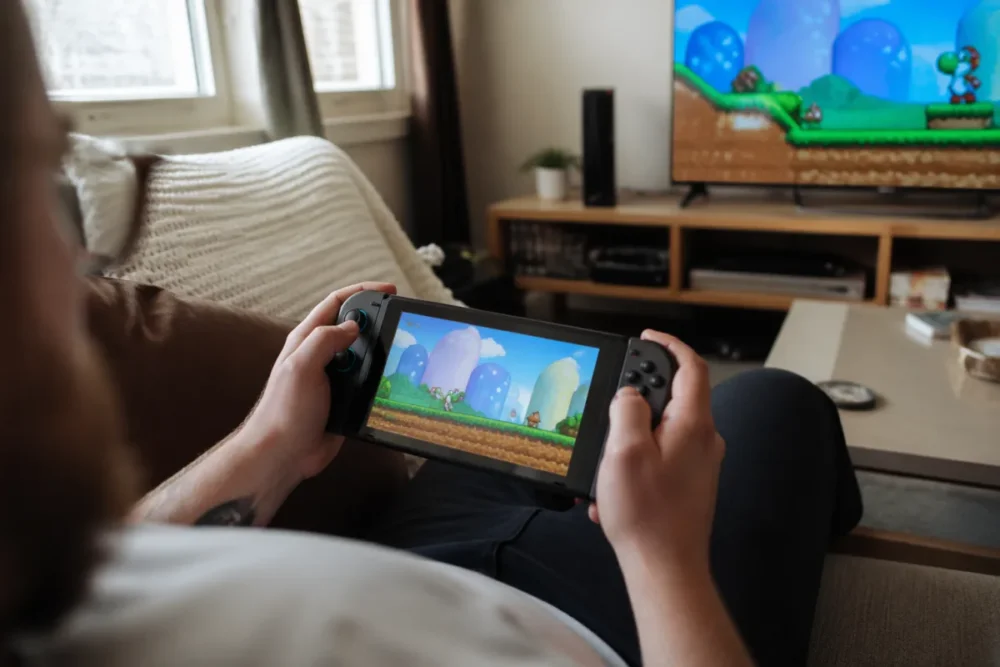
In real use, the Switch 2 mainly makes retro games easier to integrate into a modern routine. In portable mode, 2D titles with high readability and slow-paced RPGs fare best. On TV, action games, beat’em ups, and local multiplayer titles benefit the most from visual comfort and better handling. The decisive point is not raw power: it’s the ergonomics of the return.
Comfort depends on very concrete details: readable text without squinting, fast menus, absence of annoying latency, possibility to pause a short game, and good compatibility with sticks or a real directional pad. Some old games gain by being played today because the modern support reduces friction. Others mainly remind us why patches, checkpoints, and simpler interfaces were invented.
| Observed Point | What to Expect on Switch 2 | What Not to Fantasize About |
|---|---|---|
| Display | Cleaner image, better readability on certain ports and remasters, superior comfort in handheld mode | An old blurry rendering or a tiny interface do not become modern without publisher work |
| Fluidity | Sometimes better stability, especially on games supported by patches | An originally shaky framerate is not magically fixed everywhere |
| Loading Times | Often more discreet on well-optimized titles | No uniform guarantee depending on engines and editions |
| Handheld vs TV | Handheld excellent for RPG, puzzle, Game Boy, GBA; TV ideal for local action and arcade | Old 3D games can remain stiff on large screens if the camera or textures show their age |
How to Choose a Retro Game That Still Deserves to Be Bought in 2026?
A good retro purchase in 2026 must hold up without nostalgia: clean controls, immediate readability, useful modern options, and consistent price. On Switch 2, the best retro Nintendo Switch 2 games are either flawless classics via subscription, smart compilations, or remasters that truly correct the age of the original material.
The Criteria That Really Matter
The first criterion remains gameplay. A classic must still “speak” within five minutes. If learning feels natural, the gameplay loop remains clear, and failure seems fair, the title still has current value. This is why so many 16-bit games age better than some early 2000s 3D productions: they have fewer intermediaries between your input and the on-screen action.
Replayability then matters more than raw length. A four-hour retro game can be a much better purchase than a twenty-hour adventure that has become tedious. On Switch 2, this logic is even reinforced by portable use: one is more likely to restart a short game, a level, a run, or a chapter than a long corridor of archaic menus. Useful for whom? For the player who really wants to play, not just collect icons.
Third criterion: comfort of handling. A real directional pad changes everything in precise 2D games. Remapping options, save states, and rewind are not gimmicks to “casualize” retro; they are adaptation tools for modern usage, especially when playing in 15 to 30-minute sessions. A publisher who understands this more easily deserves your money.
- Still clear gameplay: quick start, clear rules, precise controls.
- Readability: characters, projectiles, text, and HUD remain understandable on the handheld screen.
- Modern comfort: instant save, filters, remapping, display options.
- Availability: subscription, cartridge, eShop, compilation, region, language.
- Value for money: number of episodes, quality of the port, frequency of promotions.
Errors to Avoid
The first mistake is to buy only out of nostalgia. The memory of a summer on Game Boy guarantees neither good readability today nor intact pleasure. Retro is not a sanctuary. Some titles remain sovereign. Others were already just good memories in a limited technical context. In 2026, one must accept this sorting without fetishism.
Second mistake: confusing simple port and true modernization. A clean menu and a flattering cover say nothing about the substance. Always check the eShop listing or physical edition on four points: control options, languages, save functions, and patch support. If none of this appears, beware. An old glory without editorial care remains a tired old glory.
Third mistake: neglecting the usage context. A text-based RPG savored in bed is not judged by the same criteria as an action game designed for a CRT TV and an arcade controller. The right question is not “is it cult?” but “is it still enjoyable in my playing conditions?”. Here, we finally step out of marketing disguised as collective memory.
The Best Retro Nintendo Switch 2 Games to Prioritize in 2026
Here is the most useful selection if you are looking for a quick, well-argued answer focused on real use. The ranking mixes classics accessible via subscription, recommendable remasters, and compilations that justify their price. I deliberately exclude “historically important” titles that are too rough for a broad recommendation.
| Title | Source | Access Type | Interest in 2026 | Recommendation Level |
|---|---|---|---|---|
| Super Mario World | SNES via Nintendo Switch Online | Subscription | Readable platformer, immediate pace, perfect for short sessions | Essential |
| The Legend of Zelda: A Link to the Past | SNES via Nintendo Switch Online | Subscription | Dense adventure, clear interface, excellent on portable | Essential |
| Castlevania Advance Collection | Konami Compilation | eShop Purchase / cartridge depending on edition | Very good selection, save states and useful modern comfort | Essential |
| Metroid Prime Remastered | Backward-compatible Switch Remaster | Purchase | One of the rare 3D remasters that modernizes without betraying | Essential |
| Final Fantasy Pixel Remaster | Square Enix Collection | Purchase | Ideal on portable, very durable if you like turn-based | Highly recommended |
| Mega Man Legacy Collection | Capcom Compilation | Purchase | Excellent for short sessions, often well priced on sale | Highly recommended |
| Donkey Kong Country 2 | SNES via Nintendo Switch Online | Subscription | Masterful platformer, more demanding but still brilliant | Highly recommended |
| TMNT: The Cowabunga Collection | Konami Compilation | Purchase | Very strong in local multiplayer, uneven in solo | Highly recommended |
| Atari 50 | Documentary Compilation | Purchase | Excellent contextual work, useful if you like understanding history | Recommended |
| Mario Kart 64 | N64 via Nintendo Switch Online | Subscription | Still fun with multiple players, less convincing solo today | Recommended |
Essentials for Beginners
Super Mario World remains the best starting point because it requires no historical indulgence. The level design is readable, collisions are clean, the speed is immediately understandable, and the structure favors both ten-minute sessions and marathons. On Switch 2, it’s a classic that doesn’t feel “important” before being enjoyable. It is enjoyable first. That’s rarer than people say.
A Link to the Past retains a huge advantage over many more recent adventures: it gets straight to the game. Little fluff, few chatty interfaces, exploration that teaches without interrupting. On portable, it’s one of the best Game Boy games not included in the usual sense of use: you pick it up quickly, find your way easily, and truly progress with each session. If you must test only one old Zelda in 2026, it’s still this one.
Castlevania Advance Collection deserves its status as a safe bet because it doesn’t just stack ROMs. Comfort options reduce friction, the set covers several series sensibilities, and playing on a modern screen remains clean. It’s exactly what you expect from a compilation: practical access, useful tools, and enough content to justify a purchase beyond the heritage gesture.
Metroid Prime Remastered, finally, reminds us that a good remaster is not about smoothing textures. Here, the controls, readability, and presentation make the game truly more welcoming without breaking its solitude or its pace. On TV, it shows what a classic 3D game can become when the publisher finally decides to embrace the present. It’s not a technical miracle: it’s editorial work. An important nuance.
Platforming and action
For 2D platformers, Super Mario World and Donkey Kong Country 2 remain the two safest purchases if you already have access to the appropriate service. The first is more welcoming, the second more intense and demanding. The choice mainly depends on your tolerance for precision. If you’re looking for short sessions and immediate fun, Mario wins. If you like tight trajectories and a bit more pressure, Donkey Kong keeps a formidable bite.
In arcade action, Mega Man Legacy Collection still makes perfect sense thanks to its format. You start a game, fail quickly, and restart even faster. It’s almost a technical response to the modern use of handhelds. The collection is mainly valuable for its franchise with the original material: it remains hard, sometimes abrupt, but clean enough for the difficulty to feel fair. And on sale, the time spent/price ratio remains excellent.
If you want a more physical and collective alternative, the beat’em ups gathered in TMNT: The Cowabunga Collection or in other bundles of the same spirit have real appeal on Switch 2. The TV output, immediate responsiveness, and the possibility to chain short local sessions still hit the mark. Solo, the effect may wear off faster. With several players, the game regains its reason for being.
RPG and adventure
The most comfortable zone in portable remains that of turn-based RPGs and adventures with clear progression. Final Fantasy Pixel Remaster is almost designed for this use: readable texts, divisible pacing, music that supports resuming play well, and chapters easy to split. The drawback remains the price, especially outside promotions. But if you know you will really play several episodes, the investment becomes rational.
In the pure Nintendo register, The Legend of Zelda: A Link to the Past and Super Metroid remain the two major landmarks of the Nintendo retro catalog. The first for intelligently guided adventure, the second for exploration that trusts the player. On Switch 2, both mainly gain in ease of access. No need to make them a fetish: they are simply games with a design still lively. That is more than enough.
If you’re looking for a bridge between retro and contemporary comfort, Metroid Prime Remastered is easier to recommend than many more talkative remakes. It retains a true period identity while correcting what was most problematic in the controls. It’s a good example of a title that needs modern work to become fully approachable again, where some 16-bit games hardly needed any.
Puzzle, thinking and party games
Puzzle games often age better than their reputation. Their language is simple, their session length natural, and their reading immediate. On Switch 2, anything relying on a clear screen, a scoring logic, or a repeatable principle mechanically gains relevance. If you have access to classics of this family via subscription, this is typically the kind to test before any separate purchase. Time will quickly tell if the desire holds.
For party games and local competition formats, you have to be less sentimental. An old game can make you laugh for ten minutes and then collapse under the weight of slow menus or controls that have become fuzzy. Mario Kart 64 remains a good social cartridge if your group accepts its historical stiffness. Otherwise, its interest becomes mainly documentary. Again, memory embellishes faster than sticks forget.
Which retro games work best multiplayer on Switch 2?
In multiplayer, the best choices are rarely the most prestigious. You need rules readable in twenty seconds, fast menus, few loadings, and a clear reading of the action on TV. Beat’em ups, party racers, and compilations with immediate local play remain the safest bets on Switch 2.
Cooperative Duo
The cooperative duo especially benefits from retro compilations, provided they have been designed for modern comfort. Beat’em ups and certain shared action games still work very well because they simplify the decision space: same screen, same direction, same urgency. If you often play two-player couch co-op, it’s a more reliable ground than an old adventure game with a dated interface or a poorly remapped action-RPG.
Local Competitive
In local competitive, readability takes precedence over everything else. Games like Mario Kart 64 remain interesting because their vocabulary is immediately understandable. However, they also reveal their limits: rougher camera, less stable speed sensation, less precise than today. For an occasional evening, it works very well. For regular use, it’s better not to confuse “iconic” with “comfortable.”
Family Games
For a family audience, the best retro games on Switch 2 are often the easiest to explain and the most generous in visual feedback. Simple 2D platformers, puzzles, and certain arcade titles win out. The good filter remains the same: does a person who didn’t grow up with the franchise understand what they have to do in less than a minute? If not, the game is more about cult than sharing.
Is the official retro catalog worth the Nintendo Switch Online subscription?
Yes, if you regularly play multiple generations of Nintendo consoles and really make use of the subscription. No, if you’re looking for two or three specific classics. In 2026, Nintendo Switch Online is excellent as a rotating buffet, less so as a universal economical solution.
Nintendo Switch Online: who it’s useful for
The subscription has an obvious advantage: it lowers the entry cost and allows testing a large number of games without impulsive purchases. For a curious player, for a family, or for someone who alternates between Game Boy Switch games, SNES Switch games, and some N64 or GBA excursions, the plan is very relevant. It also allows you to immediately feel which genres still hold up for you without multiplying costly regrets.
On the other hand, if you already know what you like, the calculation changes. A player who mainly wants a big retro RPG, a precise action compilation, and two local multiplayer games can often do better by buying. The subscription then becomes a supplementary service, not a base. This is the old problem with abundant libraries: they provide access, not necessarily attention.
Compilations and collections to watch
Retro collections have a greater interest than buying individually in three specific cases: when they group several complementary episodes, when they add truly useful modern options, and when they provide context or editorial bonuses. Atari 50 is a good example: it’s not just a basket of old games, it’s a way to understand why some titles still matter and why others mainly belong to their era.
Conversely, a compilation without comfort, without filters, without remapping, and without interface work has little more value than a well-marketed nostalgia bundle. Before buying, check the game’s page to verify:
- the presence of save states or quick saves;
- button remapping;
- display options in handheld and on TV;
- available language;
- recent update notes or patches.
Retro games to leave aside or only buy on sale
There’s no need to list a wall of proper names to understand the rule. Retro games of low interest in 2026 often belong to one of these categories: gameplay too dependent on a bygone era, archaic interface not corrected, raw port sold at full price, or lazy compilation that adds no concrete comfort. Retro then becomes an exercise in patience, not pleasure.
Also beware of 3D games from the 32/128-bit console transition when they have received neither camera adaptation, nor control work, nor interface cleanup. These are often the ones that suffer the most in 2026, especially on large screens. We can respect them historically without recommending their full-price purchase. Video game memory does not oblige anyone to overpay for its blind spots.
The right reflex remains simple: if a title is only appealing because it reminds you of a company, an ad, or a childhood Saturday, wait for a sale. If, on the contrary, it makes you want to come back after the first hour, then the purchase is justified. When it comes to retro games, the second session almost always tells the truth.
Tips for getting the most out of retro games on Switch 2
In handheld mode
In handheld mode, favor games with clear text, simple interfaces, and titles that tolerate interruptions well. Turn-based RPGs, Game Boy and Game Boy Advance games, as well as well-contrasted 2D platformers, are naturally advantaged. If a game requires precise reading of small elements or a nervous 3D camera, it may become tiring faster than enthusiastic reviews admit.
In TV mode
On TV, watch out for scaling and the readability of sprites or textures. Arcade games, beat’em ups, and local multiplayer titles benefit the most from the big screen because they rely on shared space. Conversely, some old 3D games become visually harsher as soon as everything is enlarged. Again, the Switch 2 helps, but it does not erase an artistic direction or a period framerate.
With the right controllers
For many 2D classics, a controller with a real directional pad changes the experience more than a resolution gain. This is especially true for Mega Man, Castlevania, precise puzzles, and certain fighting games. If you often play retro, the accessory is not a purist whim: it is a practical investment. However, don’t fall into the other extreme. Buying hardware to save a mediocre game remains a bad deal.
Which purchases still make sense in 2026 according to your profile?
If you want to go fast, here is the most honest sorting. Not the most sentimental, the most useful.
- You are a complete beginner: start with Super Mario World, A Link to the Past, and a good compilation like Castlevania Advance Collection.
- You mostly play handheld: target Final Fantasy Pixel Remaster, classic Game Boy/GBA via subscription, and 2D adventure games with clear progression.
- You mostly play on TV: prioritize Metroid Prime Remastered, beat’em ups in collections, and local multiplayer titles.
- You are looking for the best value for money: a well-used Nintendo Switch Online subscription can suffice for several months before any separate purchase.
- You want to buy few but well: choose a serious compilation and a truly polished remaster rather than a pile of anecdotal ports.
Ultimately, the Switch 2 does not make retro more authentic. It makes it more accessible. The rest always depends on the same verdict: do we still play it for pleasure, or only for the image we keep of it? This is the healthiest question to ask before every purchase.
FAQ on Nintendo Switch 2 retro games
Do you already need to know the series to enjoy these games?
No, not for the best ones. A true classic is understood without emotional baggage. Super Mario World, A Link to the Past, or Mega Man still work because their rules are readable and their feedback immediate. If a game is only enjoyable on the condition of already loving it, it is no longer a broad recommendation.
Are retro games compatible with all models and editions?
The majority of Switch games and retro services are designed for the current ecosystem, but there may be differences depending on the region, physical or digital edition, subscription plan, and available patches. Always check the official listing, especially for compilations, upgrades, and games dependent on online features.
Is it better to pick up a classic or wait for a compilation?
If the compilation gathers several strong episodes and adds modern options, it is often more cost-effective. Waiting makes sense when the targeted game needs save states, remapping, or interface work. However, for major classics already very polished through subscription, waiting for an additional packaging does not necessarily add much.
Which games offer the best value for money in 2026?
The best value for money generally comes from Nintendo Switch Online for broad exploration, Castlevania Advance Collection for density and options, and Mega Man Legacy Collection when it goes on sale. Final Fantasy Pixel Remaster is worth more for the time spent than for its entry price, which is not exactly the same thing.
Do Switch 2 remasters always offer more value than a simple retro game?
No. A remaster is worth the price difference only if it fixes something important: controls, camera, display, interface, overall comfort. Metroid Prime Remastered is a good example. A cosmetic remaster, on the other hand, is sometimes less interesting than a great 2D classic accessible via subscription and intact in its design.
What is the best choice between physical and digital purchase?
For retro games, the choice mainly depends on price, availability, and your usage. Digital is convenient for frequently replaying a compilation or a short classic. Physical makes sense if you buy infrequently, like to resell, or if certain editions group multiple games on a cartridge. In all cases, the interest of the content takes precedence over the format.