Neo Geo AES+ and MiSTer core: what the technical controversy really says
The Neo Geo AES+ is not only of interest to SNK cartridge collectors. It embodies an old retro-gaming fantasy: playing as close as possible to the original hardware, without the visible compromises of software emulation, but also without the constraints of an old console that has become rare, fragile, and expensive. On paper, the promise is strong. In detail, it is much less simple than a slogan on a box.
The real issue of this technical analysis Neo Geo AES+ vs MiSTer core FPGA vs ASIC comes down to a precise question: are we talking about an original hardware reproduction, an adaptation of work already done on the MiSTer side, or a hybrid sold with vocabulary that is more flattering than transparent? Between Plaion’s official position, remarks from recognized FPGA developers, and the very particular expectations of the Neo Geo audience, the subject deserves more than a forum reaction. We need to look at the architecture, usage, correction capacity, and above all a question that retro often forgets: useful for whom?
In brief
🧠 The Neo Geo AES+ is presented as a faithful reproduction of the original hardware via ASIC chips, and not as a simple software emulation nor as a single FPGA.
⚙️ The controversy comes from a statement by Pramod Somashekar: according to him, the machine would practically reuse the MiSTer core by distributing it across several chips, which changes the behavior less than the technical packaging.
🎮 For the player, the real difference lies in cartridge compatibility, update flexibility, timing fidelity, and marketing transparency, not just the noble word ASIC.
💰 The machine is announced at $249.99 for the standard edition, $349.99 for the anniversary edition, with HDMI, RGB CRT, composite video, stereo sound, and DIP switches for regions, with a planned release on November 13, 2026.
Understanding the basics: FPGA, ASIC, and hardware emulation
Before judging the Neo Geo AES+, we need to clear up the vocabulary. In the retro scene, the word emulation is often used to mix everything up: software on PC, hardware reconstruction on FPGA, conversion into fixed chips, or even “mini” consoles. Technically, it’s not the same thing. An FPGA is a reconfigurable logic matrix: you load a hardware description, often called a core, to reproduce the behavior of a system. An ASIC, on the other hand, is a specialized chip whose logic is fixed at manufacturing. Both can aim for the same functional fidelity, but they behave differently in terms of correction, iteration, and maintenance.
| Technology | Principle | Main advantage | Main limitation |
|---|---|---|---|
| Software emulation | System reproduction by a program running on general-purpose CPU/GPU | Flexibility, low cost, advanced features | Fidelity depends on software, OS, and configuration |
| FPGA | Reconfigurable hardware logic loaded as a core | Structural proximity to original hardware, possible fixes | Depends on programmable hardware and active support |
| ASIC | Logic etched into a dedicated chip | Fixed implementation, more closed finished product | Less flexibility if a hardware bug appears |
This point is central because the MiSTer is not “fake hardware” just because it uses an FPGA. It is a programmable platform that runs hardware descriptions. Conversely, an ASIC is not automatically more authentic because it is etched. It all depends on what has been etched into it. If the reproduced logic comes from existing work, the nature of the medium changes, but not necessarily the intellectual origin nor the functional behavior. This is precisely where the AES+ debate becomes interesting.
“In hindsight, the word that impresses often wins against the diagram that explains.”
For the Neo Geo in particular, expectations are high. We are talking about a machine associated with massive cartridges, specific video timings, abundant sprites, and a visual identity that experienced players quickly recognize when something is wrong. A credible solution must therefore hold on several fronts at once: image, audio, cartridge compatibility, regional management, stability, and behavior on both modern screens and CRTs.
Why does the Neo Geo AES+ spark so much technical debate?
Because the machine is sold as an ASIC reproduction of the Neo Geo hardware, while a recognized FPGA developer claims it essentially reuses the MiSTer core split across several chips. The debate is therefore not only about fidelity but about the transparency of the technical promise.
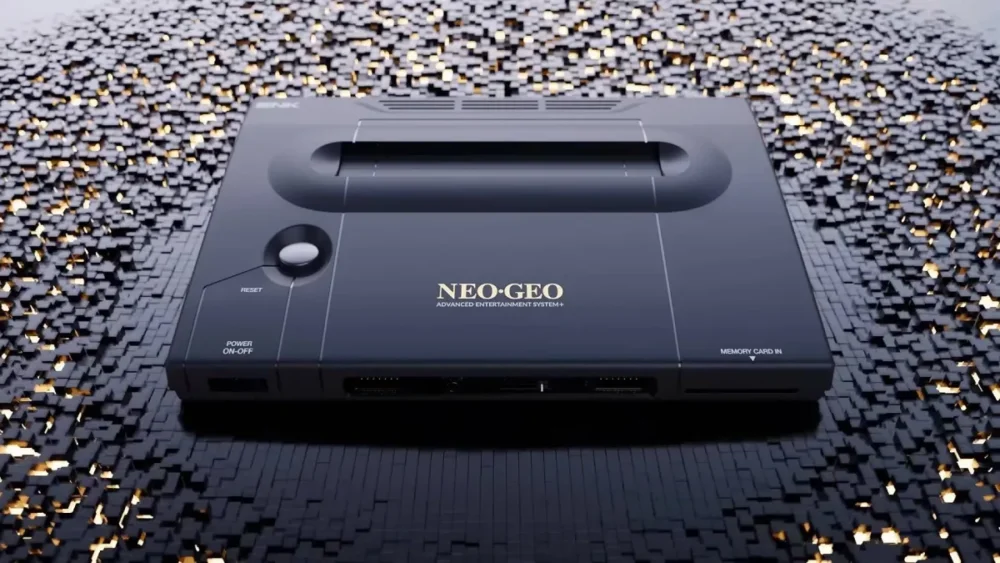
On one side, Plaion puts forward a clear line: the Neo Geo AES+ would be neither a classic emulation nor an FPGA approximation, but a faithful reproduction thanks to ASIC chips programmed to replicate the hardware of the 1990s console. On the other side, developer Pramod Somashekar argues that the approach essentially consists of a “broken” MiSTer core divided into several hardware blocks.
What must be avoided here is a false moral duel. If the MiSTer core logic served as a base, that does not automatically make the console bad. On the contrary, the Neo Geo core from the MiSTer scene benefits from serious work, closely observed and refined by the community. The problem is therefore not the intrinsic quality of a MiSTer heritage. The problem, if the claim is accurate, would be the way of selling the difference as an absolute break rather than an implementation transformation.
“It would essentially be the MiSTer core split into several chips.”
Pramod Somashekar
The tension also comes from the differentiated prestige of words. FPGA evokes open engineering, updates, proof by code. ASIC evokes industrial finality, rarity, the “real circuit.” In a retro market that mixes passion, collecting, and hardware fetishism, this nuance becomes commercial. And marketing loves words that have the scent of pure silicon.
How does the idea of a “split” MiSTer core into ASIC work?
Simply put, it means that hardware logic designed for an FPGA could be transformed into several fixed blocks engraved in ASIC. So, it would not be a shift from one technical philosophy to another at the behavior level, but from a reconfigurable support to a fixed support.
Available facts indicate that the Neo Geo AES+ ASIC chips replace the original SNK graphic chips responsible for sprites, color palettes, and communication with the CPU. In other words, the goal is not to run a Neo Geo game “in the manner of,” but to reimplement the system’s critical functions. This is where a parallel with MiSTer becomes plausible: if the functional logic is already known, validated, and portable, it can theoretically serve as a basis for a fixed implementation.
This point deserves an important clarification. An FPGA core is not a simple executable that one would copy into a chip like copying a file. The transition to ASIC requires adaptation work, synthesis, validation, functional splitting, and production. So there is indeed a real technical difference between a single FPGA and several ASICs. But this difference does not answer the question that the informed player asks: is the reference logic new, or derived?
The debate then becomes less theoretical than it seems. If the functional core is close to MiSTer, the Neo Geo AES+ potentially inherits its fidelity qualities. But it loses part of what has historically been the strength of an FPGA: the ability to publicly fix a bug, refine a timing, iterate within a community. An ASIC, on the other hand, does not like regrets.
“It is neither emulation nor an FPGA approximation, but a faithful reproduction in ASIC.”
Plaion
The reported involvement of profiles like Jotego and Furrtek in the development points to a technically serious project. But again, execution rigor does not erase the need for clarity about the origin of the logic used. In high-end retro-gaming, the buyer does not just pay for a result. They also pay for a technical story, and they do not like having the subtitles changed afterwards.
Segmented ASICs or single FPGA: what difference for the player?
For the end user, the most tangible difference is not in the prestige of the component, but in maintenance, bug fixing, transparency of the technical chain, and the ability to document timings, compatibility, and latency once the product is in hand.
On a strictly practical level, the Neo Geo AES+ already checks several boxes expected by its audience: compatibility with original and reissued cartridges, HDMI output for modern screens, RGB for CRTs, composite video, stereo sound, and DIP switches for region selection. On paper, it is exactly the type of machine the market has been demanding for years: a ready-to-play console, simpler than a community build, less risky than sometimes finicky old hardware.
| Criterion | Neo Geo AES+ | MiSTer | What this changes |
|---|---|---|---|
| Hardware support | Dedicated ASICs | Reconfigurable FPGA | More closed product on one side, more iterative on the other |
| Cartridge compatibility | Yes, original and reissues | No, usage via files and MiSTer infrastructure | Clear advantage for AES+ for the “living room console” experience |
| Video outputs | HDMI, RGB CRT, composite | Depends on the hardware configuration used | AES+ aims for plug-and-play |
| Fixes and updates | Potentially more limited on fixed logic | Highly favored by reconfiguration | MiSTer advantage for technical longevity |
| Community transparency | To be demonstrated on final hardware | Historically strong | Decisive question for demanding enthusiasts |
The point most often raised by knowledgeable players concerns latency and timings. Yet, at this stage, no public benchmark suite allows us to assert that the Neo Geo AES+ would perform better, the same, or worse than a well-configured MiSTer in this area. So we must cut short a common misconception: ASIC does not automatically mean less lag, nor does FPGA automatically mean approximation. Without measurements on the final machine, all this remains technical theater.
Another very concrete difference: the usage philosophy. MiSTer is a platform. It requires a culture of tuning, updates, display profiles, sometimes configuration compromises. The Neo Geo AES+, on the other hand, clearly seeks the opposite stance: a dedicated, targeted console, immediately understandable, closer to the cartridge you insert than the project you manage. For some players, this is real progress. For others, it is mainly a loss of control.
“The project has the potential to be the best console since SNK stopped making hardware.”
Furrtek
Marketing stakes and user perception: why does the word ASIC weigh so much?
Retro-gaming sells technology, but above all it sells symbolic hierarchies. In this hierarchy, the word ASIC sounds more definitive, more noble, more “hardware” than FPGA. This is sometimes justified, often exaggerated. An ASIC reassures the collector because it evokes a closed, determined, almost museum-like machine. An FPGA reassures the technician because it promises fixes, documentation, and continuous evolution. The two imaginaries do not overlap.
The Neo Geo AES+ thus arrives at a sensitive point in the market. It offers a simple-to-understand object, compatible with cartridges, and clearly designed to flatter the idea of a return to the dedicated console. It’s clever. But this promise can quickly backfire on the brand if the most expert audience considers that the technical discourse oversimplifies the real genealogy of the product.
| Announced Element | Known Data | Editorial Reading |
|---|---|---|
| Standard Edition | $249.99 | High entry price, but consistent with a premium retro product |
| Anniversary Edition | $349.99 | The collector’s edition targets the object more than strict technical rationality |
| Expected Release Date | November 13, 2026 | The real verdict will come from tests on the final machine, not promises |
| Positioning | Retro cartridge-compatible console | Product designed for players attached to the physical gesture |
There is also an underlying irony. Part of the community demands “real hardware,” but has been enthusiastically supporting projects like MiSTer for years precisely because they can be fixed, enriched, and publicly compared. The obsession with fixed hardware and the culture of patching do not always go together. Yet the market tries to sell both at the same time. That’s where disguised marketing begins.
What prospects for the Neo Geo AES+ and FPGA retro-gaming?
The Neo Geo AES+ can succeed if it fulfills three verifiable promises: solid cartridge compatibility, accurate timings, and honest communication about its technical lineage. Without this, it risks being judged more on its discourse than on its actual in-game behavior.
The most interesting aspect, in the medium term, is not only the console itself but what it reveals about a broader evolution. Premium retro-gaming is moving towards products that no longer want to choose between modern accessibility and hardware mythology. On one side, FPGA platforms have normalized the demand for fidelity. On the other, manufacturers seek to enclose this fidelity in objects that are simpler to sell, more readable in stores, closer to a traditional console.
This logic has a technical cost. The more the architecture is closed, the more the manufacturer’s responsibility increases at launch. If a compatibility bug, rendering anomaly, or framerate issue appears, the user will be less willing to tolerate a “we’ll fix it later” than on a community platform. Again, true superiority is not decreed by a component name.
Conversely, if the Neo Geo AES+ launches with impeccable behavior, a clean video signal, excellent cartridge handling, and sufficiently clear documentation, it can occupy a space that MiSTer does not fully cover: that of a dedicated, tangible machine, immediately usable, designed for players who want to plug in, insert a cartridge, and play on HDMI or CRT without building an ecosystem around it.
What the AES+ Case Really Reveals
The best way to understand this case is neither a trial of intent nor naive celebration. If the Neo Geo AES+ indeed adopts a logic close to MiSTer but implements it differently, then we are not facing an automatic imposture, but a shift in value: a work historically associated with an open platform is transformed into a closed, premium, simplified product that is symbolically more reassuring for part of the market.
This shift says a lot about contemporary retro gaming. Players want engineering precision, plug-and-play comfort, the beauty of the object, and the purity of the original discourse. Yet these four desires do not naturally align. MiSTer favors method, revision, iteration. The Neo Geo AES+ promises the finished product. Between the two, the real dividing line is not moral. It is editorial, technical, and commercial.
In short: if you are looking for an evolving, documented, and community-driven platform, the MiSTer model remains hard to beat. If you want a dedicated cartridge-compatible console, designed as a product for use before being a project, the Neo Geo AES+ can become relevant. But to convince the informed public, it will have to prove one simple thing that retro often forgets when it talks to itself: fidelity is measured, not proclaimed.
FAQ
Is the Neo Geo AES+ an FPGA console?
Officially, no. It is presented as a console based on ASIC chips programmed to reproduce the original hardware. This is precisely the point fueling the debate, as some believe the logic used derives from the work done on the MiSTer core.
What is the difference between an FPGA and an ASIC in this context?
An FPGA is reconfigurable: you can load and update hardware logic on it. An ASIC is fixed at manufacturing. For the player, this mainly changes the ability to fix a hardware bug, evolve the machine, and publicly document adjustments.
Will the Neo Geo AES+ be more faithful than a MiSTer?
Nothing yet allows us to seriously affirm that. Tests on final hardware will be needed, including timing measurements, cartridge compatibility, audio/video quality, and latency. The word ASIC is not a valid shortcut to technical superiority.
What equipment is announced for the console?
Available information mentions compatibility with original and reissued cartridges, an HDMI output, RGB support for CRTs, a composite video output, stereo sound, and DIP switches for region selection.
How much does the Neo Geo AES+ cost?
The announced pre-order price is $249.99 for the standard edition and $349.99 for the anniversary edition. The release is scheduled for November 13, 2026.
Who is the Neo Geo AES+ really for?
It mainly targets Neo Geo enthusiasts who want to use real cartridges on a modern machine, easy to connect and compatible with both current screens and CRTs. Users who prioritize openness, updates, and fine tuning will more naturally remain on the MiSTer side.