| Key Points | Details to Remember |
|---|---|
| 💡 Definition | SEO 2025 integrates AI at every stage of search engine optimization |
| 🚀 Benefits | Time savings and better content relevance |
| 🔧 Tools | AI tools for keyword research and data analysis |
| ⚙️ Methods | Automation and personalization thanks to machine learning |
| 📊 Applications | Real-time optimization and predictive A/B testing |
| 🎯 Results | Increased visibility and improved conversion rates |
In a digital landscape where every query generates billions of results, the challenge is no longer just to appear, but to stand out through relevance and speed. In 2025, artificial intelligence radically transforms SEO: it refines the understanding of intentions, automates tedious tasks, and anticipates trends. Here’s how to get started today to not miss the shift towards smarter search engine optimization.
Understanding the Evolution of SEO in the AI Era
One might think SEO remains a subtle game of keywords and links. However, Google’s algorithms have adopted machine learning to deploy increasingly “human” updates: natural language processing (NLP) and behavioral analysis now serve as a compass.
In truth, these models continuously learn from billions of pages, dissecting context, tone, and even the structure of a page to measure its true value.
From Classic to Intelligent: Algorithm Evolution
Where once SEO was limited to placing an exact word in a title or a h1 tag, today the engine understands synonymy, entities, and overall meaning. Take BERT or its successor MUM: they treat each query like a subtle conversation, analyzing the entire page rather than isolated fragments.
In other words, pure technique gives way to semantic finesse: SEO becomes a matter of experiences rather than brute optimization.
Impact of Machine Learning on Semantic Analysis
Thanks to machine learning, we move from manual evaluation to automated reading of meaning. Models identify patterns, group themes, and reveal unsuspected opportunities.
“Intelligent algorithms now understand an intention even when it is not explicitly stated.”
Result: you can anticipate your visitors’ questions and enrich your content even before the competition thinks of it.
Essential AI Tools for 2025
The list grows every quarter, but some players stand out for their precision and ease of use. Whether exploring new niches or automating writing, these platforms become the indispensable co-pilot for the SEO specialist.
Optimized Content Generators and AI Scripts
Instead of scribbling a draft, you can generate titles, intros, and paragraphs tailored to your topic with one click. Better yet: these tools directly integrate semantic analysis and SERP data to offer a calibrated text.
- Creation of meta-title and meta-description tags aligned with intent.
- Suggestions of semantic clusters to enhance your internal linking.
- Writing FAQs based on real user queries.
Predictive Analysis and Keyword Recommendations
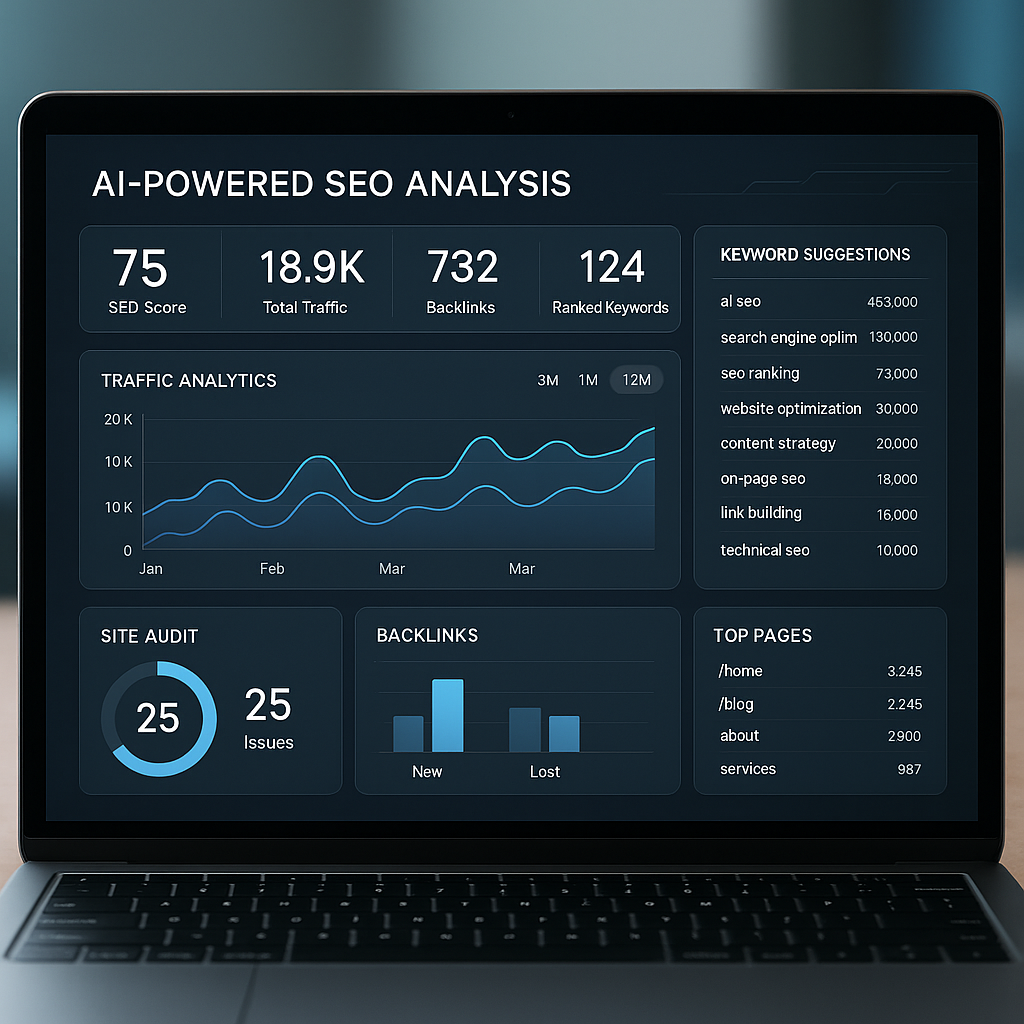
Imagine a roadmap that anticipates rising queries six months in advance: this is now possible. Predictive analysis modules scrutinize social trends, seasonal variations, and even external signals (news, social networks) to guide you towards high-potential keywords.
Strategies to Integrate AI into Your SEO Workflow
Automating does not mean letting go: it is a partnership where the human keeps the strategic control. By combining the SEO specialist’s critical eye and AI’s computing power, you achieve multiplied efficiency.
Intelligent Automation of Repetitive Tasks
Extraction of broken links, internal linking audits, or position tracking: everything is done in a few seconds. You receive detailed reports and clear recommendations without having to endure the routine.
Personalization of the User Experience
The real asset is to offer each visitor content that speaks to them. AI can adapt in real time the highlighting of articles, products, or sections according to the profile, previous visits, or even the time of day.
Case Studies and Feedback
Several SEO agencies have already taken the step and observe organic traffic increases of 30 to 50%. For example, an e-commerce site used an AI generator to restructure its product pages: result, a 35% increase in clicks from Google Shopping.
Jokes aside, the most surprising thing is sometimes the simplicity of deployment: a few well-configured APIs are enough to make your site more “intelligent”.
Risks, Limits, and Ethical Best Practices
Since AI is not infallible, it can produce redundancies or inconsistencies. It is not about letting a robot write your strategy without proofreading or adjustments.
Avoid Automatically Generated Duplicate Content
Models can draw inspiration from descriptions that are too similar. Regular human checks prevent duplication and ensure a unique style.
Transparency and Respect for Privacy
Some tools collect user data to refine their recommendations. Check GDPR compliance and inform your visitors transparently.
Outlook for the Future
In 2025, SEO will no longer be limited to a few isolated experts: it is a collaborative approach where AI and humans co-create richer content. The icing on the cake: small sites can compete with giants, provided they use these tools strategically.
Ultimately, the secret lies in smart delegation: entrusting mechanical tasks to AI to free your creativity and your ability to tell stories that leave a mark.
FAQ
- How does AI improve keyword research?
- By processing massive volumes of data and identifying hidden trends before they explode.
- Will AI automation replace SEO experts?
- No: humans remain the arbiters, AI is just a co-pilot that executes repetitive tasks.
- Which AI tools should beginners choose?
- Platforms with content generation modules and predictive analysis, like some popular SaaS, for quick deployment.