To verify an international number, read its country code, reformat the number, search for it without calling back, cross-check reports, then block or report the suspicious contact. This method allows identifying the country or numbering area associated, without claiming to know the real identity of the caller.
An international code provides information about a numbering plan, not about an address or the person using the line. The right reflex is therefore not to click on any links, not to share any codes, and to treat any unexpected call as information to verify.

Correctly reading an international number
An international number is generally recognized by the “+” sign followed by a country code, then the national number without its local prefix. This reading reveals an assigned numbering area, while the caller’s identity, real location, and communication reliability remain unknown.
Recognizing the international format
The standardized E.164 format starts with a country code and can contain up to 15 digits, not counting the “+” sign. It does not include spaces, parentheses, or dashes in its technical form, although phones often add these separators to facilitate reading.
The national prefix disappears when switching to the international format. For a French number written locally as 01 42 68 53 00, the initial zero becomes +33: the readable format is therefore +33 1 42 68 53 00.
In practice, start by isolating the digits immediately following the “+”. The country code consists of one to three digits depending on the numbering plan. France uses +33, while the United States and Canada share the +1 code in the North American Numbering Plan.

What the code really allows to identify
The code allows associating a number with a country or a numbering area. It does not provide GPS location, postal address, or the holder’s name. A French number can be used from abroad, notably in roaming, while a foreign number can be displayed by a person present in France.
Moreover, a virtual number adds another difficulty: it can receive calls or SMS via an online service, without directly corresponding to the SIM card of a traditional phone. An international call, roaming, and a virtual number thus designate three different situations.
- International call: the communication crosses a telephone border or targets a number linked to another country.
- Roaming: the subscriber uses their plan from another country, without necessarily changing the number.
- Virtual number: the number is managed by a platform or an online service, with a technical location sometimes different from that of the user.
How to verify an international number without calling it back?
Verify an international number remotely by keeping its original format, searching for multiple variants, and comparing the results with an official source or a reporting tool. This approach avoids unexpected charges, makes it less likely to confirm that your line is active, and limits exposure to malicious contacts.
Step 1: reformat and search the number
Copy the displayed number without adding any personal information. First keep the version with “+”, then try a version without spaces and a national version if the country is clearly identified. Do not call the number during the search.
Place the variants in quotation marks in a search engine, then observe the context of the results. A number reported on several pages for automated calls is a useful clue. A lack of results proves nothing: public databases do not list all lines and scammers change numbers quickly.
If the message contains a link, search for the organization’s name separately instead of using the received address. Open the official site from an independent search. To deepen the reading of an area code, you can also check the origin of a number without calling the correspondent back.

Step 2: compare sources without exposing your data
Compare three elements: the area code, the reason for contact, and available reports. An international reverse directory can help when it clearly documents its method, publisher, and terms of use, while an opaque service that requires your address or contacts should be avoided.
| Source consulted | Useful information | Limit to keep in mind |
|---|---|---|
| ITU numbering plan | Code assigned to a country or area | Does not confirm the caller or current use of the number |
| Telephone operator | Pricing, blocking, and reporting | Does not always have the identity of the displayed sender |
| Official reporting platform | Procedure adapted to calls, SMS, or fraudulent content | Delays and channels vary by country |
| Transparent reverse directory | Comments or categories of reports | Incomplete database, possible errors, and data collection to monitor |
In France, check the 33700 procedure for unwanted SMS and calls, then consult Cybermalveillance.gouv.fr for advice related to fraudulent messages. In case of a banking request, log in directly to your bank’s official app, without using the transmitted number or link.
Step 3: check the cost before any action
Before calling back, check your operator’s pricing grid for the destination concerned. The price may apply to the minute, SMS, or mobile data; it varies according to the country of departure, the country called, the plan, and activated options.
An example published by SFR mentions calls to France at €0.23 per minute from Andorra, €1.32 from Switzerland, and €1.56 from the United States, as well as SMS ranging from €0.07 to €1.58 depending on the zone. These amounts are indicative, dated from the consulted grid, and must be verified in your offer before any communication.
Received SMS are generally treated differently from sent SMS. A messaging app using the Internet can also modify the cost structure, without making the contact reliable for all that.
Recognizing a Suspicious International Number
An international call becomes suspicious when the unexpected contact combines pressure, unusual requests, and lack of independent verification. The foreign country code provides a technical clue; the observed behavior, message content, and imposed urgency help decide whether to end the exchange.
“A foreign country code necessarily signals a scam” is an incomplete misconception. Relatives, businesses, or legitimate services use foreign numbers, while a fraud can display a national number.
A displayed number is never enough to authenticate the caller. Number spoofing, often called “spoofing,” allows a fraudster to make the number of another person, a company, or a known service appear.
Refuse the exchange when a caller asks for a code received by SMS, a password, a copy of an identity document, bank details, or urgent installation of an application. Do not follow instructions to transfer calls and do not disable any protection to “unlock” an account.
- Very short call intended to provoke a callback.
- Alarmist message announcing a blocked package, an invoice, or account closure.
- Request for secrecy, validation code, or immediate payment.
- Shortened link, strange address, or unusual mistake in an allegedly official message.
- Caller who refuses verification via the public number of the organization.
Thus, the best test is to hang up and then look up the concerned organization yourself, its official website, and its public number. In this case, never call back the number displayed in the message.
What to Do After a Suspicious Call or Message?
After a suspicious contact, interrupt the exchange, keep the evidence, block the number, and use the appropriate official channel. If you have transmitted sensitive data or made a payment, act immediately with your bank or the concerned service, then report the facts to the competent authorities.
Step 4: Secure the Situation
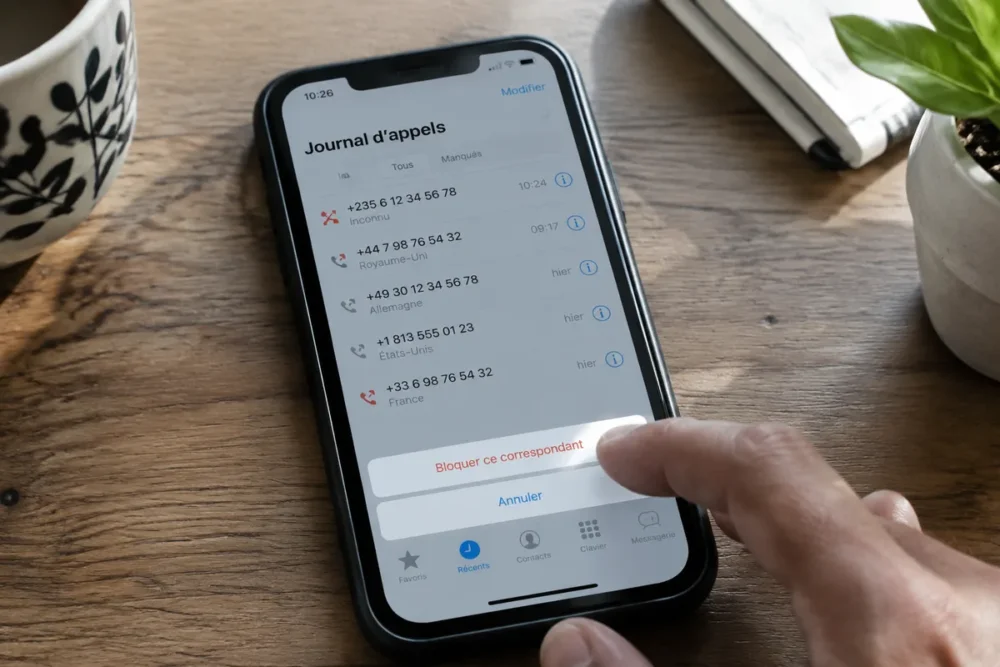
If you have not communicated any information, do not respond further, block the number, and keep a screenshot of the call log or SMS. Do not delete the elements before reporting: the time, exact text, displayed number, and received link can help qualify the incident.

If you opened a link, close the page and do not fill out any additional forms. Change the password from the official site if you entered it, enable two-factor authentication, and check open sessions when the service offers this feature.
If a bank code, identifier, or payment data was transmitted, contact the institution immediately via its official number. Request a block when necessary, monitor transactions, and keep exchanges for a complaint or report.
And if an application was installed at the caller’s request, uninstall it only after preserving useful elements, run available security checks, and have the device examined if remote access was granted.
Step 5: Report the Fraudulent Number
Adapt the report to the channel used: 33700 in France for unwanted SMS and calls, operator for blocking, bank for a financial transaction, and competent public services for confirmed fraud. A complaint may be necessary when money, identity, or an account has been compromised.
Reporting does not guarantee immediate removal of the number, especially if the display was spoofed. It remains useful to document the campaign and protect other recipients.
Final check before responding
Respond only after confirming the correspondent’s identity through an independent channel: official website entered manually, number printed on a reliable document, or already recorded contact. Any lingering doubt is enough to interrupt the exchange and report the number; no urgent conversation justifies sharing a code.