| Key Points | Details to Remember |
|---|---|
| 🖥️ Definition | Processing data at the network edge rather than at the heart of the cloud |
| 🔄 Operation | Distribution of Edge nodes to reduce latency |
| 🚀 Benefits | Increased responsiveness and bandwidth savings |
| 💡 Use Cases | IoT, autonomous vehicles, Industry 4.0, connected healthcare |
| ⚙️ Challenges | Security, distributed management and complex orchestration |
| 🔐 Perspectives | 5G/AI convergence and new hybrid models |
Behind a somewhat technical term lies a profound change in the way we conceive information processing: Edge Computing. Rather than sending every byte to a distant computing center, it is “dropped off” where it is born — sensors, phones, industrial machines. The result? Less latency, more privacy, and unprecedented uses for those who know how to take advantage of this proximity.
Understanding Edge Computing
When we talk about cloud computing, we often imagine a distant, gigantic data center capable of storing and analyzing petabytes of data. In reality, not all scenarios require such a journey. Edge Computing is the idea of processing part of the information flow directly “at the source,” in mini-servers or embedded devices.
This approach does not aim to replace the cloud but to complement it: latency-sensitive or bandwidth-heavy tasks are offloaded to local nodes, while heavy analyses, long-term archiving, or resource-intensive Machine Learning continue to be entrusted to the core network.
Edge vs Cloud: a Complementarity
One might think this is a direct competition. In reality, it is a division of labor:
- Central cloud for massive storage, model training, and global aggregation.
- Edge for instant responsiveness, local collection, and preprocessing.
Concretely, a temperature sensor in a factory can first filter, compress, and alert locally, then periodically transfer aggregated data for global monitoring in a data center.
How Does Edge Computing Work in Practice?
Behind this concept, a hybrid ecosystem is put in place:
- Peripheral devices (IoT, cameras, PLCs) that generate and sometimes process data.
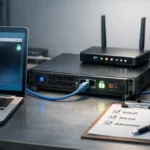
- Edge mini-servers installed at the network edge, often in rack cabinets or industrial enclosures.
- Orchestrators (Kubernetes, OpenStack, proprietary solutions) to dynamically deploy and manage services.
- Gateways to secure and route the flow between Edge and central cloud.
Each Edge node executes specific functions – filtering, image recognition, time series analysis. The goal remains constant: bring the code closer to the sensors.

The main advantages of Edge Computing
Adopting Edge Computing is above all about reacting faster: a smoke detection signal processed locally immediately triggers the alarm, without going through an intercontinental server. The gains are often measured in milliseconds.
- Minimal latency for critical applications (autonomous vehicles, industrial process control).
- Optimized bandwidth: the raw sensor stream is no longer transferred, but preprocessed or aggregated data.
- Increased privacy: sensitive information stays on site, reducing the exposure surface.
- Resilience: if the link to the cloud is cut, Edge services continue to operate autonomously.
According to a 2022 IDC report, 75% of data generated by IoT will not be processed in the cloud by 2025, but closer to the sensors. This evolution is explained by the explosion of volumes and the multiplication of real-time uses.
Application areas and concrete cases
The first champions of Edge Computing are unsurprisingly the sectors where every millisecond counts. Automotive, healthcare, and industry have already adopted hybrid architectures.
| Sector | Typical use | Impact |
|---|---|---|
| Automotive 🚗 | Sensor analysis for emergency braking | Reduction of accidents thanks to instant reactions |
| Healthcare 🏥 | Remote monitoring and real-time diagnosis | Better care and saving human lives |
| Industry 4.0 🏭 | Predictive maintenance of machines | Optimization of downtime and reduction of maintenance costs |
| Retail 🏬 | Behavioral analysis in stores | Instant personalization of the offer |
Connected farms can also be imagined where each drone or soil sensor makes local decisions, then sends a summary for precision agriculture. The example of ABB Ability™ clearly illustrates this synergy between Edge and cloud to offer real-time industrial supervision.
Challenges and issues to address
Nothing is ever free in distributed computing. Installing Edge boxes in every corner of a factory, hospital, or farm requires very precise logistics and management.
- Security: each node becomes a potentially vulnerable entry point. Encryption, strong authentication, and automatic updates are imperative.
- Management and orchestration: coordinating hundreds of micro-services deployed at the edge is no small feat. Kubernetes Edge or Azure IoT Edge solutions have emerged to meet this need.
- Standardization: lack of a universal standard, diversity of protocols (MQTT, CoAP, OPC UA)… interoperability remains an open issue.
- Operational cost: deploying and maintaining on-site equipment generates operating expenses, especially in demanding environments (temperature, dust).
Future Perspectives and Developments
While 5G promises blazing speeds and ultra-low latency, it does not eliminate the need for Edge: it strengthens it. We now talk about Multi-Access Edge Computing (MEC) where telecom operators integrate servers directly at the base of antennas.
At the same time, embedded artificial intelligence is maturing: lightweight models (TinyML) and optimized frameworks (TensorFlow Lite, OpenVINO) allow neural networks to run at the edge. The future is shaping up in a hybrid mode:
“Edge infrastructures will be orchestrated in concert with public and private clouds, forming a continuum of services.”
— Gartner Report, 2023
Finally, the rise of quantum computing or neuromorphic architectures could soon add an additional dimension to the Edge, offering processing capabilities still unmatched directly on site.
FAQ
What is the difference between Edge Computing and Fog Computing?
Fog Computing is positioned halfway between the central cloud and the Edge, often at the metropolitan network level. The Edge, on the other hand, is literally closest to the sensor. Fog can be seen as an intermediate “light cloud.”
Will Edge Computing replace the central cloud?
Rather than replacing, it complements. Tasks requiring heavy computation will remain in data centers, while real-time uses migrate to the edge.
What are the costs to deploy an Edge infrastructure?
Besides hardware (100-500 € per node depending on robustness), management, energy, and maintenance costs must be considered. “Edge as a Service” offerings are beginning to emerge to smooth these expenses.
Which protocols are favored at the Edge?
MQTT and CoAP for their lightness, OPC UA in industry for interoperability, HTTPS or gRPC depending on security and performance needs.