| Key Points | Details to Remember |
|---|---|
| 🔎 Definition | Browser scanning: evaluation of client-side vulnerabilities and performance. |
| 🚀 Major tools | BrowserScan, WebScanPro, SnapInspect. |
| ⚙️ Features | Detection of malicious extensions, CORS tests, JS audit. |
| 🏆 Performance | Speed of execution and accuracy of reports. |
| 📂 Integration | REST API, CI/CD plugins, and customizable dashboards. |
| ⚖️ Pricing | Flexible plans, open source license or SaaS subscription. |
| 🤝 Support | 24/7 support and comprehensive documentation. |
Auditing a website’s attack surface is no longer limited to servers: browsers have become a major entry point for hackers and a lever for SEO optimization. This comparison puts BrowserScan side by side with its challengers, examining every aspect : speed, functional coverage, common integrations, and costs. The goal ? To help you identify the tool best suited to your operational and strategic needs.
Why browser scanning is essential today
Once limited to server audits, browser scanning is evolving under the influence of two strong trends. On one hand, malicious extensions and session hijacking exploit JavaScript vulnerabilities. On the other hand, the SEO challenge pushes to verify how bots and mobile users interact with pages. The result : a modern browser scanning tool must both detect vulnerabilities and measure perceived performance.
Beyond security, it can also be considered a quality assistant. Do you want to know if your SPA responds in less than 200 ms or if your CORS security policy blocks a critical call ? These solutions generate structured reports and often offer clear recommendations to optimize client-side rendering.
Comparing tools: essential criteria
Performance and speed
An overly resource-intensive scan slows down your CI/CD pipelines and discourages regular use. BrowserScan stands out with an asynchronous architecture, capable of launching multiple sessions in parallel without consuming the main server’s resources. At WebScanPro, scalability is also present, but a slight lag is noted when pushing beyond 10 simultaneous instances. SnapInspect, for its part, offers a somewhat slower execution but a more faithful visual rendering of pages.
Functional coverage
When it comes to tests, nuance makes the difference. BrowserScan covers:
- XSS and CSRF vulnerabilities targeting embedded scripts.
- Potentially malicious extensions and plugins.
- SEO compliance and accessibility (WCAG).
WebScanPro relies more on a third-party JavaScript scanner and a pentest module via Selenium. SnapInspect shines with its Web Vitals performance analysis engine, a paid option with the others.
Integration and Automation
Whether you work with Jenkins, GitLab CI, or Azure DevOps, BrowserScan’s REST API integrates seamlessly. A simple POST call is enough to launch a batch of scans, then reports can be retrieved in JSON or PDF. WebScanPro offers a ready-to-use npm plugin, while SnapInspect integrates natively into certain front-end frameworks, avoiding double configuration.
Ease of Use and Support
In terms of onboarding, BrowserScan offers an intuitive web interface and step-by-step tutorials. Teams join a dedicated Slack chat and receive a response in under 30 minutes on average. WebScanPro provides premium support at any time, but some users regret the lack of video tutorials. SnapInspect invests heavily in technical documentation, which is comprehensive but somewhat austere for non-specialists.
Pricing and Licensing Models
Financially, BrowserScan adopts a freemium model: a free plan limited to 100 scans per month, then tiers at €29/month, €99/month, and a custom enterprise offer. WebScanPro offers pay-as-you-go pricing, interesting for very occasional needs, but the unit price can rise quickly. SnapInspect prefers an open-source license, with paid support at €199/year, ideal for small technical teams.
BrowserScan Put to the Test
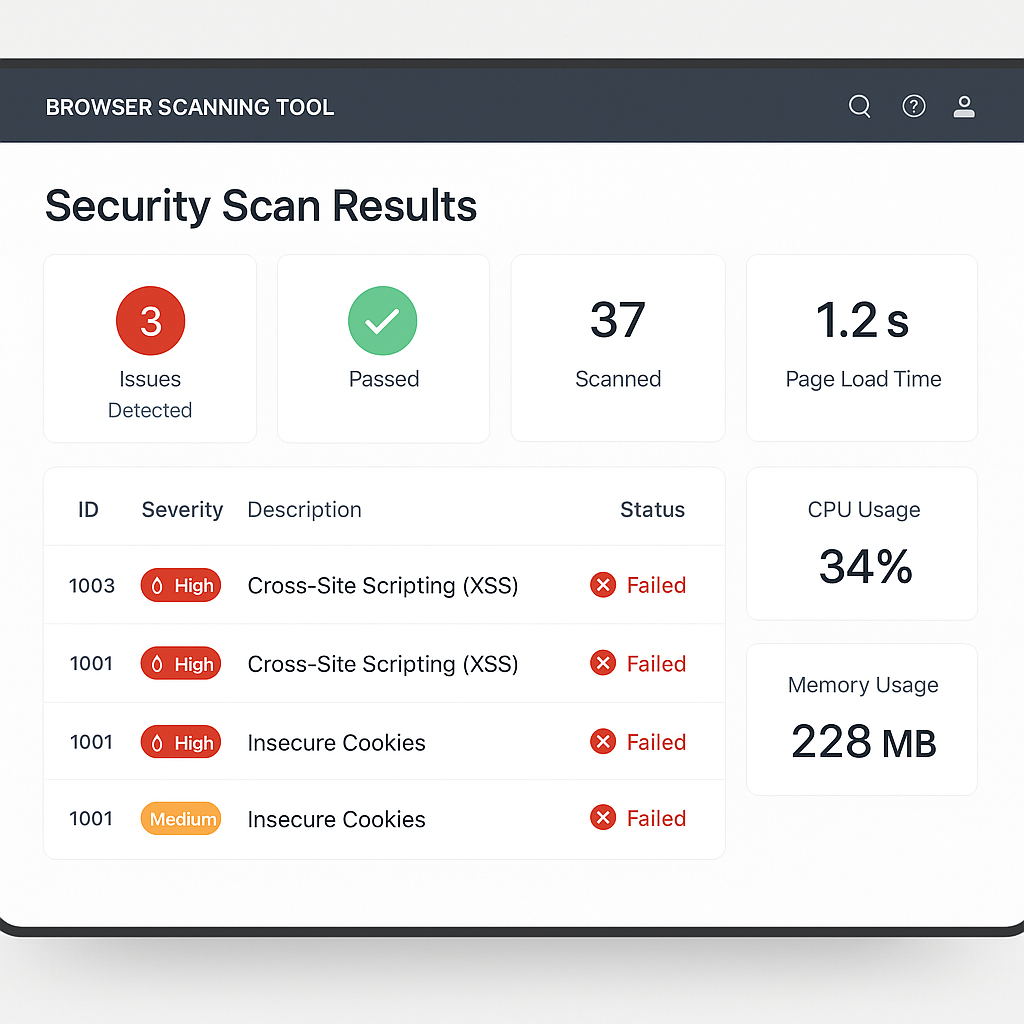
To objectively test the tools, we launched a prototype of a fictitious site integrating various use cases: dynamic forms, React components, cross-origin API calls, third-party extensions, and audio/video modules. Here is a comparison of the results on the same environment (dual-core, 4 GB RAM):
| Feature | BrowserScan | WebScanPro | SnapInspect |
|---|---|---|---|
| XSS Vulnerabilities | ✅ Advanced detection | ✅ Basic recognition | ✅ JS profiling |
| SEO Report | ✅ WCAG & Mobile audit | ⚠️ SEO only | ⚠️ Not included |
| Average Time | 45 s | 52 s | 65 s |
| API & CI | ✅ REST + plugins | ✅ npm plugin | ⚠️ Manual configuration |
| Support | ⏱ 30 min | ⏱ 15 min (premium) | 📖 Documentation only |
Practical Cases and Feedback
An e-commerce team adopted BrowserScan to automate security audits before each deployment. Result: 40% of JavaScript regressions detected upstream, significantly reducing production incidents. Meanwhile, a SaaS startup opting for SnapInspect focused on user performance and reduced its Largest Contentful Paint by 600 ms thanks to the tool’s recommendations. Finally, a major finance client chose WebScanPro for its pentesting module integrated into their internal platform, while relying on premium support for in-depth monthly audits.
Final Tips for Choosing Wisely
- First define your goals: security, SEO, user performance.
- Evaluate scan frequency: heavy use points to a fixed subscription.
- Test the learning curve: favor an intuitive solution if the team is small.
- Anticipate CI/CD integration to avoid wasting time.
- Consider support and the community around the tool.
FAQ
What is a browser scan?
It is an automated check that simulates browsing to detect vulnerabilities, performance issues, and SEO or accessibility non-compliances.
Why BrowserScan instead of an open source competitor?
BrowserScan’s freemium plan already includes advanced modules (WCAG audit, XSS tests) that are often paid elsewhere, with responsive support.
Can it be integrated with Jenkins or GitLab CI?
Absolutely: BrowserScan offers a REST API and dedicated plugins for the most common pipelines.
Is the SEO report really useful?
Yes, it highlights client-side blocking points that impact mobile and desktop rankings, such as rendering time or the absence of ARIA tags.
Which tool for a one-time audit?
WebScanPro on a pay-per-use basis can be more cost-effective if your needs do not exceed a few dozen scans per month.
{
“@context”: “https://schema.org”,
“@type”: “WebPage”,
“about”: {
“@type”: “Thing”,
“name”: “Comparatif outils scan navigateurs”
},
“keywords”: [“browser scan”, “scan navigateurs”, “BrowserScan”, “audit sécurité”, “WebScanPro”]
}
{
“@context”: “https://schema.org”,
“@type”: “Article”,
“headline”: “Comparatif des meilleurs outils de scan de navigateurs : BrowserScan face à la concurrence”,
“description”: “Analyse approfondie des meilleurs outils de scan de navigateurs et évaluation de BrowserScan par rapport à WebScanPro et SnapInspect pour choisir la solution la plus adaptée.”,
“keywords”: [“browser scan”, “BrowserScan”, “WebScanPro”, “audit sécurité”, “scan navigateurs”],
“mainEntity”: {
“@type”: “FAQPage”,
“mainEntity”: [
{
“@type”: “Question”,
“name”: “Qu’est-ce qu’un scan de navigateurs ?”,
“acceptedAnswer”: {
“@type”: “Answer”,
“text”: “Il s’agit d’un contrôle automatisé qui simule la navigation pour détecter failles, problèmes de performance et non-conformités SEO ou accessibilité.”
}
},
{
“@type”: “Question”,
“name”: “Pourquoi BrowserScan plutôt qu’un concurrent open source ?”,
“acceptedAnswer”: {
“@type”: “Answer”,
“text”: “Le plan freemium de BrowserScan inclut déjà des modules avancés (audit WCAG, tests XSS) souvent payants ailleurs, avec un support réactif.”
}
},
{
“@type”: “Question”,
“name”: “Peut-on l’intégrer à Jenkins ou GitLab CI ?”,
“acceptedAnswer”: {
“@type”: “Answer”,
“text”: “Absolument : BrowserScan propose une API REST et des plugins dédiés pour les pipelines les plus courants.”
}
},
{
“@type”: “Question”,
“name”: “Le rapport SEO est-il vraiment utile ?”,
“acceptedAnswer”: {
“@type”: “Answer”,
“text”: “Oui, il met en évidence les points bloquants côté client qui impactent le classement mobile et desktop, par exemple le temps de rendu ou l’absence de balises ARIA.”
}
},
{
“@type”: “Question”,
“name”: “Quel outil pour un audit ponctuel ?”,
“acceptedAnswer”: {
“@type”: “Answer”,
“text”: “WebScanPro en pay-per-use peut être plus rentable si vos besoins ne dépassent pas quelques dizaines de scans par mois.”
}
}
]
}
}