| Key Points | Details to Remember |
|---|---|
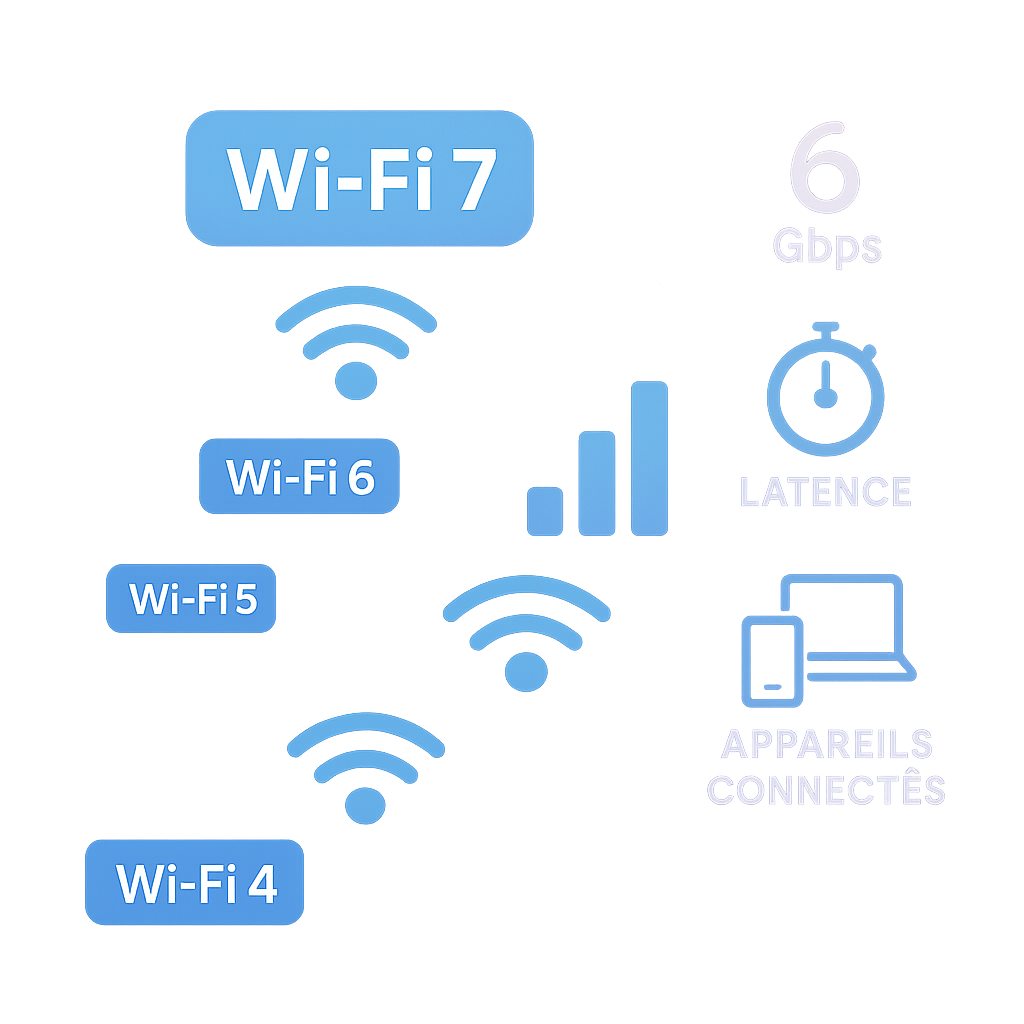
| 🚀 New Generation | Wi-Fi 7 quadruples the theoretical speeds of Wi-Fi 6 |
| ⚡ Minimal Latency | Response in less than 2 ms for real-time applications |
| 🛡️ Improved Stability | MLO technology combines multiple bands simultaneously |
| 🏠 Revolutionary Uses | Ideal for virtual reality, cloud gaming, and connected homes |
| 🔌 Progressive Compatibility | Works with older devices but limits their performance |
| 💸 High Initial Cost | Current hardware 20 to 40% more expensive than Wi-Fi 6E |
Imagine downloading a 4K movie in two seconds, playing a video game via streaming with no latency, or controlling 80 connected devices without slowdown. This is what Wi-Fi 7 promises, the new wireless standard that will transform our digital daily lives. Behind this figure lies a technological revolution much deeper than a simple increase in speed. This IEEE 802.11be standard brings structural changes that meet the growing needs of our connected environments. We move here from simple “internet access” to a true wireless digital infrastructure, capable of simultaneously managing complex multimedia streams and critical applications. But like any innovation, it also has practical limits that you need to know before taking the plunge.
Understanding the Technical Foundations of Wi-Fi 7
What fundamentally distinguishes this new standard are three key innovations that work in synergy. The first concerns spectrum use: Wi-Fi 7 exploits ultra-wide 320 MHz channels, which is double the maximum width of Wi-Fi 6. Imagine a highway expanding from four to eight lanes – data flow can move much more freely. This expanded bandwidth mainly operates on the 6 GHz frequency, less congested than the traditional 2.4 GHz and 5 GHz bands.
The Magic of Multi-Link Operation (MLO)
The real breakthrough comes from MLO, a feature that radically changes how devices communicate. Until now, your smartphone had to choose between the 5 GHz band (fast but limited range) and 2.4 GHz (slow but long range). With Wi-Fi 7, compatible devices can use multiple frequency bands simultaneously to transmit data. It’s like being able to take three different routes at the same time to deliver a package. Concrete result: no more dropouts when moving from one room to another and extremely reduced latency.
QAM-4096: Smart Compression
Another significant advancement: QAM-4096 modulation. Without going into too much technical detail, this means increasing the number of symbols transmitted in each radio wave “packet.” Compared to Wi-Fi 6’s QAM-1024, Wi-Fi 7 encodes 20% more data in the same signal. For the user, this translates to actual speeds closer to the announced theoretical values, even in crowded environments. Laboratory tests conducted by Broadmont Technologies show a 25% gain in connection stability in dense buildings.
Concrete Benefits for the End User
Forget the abstract technical numbers: what really matters is how Wi-Fi 7 will change your everyday digital experience. The first noticeable change will be the disappearance of buffering during 8K streaming.
With theoretical speeds reaching up to 46 Gbps (compared to 9.6 Gbps for Wi-Fi 6), even the most demanding content loads instantly. But the real revolution lies elsewhere: in ultra-low latency.
The end of lags in gaming and virtual reality
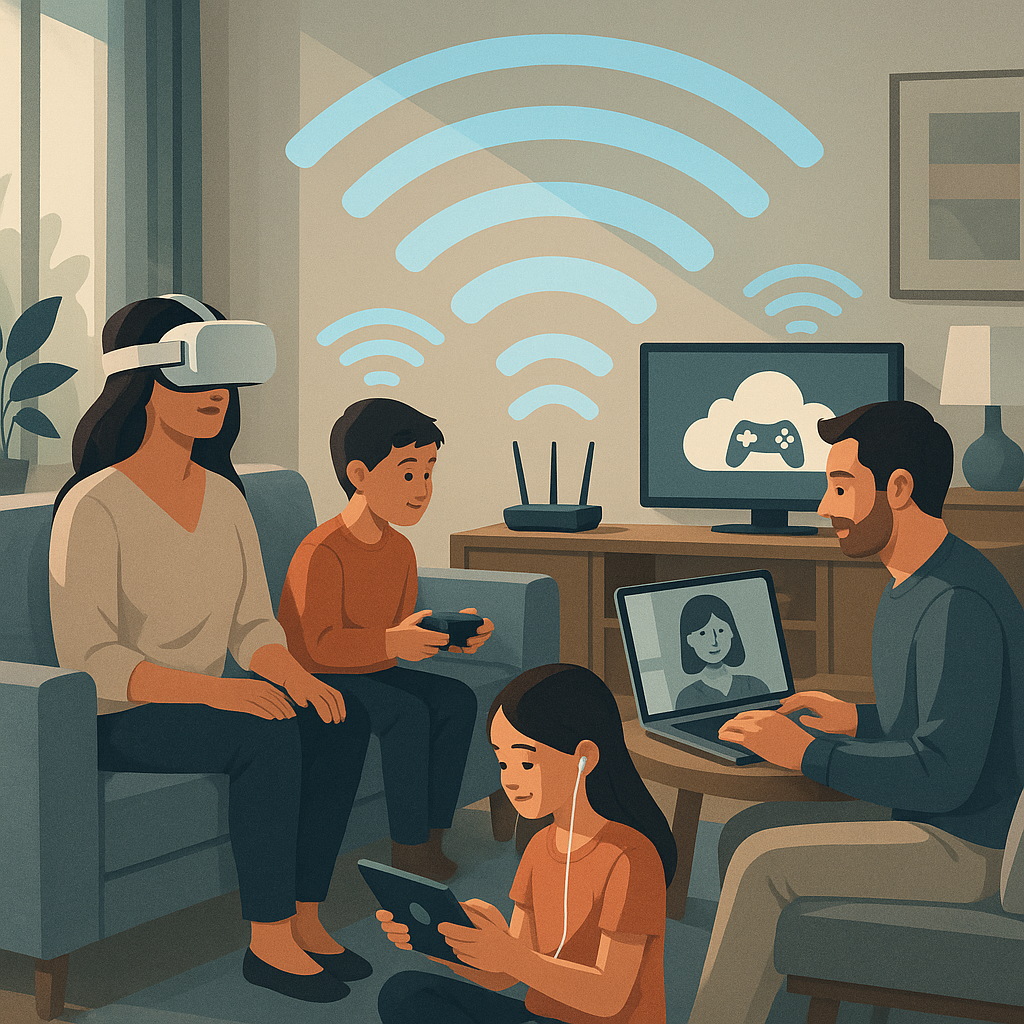
For gamers, Wi-Fi 7 is a blessing. Response times drop below 2 ms – a performance until now reserved for wired connections. You will finally be able to play cloud gaming on your TV without perceiving any delay between your controller and the screen. The same advantage applies to virtual reality: no more nausea caused by the lag between your movements and the headset display. Prototypes tested with the Meta Quest 3 show an 80% reduction in motion sickness thanks to this increased responsiveness.
Enhanced stability in dense environments
Where Wi-Fi 7 truly excels is in managing saturated environments. The Multi-RU (Resource Unit) technology allows the router to dynamically allocate channel portions to different devices according to their immediate needs. Concretely, while your teenager streams a 4K match, your Zoom meeting will continue without stuttering. In real-world tests conducted by the Wi-Fi Alliance, a Wi-Fi 7 router managed 50% more devices without service degradation compared to its Wi-Fi 6 equivalent.
Limitations and practical challenges
Before rushing to buy equipment, it is important to be aware of current constraints. The first barrier is hardware: to fully benefit from Wi-Fi 7, both your router AND your devices must be compatible. Your latest smartphone? If it dates from before 2023, it will not be able to exploit MLO or 320 MHz channels. This is the “weakest link” syndrome: the overall connection will adapt to the most limited device.
Wave penetration issue
Another physical challenge: the 6 GHz frequencies, although less congested, have lower penetration through materials. A reinforced concrete wall can attenuate the signal by up to 40% compared to 5 GHz according to ARCEP measurements. This means that in large houses, a multi-access point installation remains necessary. Fortunately, the standard includes coordination mechanisms between nodes to facilitate mesh deployments, but this complicates the initial installation.
Cost and availability
Finally, let’s talk budget. The first Wi-Fi 7 routers are priced between €400 and €700 – a significant extra cost compared to Wi-Fi 6E. And on the device side, only recent flagships like the Samsung Galaxy S24 or the iPhone 15 Pro are equipped. This premium is expected to decrease by 2025 according to Gartner analysts, but for now, adoption remains an investment. Another downside: regulation. Some countries like Russia have not yet opened the 6 GHz band, thus limiting potential benefits.
Revolutionary uses and concrete cases
Wi-Fi 7 is not just a simple technical evolution – it opens the door to entirely new uses. Take connected health as an example: real-time medical monitoring devices will be able to transmit vital data without the risk of critical latency. Prototypes of telemedicine systems using augmented reality have already reduced diagnostic errors by 30% during remote clinical trials.
Transformation of professional spaces
In companies, Wi-Fi 7 will streamline collaborative spaces. Imagine meeting rooms where 30 participants simultaneously share UHD video streams without any slowdown.
Industrial applications are just as promising: real-time control of robots, remote maintenance via augmented reality, or dense supervision of IoT sensors. Pilot factories at Siemens have already tested local networks based on this technology, advantageously replacing some Ethernet cabling.
Revolution in Home Audiovisual
For movie lovers, Wi-Fi 7 changes the game with Wireless HDMI. No more cables between your TV box and your 8K projector – wireless now offers the necessary bandwidth. Multiroom audio systems achieve perfect synchronization between speakers, eliminating perceptible delays. Brands like Sonos and Bose are already preparing products exploiting these capabilities for 2025.
Should You Switch to Wi-Fi 7 Today?
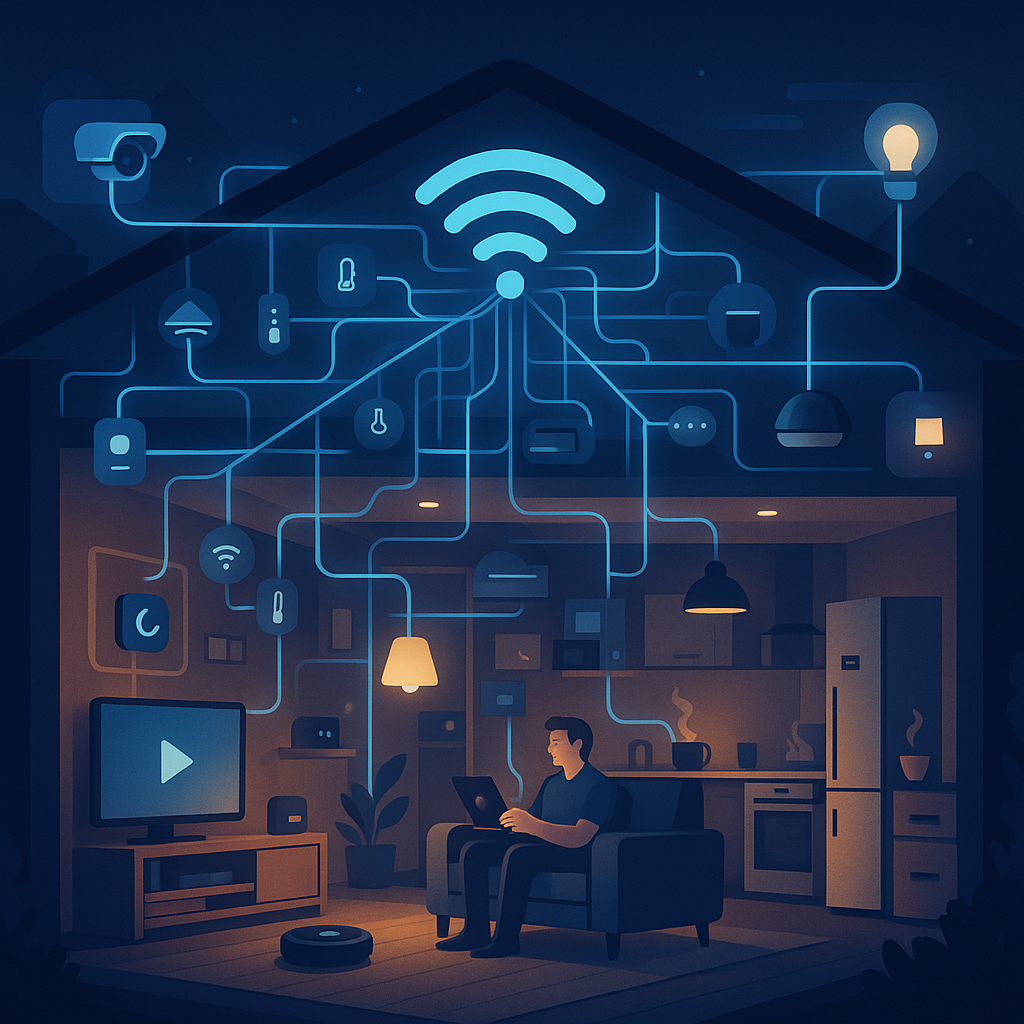
The answer depends on your current and future usage. If you are a compulsive gamer, a video editing professional, or an early adopter of a dense smart home, the investment may be justified right now. High-end routers like the TP-Link Deco BE95 already offer remarkable performance. But for most households with standard needs (HD streaming, occasional teleworking), Wi-Fi 6E remains more than sufficient for another 2 to 3 years.
Tips for a Successful Transition
If you take the plunge, prioritize devices certified “Wi-Fi 7 Certified” by the Wi-Fi Alliance to ensure interoperability. Also check that your internet box supports at least 2.5 Gbps Ethernet to avoid creating a bottleneck. Finally, think about the ecosystem: investing in a single compatible device hardly makes sense. It is better to plan a gradual renewal of your connected equipment. Network experts agree that 2025-2026 will be the ideal period for a complete migration, when prices have dropped and compatibility has become widespread.
Frequently Asked Questions About Wi-Fi 7
Is my old Wi-Fi 5 equipment compatible with Wi-Fi 7?
Yes, but with significant limitations. Your Wi-Fi 5 devices will be able to connect to a Wi-Fi 7 router but will not benefit from MLO or 320 MHz channels. Their throughput will remain the same as it currently is.
Does Wi-Fi 7 consume more energy?
Contrary to popular belief, no. Thanks to mechanisms like enhanced TWT (Target Wake Time), compatible devices can reduce their consumption by up to 30% compared to Wi-Fi 6 for similar tasks, according to IEEE measurements.
Do I need to change my internet box to benefit from it?
Not necessarily. A standalone Wi-Fi 7 router can connect to your existing box via Ethernet. Just make sure the Ethernet port used supports at least 2.5 Gbps to avoid limiting throughput.
Is the range better than with Wi-Fi 6?
On the 6 GHz band, the range is slightly lower. But thanks to MLO, which simultaneously uses 2.4 GHz and 5 GHz, the overall coverage is more stable and homogeneous, especially in complex environments.
When will Wi-Fi 7 become widespread?
Analysts predict a tipping point in mid-2025, when 60% of new high-end smartphones will integrate the technology. Complete democratization in connected home appliances will occur around 2027-2028.