| Key Points | Details to Remember |
|---|---|
| 🌐 Definition | Data processing as close as possible to their source rather than in the remote cloud |
| ⚡ Main Advantage | Drastic reduction of latency and required bandwidth |
| 🏭 Key Areas | Industrial IoT, autonomous vehicles, connected health, smart cities |
| 🔧 Operation | Network of local micro data centers (gateways, edge servers) |
| 🛡️ Security | Data secured locally without systematic transit to the cloud |
| 📈 Growth | Market expected to reach $274 billion by 2025 (Source: MarketsandMarkets) |
Imagine a factory where hundreds of sensors monitor the machines’ status in real time. Every second of latency in data analysis can cost thousands of euros in undetected downtime. This is where Edge Computing becomes indispensable. This technological revolution shifts computing intelligence from the clouds to the data sources themselves, creating a digital landscape radically different from what we knew. Far from being a mere gadget, this approach addresses concrete challenges that traditional cloud alone cannot solve.
What is Edge Computing? Technical Definition and Context
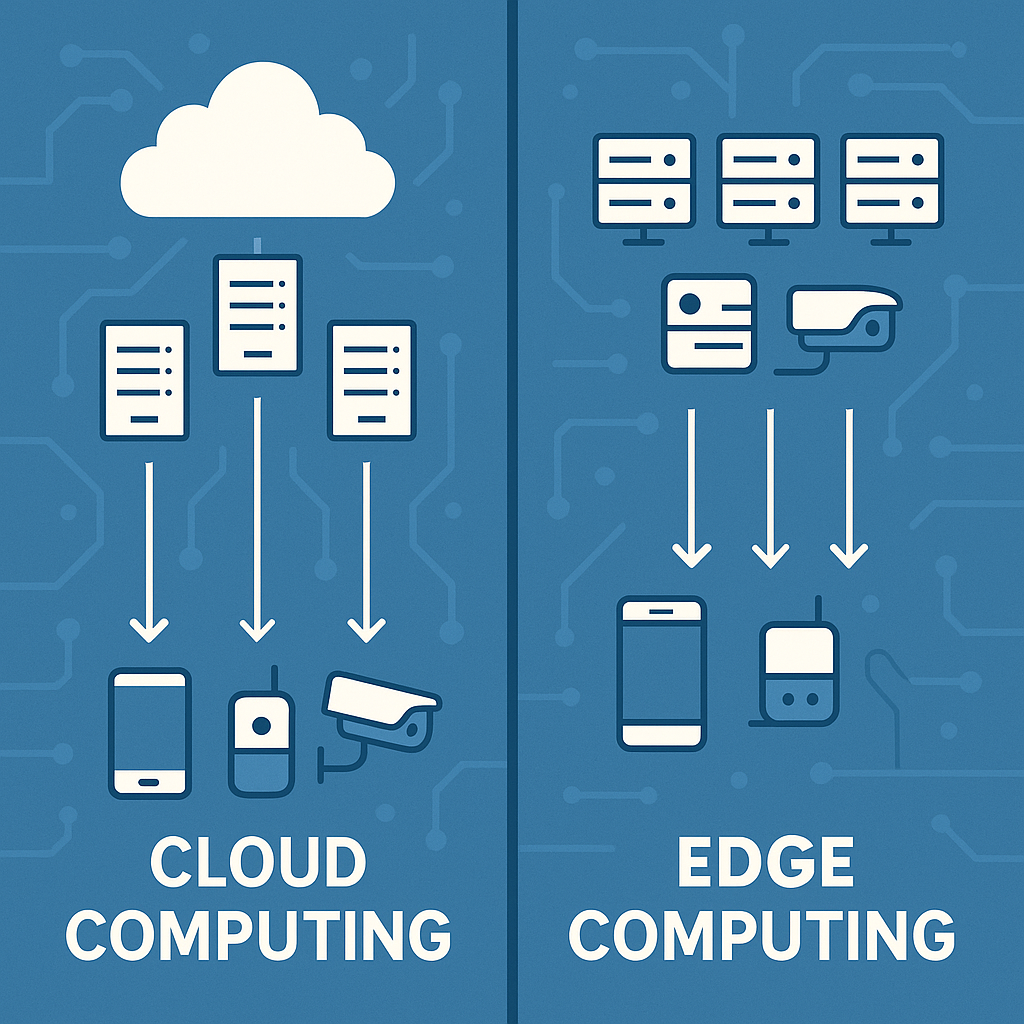
Edge Computing refers to a computing architecture where data processing takes place at the periphery (“edge”) of the network, physically close to the devices generating it. Unlike the classic cloud model that centralizes everything in data centers sometimes located thousands of kilometers away, this decentralized approach transforms every sensor, camera, or machine into a potential decision point.
The Birth of a Silent Revolution
The idea originated in the 1990s with Content Delivery Networks (CDN), but truly exploded with the Internet of Things. When a connected factory generates 5 petabytes of monthly data (equivalent to 5 million DVDs), sending it all to the cloud becomes inefficient. Pioneers like Cisco and IBM theorized this paradigm, but it was the urgency of real-time applications that imposed it. 5G acts as a catalyst by enabling speeds compatible with this massive decentralization.
How is it really different from fog computing?
Often confused with fog computing, edge differs by its granularity. Fog operates at the scale of a local network (factory, neighborhood), while edge processes data directly on the device or its immediate vicinity. A surveillance camera with embedded AI analyzing faces locally is edge computing. If it sends this data to a mini-server in the building for cross-referencing with other streams, that shifts to fog computing. This nuance directly impacts Edge architecture choices.
Why is Edge Computing becoming indispensable?
The race for responsiveness explains this transition. An autonomous vehicle traveling at 110 km/h covers 30 meters every second. A braking decision delayed by 100ms due to a cloud round trip equals 3 meters of lost control – an eternity in a critical situation. But latency is only one aspect of the problem.
The Economic Pressure of Data
Transferring 1 TB of data from an offshore oil platform costs about $20,000 via satellite. However, less than 10% of this data actually requires central analysis. Edge computing allows filtering and local preprocessing, sending only the essentials. Schneider Electric reports 30% savings on its cloud costs thanks to this optimization.
The Imperative of Resilience
When an internet connection fails, a purely cloud-based system becomes blind. Edge computing maintains critical operations: a medical ventilator continues to adjust its settings, a production line adapts to anomalies detected locally. This partial autonomy is vital for sensitive infrastructures.
“Edge Computing is not a replacement for the cloud, but its essential complement for applications where time and location are decisive” – Karim Bousta, CTO of Orange Business Services
How Does Edge Computing Work in Practice?
The typical architecture relies on three interconnected layers:
- Device layer: sensors and actuators with embedded computing capacity (e.g., AI cameras)
- Gateway layer: local mini-servers aggregating data from multiple devices
- Edge cloud layer: regional processing centers (within 100 km of the sources)
The Crucial Role of Intelligent Gateways
These often overlooked boxes are the workhorses of the system. A gateway in a wind farm can:
- Preprocess turbine vibrations to detect anomalies
- Aggregate data from 50 sensors into a single optimized stream
- Execute predictive maintenance algorithms locally
- Transmit only summary reports to the central cloud
This logic multiplies efficiency, especially in industrial IoT environments where raw data is massive but alone not very informative.
The Impact of 5G and MEC
Multi-access Edge Computing (MEC) changes the game by integrating servers directly into 5G antennas. The result: a surgeon performing a remote operation via augmented reality benefits from latency of 1 to 5 ms compared to 50 ms on 4G. This network/computing fusion is made possible by ETSI standards that standardize these hybrid architectures.
Concrete Applications: Where Edge Computing Is Already Transforming Our Lives
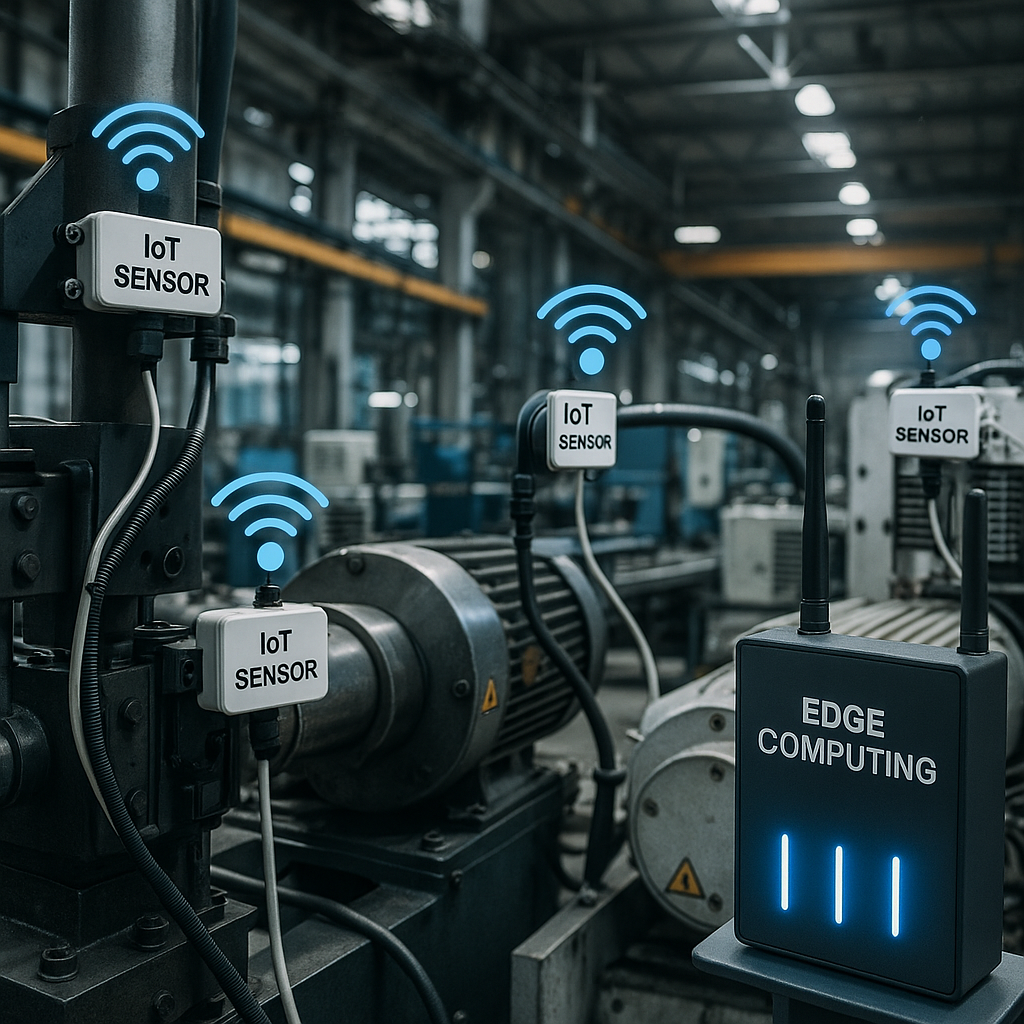
Industry 4.0 Revolution
In Siemens factories, collaborative robots adjust their movements in milliseconds thanks to edge computing. The benefits are tangible:
| Indicator | Average Improvement |
|---|---|
| Defect detection | Up to 90% faster |
| Energy consumption | -15% thanks to real-time adjustment |
| Predictive maintenance | 40% reduction in unexpected downtime |
Connected Health and Vital Emergencies
Next-generation cardiac monitors analyze ECG signals locally. They can alert even before an arrhythmia is visible to a doctor, while respecting the confidentiality of sensitive medical data that never leaves the device.
Smart Cities and Traffic Management
In Singapore, traffic lights dynamically adapt thanks to edge computing:
- Instant traffic analysis by smart cameras
- Cycle optimization without central intervention
- Measured 25% reduction in traffic jams during peak hours
Advantages and Challenges of Edge Computing
While the benefits are spectacular, this technology is not a magic wand. Understanding its limitations is crucial for proper implementation.
The 5 Decisive Strengths
- Minimal latency: Response in a few milliseconds
- Optimized bandwidth: Up to 95% less data transmitted
- Privacy compliance: Sensitive data processed locally
- Increased reliability: Partial operation without cloud connection
- Economic scalability: Costs proportional to local needs
Challenges to Overcome
Decentralization creates new challenges:
- Physical security: Protecting thousands of edge sites against theft or sabotage
- Firmware management: Updating millions of heterogeneous devices
- Standardization: Interoperability between manufacturers (challenge addressed by the Industrial Internet Consortium)
- Technical skills: Shortage of experts capable of managing these hybrid architectures
Future Perspectives: Where is Edge Computing Going?
Integration with embedded AI opens fascinating horizons. The next generations of chips (such as neuromorphic ones) will consume 100 times less energy for complex computations. We will see the emergence of:
- Real-time digital twins of entire cities
- Remote holographic surgery with haptic feedback
- Self-healing electrical grids thanks to edge computing
The real change will be cultural: accepting that part of our digital intelligence resides in everyday objects rather than in distant clouds. This technological proximity could well redefine our relationship with the digital world.
FAQ: Your Questions About Edge Computing
Will Edge Computing replace the Cloud?
Absolutely not. The two models are complementary. Edge handles urgent and local data, while the cloud remains essential for global, historical analyses and large-scale machine learning. We rather talk about intelligent hybridization.
Which sectors benefit the most today?
Manufacturing, telecommunications, healthcare, and transportation are at the forefront. But retail (real-time inventory tracking), agriculture (irrigation optimization), and even video games (cloud gaming) also benefit.
Is it secure to process sensitive data at the edge?
It is often safer! Less transit means less exposure to hacking. Solutions like integrated TPMs (Trusted Platform Modules) encrypt data at the source. The remaining challenge is physically securing these massively deployed devices.
Is it necessary to reinvent applications for the Edge?
Not necessarily. Platforms like AWS Outposts or Azure Stack allow running classic cloud applications on edge infrastructures. But to fully leverage the advantages, an architectural redesign (microservices, containers) is recommended.