1. 192.168.1.1: what is it?
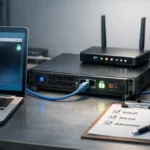
192.168.1.1 is a private IP address belonging to the 192.168.0.0/16 range defined by RFC 1918. Unlike public addresses, it is not routed on the Internet: it is used exclusively for internal communication within a local network (LAN). In most ISP boxes and consumer routers, it serves as the default gateway, meaning the mandatory passage point between your devices (PCs, smartphones, connected objects) and the web. By accessing the mini web server hosted on 192.168.1.1, you take control of:
- Wi‑Fi configuration (name, password, channels, 2.4 GHz / 5 GHz / 6 GHz bands)
- NAT and port forwarding (video games, NAS server, home automation)
- Parental controls and content filtering
- Firmware updates and monitoring connected devices
2. How to access the administration interface
- Connect your computer or smartphone to the network (Wi‑Fi or Ethernet cable).
- Open your browser and type http://192.168.1.1 (without
https). If the page stays blank, try http://192.168.0.1 or http://192.168.1.254. - The box displays a login form. Enter the default credentials found on the device label (often admin / admin or a unique password).
- At first access, immediately change the administrator password to enhance security.

3. Configure and optimize Wi‑Fi
3.1 Choose the right frequency band
The 2.4 GHz band penetrates walls better but offers lower speed; the 5 GHz band (or even 6 GHz on Wi‑Fi 6E routers) provides higher speed but reduced range. Activate both to enjoy smart switching (Smart Connect).
3.2 Select the ideal channel
A channel saturated by neighboring networks causes collisions and packet loss. Use your box’s built-in Wi‑Fi analyzer or a free mobile app to identify the least congested channels; favor 1, 6, or 11 on 2.4 GHz and 36, 44, or 100 + DFS on 5 GHz.
3.3 Enable a guest network
Create a separate SSID for your guests: they can surf without accessing your shared files or home automation. Limit its speed or duration to prevent abuse.

4. Optimize coverage and speed
- Position the box in the center of the home, elevated, away from load-bearing walls and sources of interference (microwaves, baby monitors, consoles).
- Regularly update the firmware: each new version fixes vulnerabilities, stabilizes speed, and sometimes introduces new features (band aggregation, 802.11k/v/r, etc.).
- Add a repeater, mesh system, or powerline kit + access point if range is insufficient.
- Disable Bluetooth and Zigbee on the closest channels if you notice interference on the 2.4 GHz band.
5.
Troubleshooting Common Errors
| Symptom | Likely Cause | Quick Solution |
|---|---|---|
| Cannot access 192.168.1.1 | Different gateway or cable/Wi‑Fi disconnected | Run ipconfig (Windows) or ip a (Linux/macOS) to find the exact gateway; try 192.168.0.1 or 192.168.1.254. |
| Forgot login/password | Credentials changed then lost | Press RESET for 10 seconds to reset to factory settings, then reconnect with the original credentials. |
| Unstable Wi‑Fi / low speed | Channel saturated, poorly placed router | Change the channel, reposition the box, install a repeater or a mesh system. |
| High pings in online gaming | QoS not enabled, ports not forwarded | Enable QoS to prioritize gaming traffic and open the ports recommended by the game publisher. |

6. Securing 192.168.1.1 and Your Network
The first line of defense remains a strong administrator password. Add:
- WPA3 or WPA2‑AES for Wi‑Fi (avoid WPA + TKIP).
- Disable remote administration (WAN Management) unless you use a VPN.
- MAC filtering with a whitelist to block unknown devices.
- Parental controls and scheduling to turn off Wi‑Fi at night.
- Regular backups of the configuration; in case of a crash, restoration takes one minute.

7. Changing the Default IP Address
To avoid network conflicts (especially if you connect a second router or a mesh system), you can change the gateway:
- In Network › LAN, replace
192.168.1.1with a new address (e.g.,192.168.10.1or10.0.0.1). - Confirm, let the box restart, then reconnect via the new IP.
- Make sure the DHCP server now distributes consistent addresses (192.168.10.x).
FAQ
What is the difference between 192.168.1.1 and 192.168.l.l?
“192.168.l.l” contains the letter “l”; however, only numbers 0-255 are valid in an IP address. The correct address is 192.168.1.1.
How many devices can I connect to my router?
With the default /24 mask, 254 addresses are available (from 192.168.1.1 to 192.168.1.254). The real limit depends, however, on your router’s processor, RAM, and bandwidth.
Can I manage my box from outside?
Yes, via a VPN or the “Remote Access” option secured with HTTPS and a strong password. It is not recommended to expose port 80/443 openly on the Internet.
Do I need to restart the box after changing the Wi‑Fi password?
Not necessarily; most firmwares apply the change on the fly. However, your devices will need to enter the new password to reconnect.
How do I know if someone is hacking my Wi‑Fi?
Check the list of connected devices in the interface; any unknown MAC address should be blocked. Enable an email alert or push notification if your router offers it.
© 2025 – Exclusive article for Tech‑Maîtrise. Reproduction prohibited without permission.