| Key Points | Details to Remember |
|---|---|
| 📶 Definition | Wi-Fi 7 corresponds to the IEEE 802.11be standard, the successor to Wi-Fi 6. |
| ⚡ Speeds | Up to 46 Gbit/s theoretical thanks to channel aggregation and advanced MIMO. |
| ⏱ Latency | Significant reduction compared to Wi-Fi 6, ideal for gaming and VR. |
| 🔗 Operation | Use of OFDMA in uplink/downlink and 320 MHz channels. |
| 🏭 Uses | 8K streaming, augmented reality, industrial IoT, cloud collaboration. |
| 🚧 Limitations | Increased sensitivity to obstacles, limited compatibility, router prices. |
After several iterations, Wi-Fi 7 is showing its antenna: a boosted version to meet the dizzying growth of wireless traffic. More than just a frequency increase, it is a whole technological arsenal that optimizes speed, latency, and reliability. Here we explore its mechanisms, concrete benefits, and points of caution before investing.
What is Wi-Fi 7 and why is it being talked about?
Wi-Fi 7, standardized under the reference IEEE 802.11be, represents the third major evolution after Wi-Fi 5 (802.11ac) and then Wi-Fi 6 (802.11ax). Behind this number lies the desire to support an ever-growing number of devices and volume — imagine 8K surveillance cameras, high-fidelity VR headsets, or connected factories. To achieve this, engineers at the Wi-Fi Alliance draw on several techniques designed to push spectral capacity and optimize every fragment of frequency.
Specifically, the maximum channels go from 160 MHz with Wi-Fi 6 to the possibility of combining two 160 MHz blocks to form a 320 MHz channel. Added to this are more advanced MIMO (Multiple Input Multiple Output) schemes, capable of handling up to 16 simultaneous streams. The result? Theoretical speeds approaching 46 Gbit/s, almost five times more than completed Wi-Fi 6. Yet, it’s not just about raw speed: latency also improves by a few microseconds, a particularly valuable asset for real-time uses.
Key technical innovations of Wi-Fi 7
One might think that simply widening the bandwidth is enough to boost performance, but the improvements go far beyond:
- 320 MHz channel aggregation: merging two 160 MHz blocks to form an ultra-wide data corridor, especially in 6 GHz.
- Bidirectional OFDMA: dynamic slicing of frequencies into subcarriers, optimizing the distribution between uplink and downlink and reducing latency.
- Expanded MIMO: up to 16 antennas in transmission and reception, to better manage massive traffic without congestion.
- Multi-Link Operation (MLO): ability to distribute the same session across multiple bands (2.4 GHz, 5 GHz, 6 GHz) for resilience and performance.
These technical building blocks interact to offer not only “faster” but also “more stable” connections: in case of interference on one band, the transfer automatically switches to another. This is a small revolution for dense environments (building facades, university campuses, exhibition halls), where one can achieve consistent quality of service.
Wi-Fi 6 vs Wi-Fi 7 Comparison
| Feature | Wi-Fi 6 (802.11ax) | Wi-Fi 7 (802.11be) |
|---|---|---|
| Max Channel | 160 MHz | 320 MHz |
| Theoretical Throughput | 9.6 Gbit/s | 46 Gbit/s |
| MIMO | 8×8 | 16×16 |
| Latency | ~2 ms | <1 ms |
| Bidirectional OFDMA | Downlink only | Downlink and uplink |
| MLO | No | Yes |
Practical Applications: From Living Room to Data Center
Let’s see how these feats translate into everyday life or industry:
Ultra-HD Streaming and Immersive Entertainment
If you thought 4K streaming saturated your network, wait until you start an 8K HDR movie. Add to that several secondary devices (tablets, smart speakers, smartphones), and Wi-Fi 7 maintains smoothness without losing quality. The icing on the cake: in virtual reality, latency under one millisecond helps avoid nausea and makes the experience more believable.
Online Gaming and E-sports
In competition, every millisecond counts. Wi-Fi 7 reduces bottlenecks and offers a more stable ping, provided you have a compatible router and an up-to-date chipset in your PC or console. The real advantage is felt during remote battles where even the slightest latency fluctuation can make the difference between victory and defeat.
Internet of Things and Industry 4.0
In a factory where dozens of sensors and actuators communicate in real time, OFDMA’s ability to manage multiple simultaneous streams and the redundancy offered by MLO are real assets. From automated carts to robotic arms, everything can operate without congestion worries, even in areas with high metallic density.
Limits and Points of Caution
Despite its potential, Wi-Fi 7 is not without constraints:
- Reduced range on the 6 GHz band compared to 2.4 GHz, with increased sensitivity to thick walls.
- Cost of compatible routers and adapters still high, price remaining a barrier for the general public.
- Interoperability: not all devices will immediately support 802.11be, requiring juggling between multiple standards.
- Regulations: some countries have not yet fully freed the 6 GHz band, limiting available channels.
In short, adoption must be done with full awareness: for a small home, a high-end Wi-Fi 6 router might suffice, whereas a space with several heavy users will benefit from Wi-Fi 7.
How to Choose Your Wi-Fi 7 Equipment?
Before splurging on the latest model seen on a shopping site, here are some tips:
- Ensure the presence of MLO and support for 320 MHz channels.
- Check the number of antennas (the more there are, the better the MIMO coverage).
- Verify compatibility with your operator’s box and your Internet box.
- Prefer firmware that is regularly updated, a guarantee of security patches.
- Consider placing the router in an open location to limit interference.
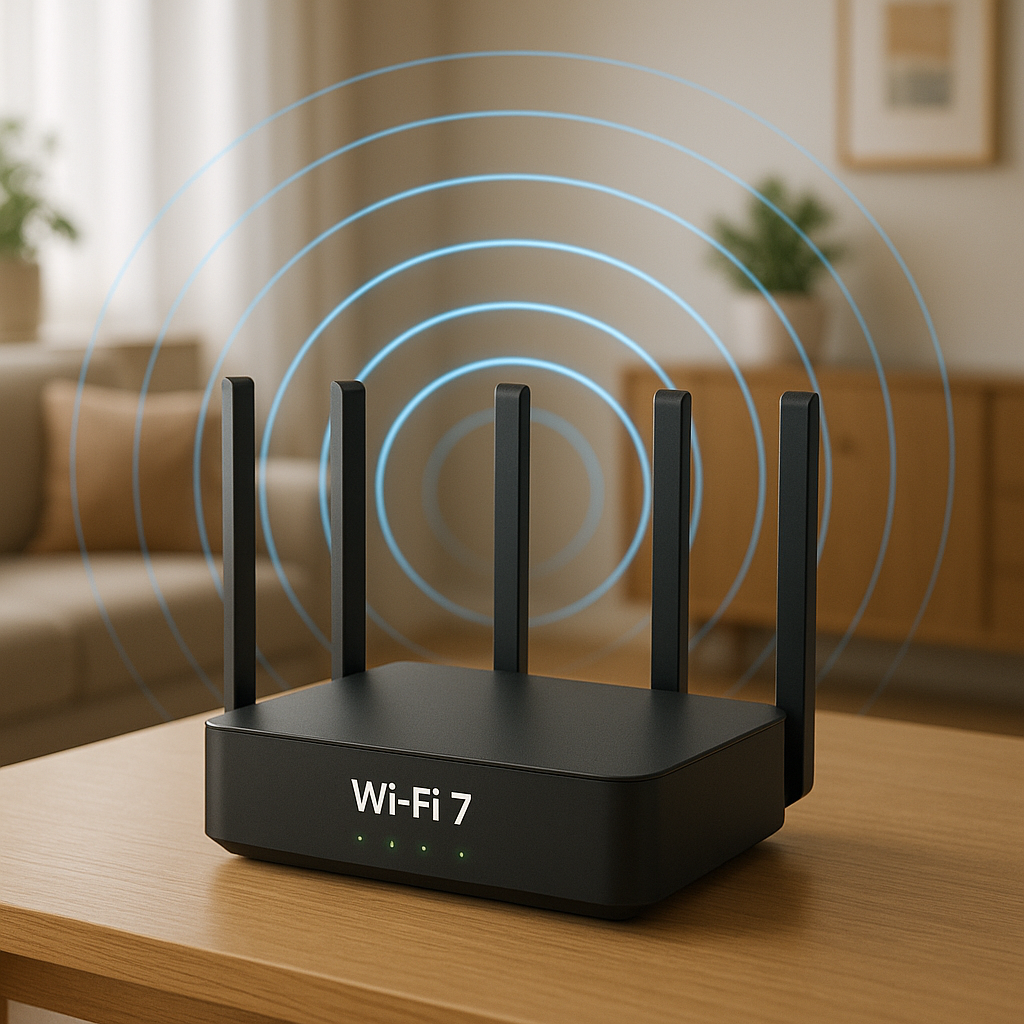
Note that some manufacturers are already paving the way with consumer products integrating 3 radio bands, adjustable antennas, and very advanced user applications to diagnose their network in real time.
FAQ
What frequencies does Wi-Fi 7 use?
It uses the 2.4 GHz, 5 GHz bands and, in authorized areas, the 6 GHz band to offer more channels and higher speeds.
Is it compatible with Wi-Fi 6 devices?
Yes, Wi-Fi 7 remains backward compatible: your older devices will still connect, but without benefiting from the 802.11be optimizations.
When will we be able to enjoy it at home?
The first consumer routers have already been announced, while chipset manufacturers (Intel, Qualcomm) are gradually rolling out their chipsets. Expect wider adoption in 2024–2025.
Is Wi-Fi 7 worth the investment?
If you are a gamer, 8K videographer, or manage a dense IoT network, yes. For basic use (browsing, HD streaming), a good Wi-Fi 6 router remains relevant today.