| Key Points | Details to Remember |
|---|---|
| 🤖 Definition | In 2025, machine learning relies on systems capable of continuous self-improvement. |
| 📊 Data | Volume and quality guide model performance and prediction robustness. |
| ⚙️ Algorithms | AutoML and hybrid neural networks dominate production pipelines. |
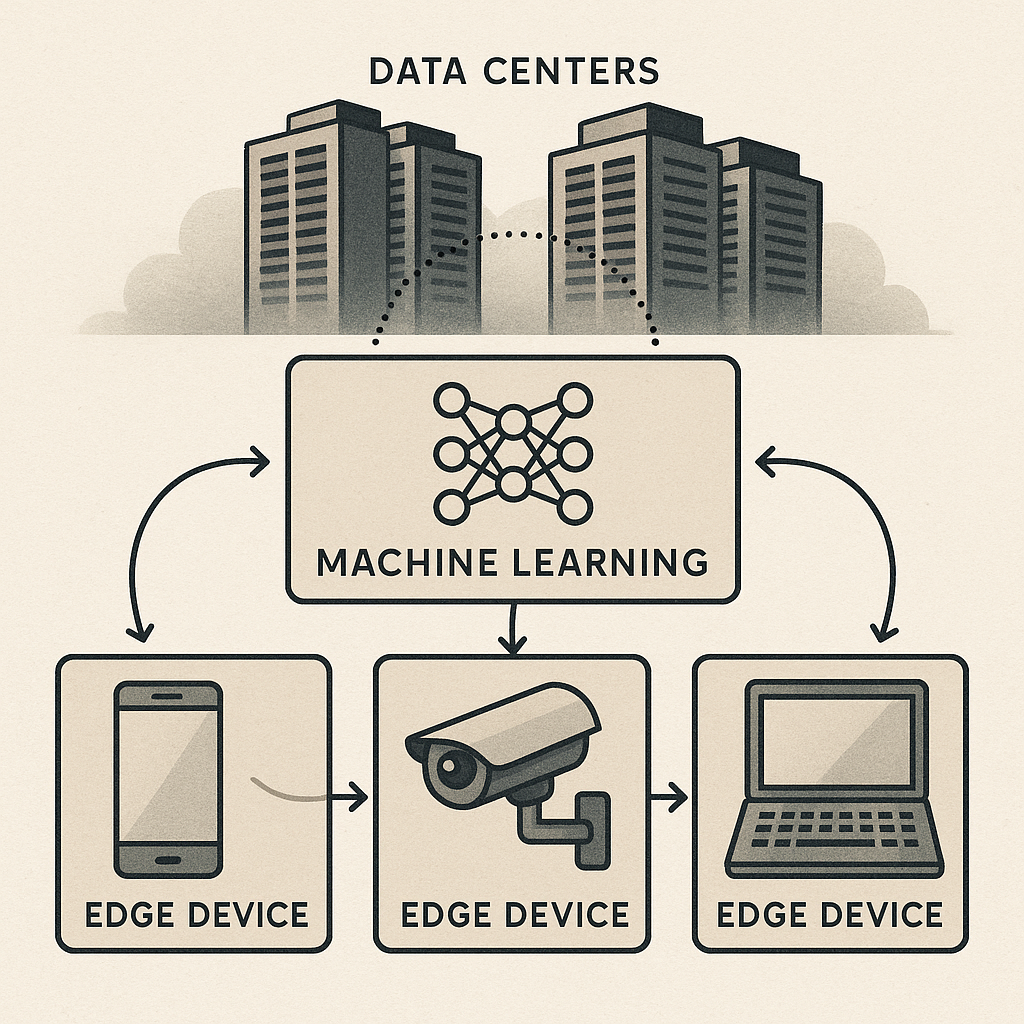
| 🌐 Architecture | Edge AI and distributed computing reduce latency and improve privacy. |
| 💡 Applications | Health, industry, mobility massively adopt these innovations. |
| ⚖️ Ethics | Transparency and combating bias are at the heart of debates. |
Machine learning in 2025 bears little resemblance to the prototypes from ten years ago. Today, we talk about nearly autonomous systems capable of adjusting their own parameters, deploying at the network edge (Edge AI), and even offering complete pipelines without human intervention. This article explores the technical foundations, emerging architectures, and ethical issues shaping this new era.
The Pillars of Machine Learning in 2025
To understand the current boom, we must return to the basics: data, algorithms, and infrastructures. Their synergy has evolved in a context where computing power, distributed storage, and access to colossal databases redefine what is possible.
At the same time, robustness and transparency requirements push to review every component of the pipeline, from dataset ingestion to result interpretability.
Massive Data and Quality
One might think that the more data, the better. In reality, the main issue in 2025 is quality and representativeness. Recent studies show that poorly labeled or biased data lead to less reliable models, sometimes catastrophic in sensitive contexts like health.
- Automated cleaning: AI tools detect and correct anomalies without human intervention.
- Time savings: preprocessing pipelines can reduce labeling time by up to 70%.
- Dynamic sampling: some platforms adapt data composition in real time to avoid statistical drifts.
Self-Adaptive Algorithms
Static training is out: the trend is towards “self-learning” models. They implement continuous feedback loops, adjusting as soon as a new batch of data arrives. This approach minimizes obsolescence and reduces the need for manual retraining.
Concretely, a hybrid neural network can modify its architecture depending on task complexity, increasing or simplifying its layers according to the operational context.
Emerging Architectures and Tools
After the basics, let’s look at infrastructure. Advances in hardware and software create fertile ground for deploying large-scale ML systems while controlling costs and security.
Edge AI and Distributed Computing
Rather than centralizing everything in the cloud, more and more companies are deploying their models at the edge of the network. Edge AI offers several advantages:
- Reduction of latency: decisions are made in milliseconds, essential for robotics or autonomous vehicles.
- Enhanced privacy: sensitive data (health, finance) remains on-site.
- Scalability: thousands of IoT sensors can host small ML models without saturating the overall network.
This architecture distributes the load and optimizes resources, while meeting regulatory requirements on data localization.
AutoML and Autonomous Pipelines
The dream of every data scientist? A tool capable of automatically testing multiple algorithms, selecting hyperparameters, and deploying the best model without human intervention. By 2025, this has become almost commonplace.
“AutoML has democratized access to ML: business teams can produce prototypes in a few hours instead of several weeks.” Dr. Clara Dupont, AI expert.
Cherry on top, some frameworks already integrate ethical safeguards, ensuring that the solution does not fall into cases of discrimination.
Concrete Applications and Ethical Challenges
Whether in health, logistics, or finance, use cases are multiplying. For example, we are witnessing:
- Predictive analysis in medicine: detection of early signs of neurodegenerative diseases.
- Predictive maintenance in industry: reduction of machine downtime by up to 40%.
- Optimization of energy distribution networks: fine real-time adjustment to absorb demand peaks.
However, these advances raise questions:
- How to guarantee the transparency of decisions made by a model?
- What mechanisms can be put in place to counteract historical biases?
- Can performance and respect for privacy be reconciled?
Perspectives and Innovations to Watch
In 2025, we keep an eye on several emerging trends:
- Multimodal models: fusion of text, image, and sound for richer understanding.
- Federated learning: collaborative training without sharing raw data.
- Supervised generative AI: content creation while respecting ethical guidelines.
As these technologies mature, the challenge will be to find the right balance between rapid innovation and safeguards to prevent abuses.
FAQ
What differentiates machine learning in 2025 from that of ten years ago?
Models today are capable of self-adjustment, “continuous learning,” and deployment at the edge. Infrastructures are more modular and natively integrate ethical mechanisms.
Will AutoML replace data scientists?
Rather than disappearing, their role evolves: they become supervisors, ethicists, and strategists, while repetitive tasks are automated.
Which sectors benefit most from Edge AI?
Health, Industry 4.0, and autonomous transport lead the way, as they require real-time decisions and strict data protection.
How to combat biases in ML models?
By diversifying datasets, using regular audits, and integrating algorithmic safeguards within AutoML pipelines.